
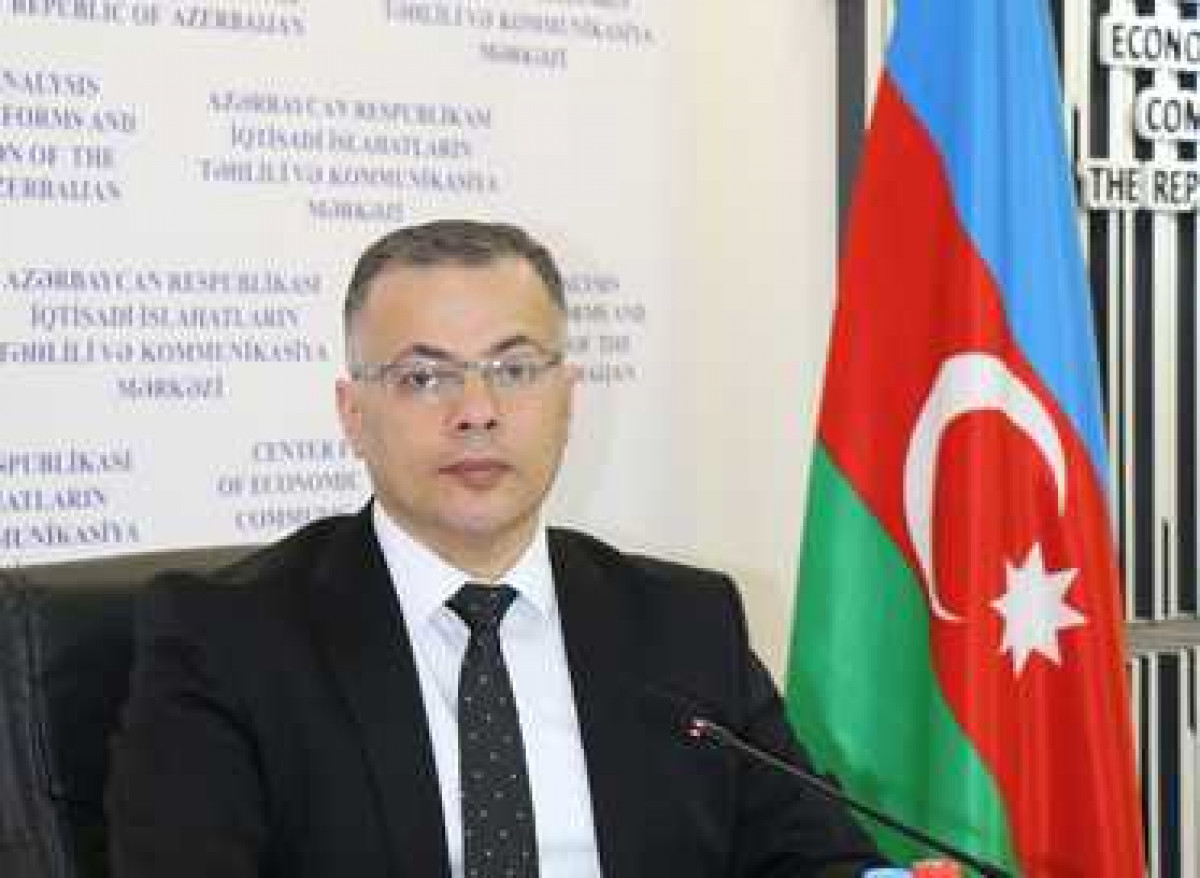
Vusal Gasimli: The Real Effective Exchange Rate of the Manat Has Reached Its Highest Level in the Last 5 Years
Amid the COVID-19 pandemic, the real effective exchange rate of the Azerbaijani manat has been increasing and has even reached its highest level in the past five years. Commenting on this issue, Vusal Gasimli, Executive Director of the Center for Analysis of Economic Reforms and Communication (CAERC) of the Republic of Azerbaijan and Doctor of Economic Sciences, stated that over the past five years Azerbaijan’s economy has, for the second time, been adjusting its equilibrium level under the impact of external shocks. In this context, he noted that there are both positive and negative factors affecting the real effective exchange rate of the manat.
According to him, there is a direct proportional relationship between the real effective exchange rate and the Central Bank’s policy (discount) rate. He noted that the Central Bank recently reduced the policy rate from 7.25% to 7%. This decision was made taking into account declining inflation and inflation expectations, continued stability in the foreign exchange market, partial improvement in the international economic environment, and the need to stimulate investment activity. The implementation of 3.5 billion AZN in anti-crisis measures led to an 8.5% expansion of the monetary base in May. He added that in the coming months, the monetary base is expected to increase further from its minimum level observed in April, in line with fiscal policy requirements. The reduction of the policy rate and expansion of the monetary base have a downward effect on the real effective exchange rate of the manat.
Vusal Gasimli also noted that the real effective exchange rate depends on national productivity. He explained that population growth combined with the pandemic-related decline in GDP has reduced productivity levels. In the first five months of the year, GDP per capita decreased by 2.5%. According to IMF panel estimates, a 1% increase in relative productivity leads to a 0.2% appreciation of the real exchange rate. In this sense, the decline in productivity in Azerbaijan would normally exert a depreciating effect on the real effective exchange rate; however, this effect is neutralized by a smaller decline in productivity compared to trading partner countries.
He further referred to the Balassa–Samuelson effect, which explains price differences between developed and developing countries through differences in productivity levels. According to purchasing power parity (PPP), prices in Azerbaijan are already lower than in developed countries, and the Penn effect confirms this. With inflation at 2.9%, there is no significant distortion of purchasing power parity. In addition, the stability of the manat against the US dollar, unlike the depreciation of currencies in other partner countries, further explains the increase in the real effective exchange rate. He emphasized that improving productivity is not only important for exchange rate stability but is a key objective for sustainable economic growth.
Vusal Gasimli also addressed the impact of the global “fear index” (VIX). He noted that the VIX volatility index has reached historical highs, indicating that investors are withdrawing from risky assets, with more than 100 billion USD flowing out of developed countries. Despite very low global interest rates, borrowing costs for developing countries have increased significantly. Sovereign bond spreads have more than doubled since the beginning of the year, reaching 600 basis points (6%). More than 100 countries have applied to the IMF for emergency financing through the Rapid Financing Instrument (RFI).
He added that the IMF has also proposed debt restructuring and partial debt suspension for 76 developing countries under the International Development Association of the World Bank, as well as for 25 least developed island countries.
According to him, Azerbaijan, as a country with strong reserve buffers, is able to finance its balance of payments deficit through reserve assets, while countries without such buffers are more dependent on exchange rate depreciation as a limited adjustment mechanism. He also noted that a 10% decline in the VIX index reduces the real effective exchange rate of developing countries by an average of 2.5%.
He emphasized that efficient use of Azerbaijan’s strategic foreign exchange reserves requires balancing current account pressures through foreign investment inflows. In this regard, privatization, capital amnesty, infrastructure development, human capital and institutional improvements, and continued reforms are essential policy tools.
According to Vusal Gasimli, international experience shows that domestic investment by residents positively affects the real effective exchange rate. He gave Japan as an example, where domestic savings significantly contribute to financing the economy. He suggested that investments by Azerbaijani residents in shares, bonds, government and central bank securities listed on the Baku Stock Exchange and over-the-counter markets, as well as real estate and startups, would be beneficial.
He also noted that according to the debt strategy, replacing part of external debt with domestic debt and attracting manat-denominated financing from institutions such as the Asian Development Bank positively affects the real effective exchange rate. However, he stressed that investment market infrastructure and intermediary institutions must be developed, including investment funds, brokerage companies, crowdfunding, and crowd-investing platforms.
He further stated that expectations of GDP growth also have a positive effect on the real effective exchange rate. While economic contraction is expected this year, recovery and growth are forecast for the following years. IMF estimates suggest that a 1% increase in GDP leads to a 2.5% appreciation of the real effective exchange rate.
He also highlighted the role of external trade conditions. According to him, export prices—particularly oil prices—have fallen more sharply than import prices, worsening the terms of trade and negatively affecting the real effective exchange rate. The exchange rate acts as a buffer against external shocks, reducing their impact on domestic consumers.
In countries with fully floating exchange rates, a deterioration in trade conditions immediately reduces domestic demand and imports. In managed exchange rate regimes like Azerbaijan’s, the adjustment is slower but still occurs through demand contraction. This is known as the “expenditure effect.”
In the first four months of the year, imports declined by 40.5% in real terms due to worsening trade conditions. This deterioration can also lead to a “switching effect,” redirecting consumption and investment toward domestic production. He gave the example of the healthcare industry, which has been developing during the pandemic, noting that a softer real effective exchange rate supports this process.
Vusal Gasimli also noted that an increase in the share of private sector credit in GDP contributes to the appreciation of the real effective exchange rate. During the pandemic, measures such as loan restructuring, interest rate subsidies, and credit guarantees have expanded the credit portfolio. However, credit to GDP in Azerbaijan is only 20%, compared to a global average of around 130%, indicating significant growth potential.
Global estimates show that a 10% increase in private credit-to-GDP raises the real effective exchange rate by 1.3%.
In conclusion, he stated that an increase in the real effective exchange rate has a negative impact on export competitiveness but a positive impact on household purchasing power. “In the current situation, the choice reflects the interests of Azerbaijani citizens,” he added.
Related news

A representative of the CAERC participated in a conference dedicated to the future…
Rashad Najafli, Deputy Director of the Economic Analysis Department of the Center for Analysis of Economic Reforms and Communication (CAERC), participated in the international conference on “New Challenges in Maintaining Financial…

New Opportunities in Technology Parks: Commercialization and Export of Innovations
The Decree of the President of the Republic of Azerbaijan dated October 22, 2026 on Amendments to the “Model Regulation on Technology Parks” provides for important innovations in terms of improving the activities of technoparks,…

Vusal Gasimli spoke at the opening of the Islamic Finance Forum
Vusal Gasimli, Executive Director of the Center for Analysis of Economic Reforms and Communication (CAERC) — a Doctor of Economic Sciences and Professor — delivered a speech at the opening ceremony of the "3rd Islamic…

CAERC expands cooperation with think tanks and universities in Uzbekistan
Ilyas Huseynov, Head of the Turkic World Research Center (TWRC) at the Center for Analysis of Economic Reforms and Communication (CAERC), held meetings with representatives from think tanks and higher education institutions, and delivered…

Meetings regarding preparations for the final monitoring and evaluation of the Socio-Economic…
The Center for Analysis of Economic Reforms and Communication (CAERC) has concluded a series of meetings with representatives from relevant government agencies. These meetings were held to refine outcome indicators for the year 2026—within…

The investment portfolio of “Enterprise Azerbaijan”’s partners exceeds 3 billion…
The global innovation program “Startup School 4: Five Continents – 500 Startups,” implemented by the “Enterprise Azerbaijan” portal of the Center for Analysis of Economic Reforms and Communication (CAERC),…

The establishment of the Karabakh National Park creates new opportunities for ecological…
The Order of the President of the Republic of Azerbaijan, Ilham Aliyev, dated October 20, 2026, "On the Establishment of the Karabakh National Park of the Republic of Azerbaijan," is regarded as a significant step toward…

World Bank: Azerbaijan’s strong financial buffers support economic stability and…
The "Europe and Central Asia Economic Update" and the "Macro-Poverty Outlook" for Azerbaijan, published by the World Bank in October 2026, indicate that the country has maintained its macroeconomic stability, strong…
Op-eds
Ilkin Gasimov
Chief advisor of the Economic analysis division
New Financial Model for Resource Allocation in General Education
Baghish Ahmadov
Advisor to the Executive director of the Center for Analysis of Economic Reforms and Communication
Azerbaijan International Investment Forum: Investment Cooperation and National Development Priorities
Abdulrahim Dadashov
Deputy head of the Monitoring and evaluation division
Environmental Responsibility is One of the Key Conditions in the Development of the Mining Industry
Latif Zeynalli
Head of State Programs Division
Development of Competition Will Create New Opportunities for Sustainable Economic Growth
Orkhan Sadigov
Head of the Monitoring and evaluation division
A New Approach to Managing Off-Budget Funds Will Strengthen Financial Discipline
Elshan Yusifli
Head of the Monitoring of sectoral programs sector
New Changes to Nakhchivan’s State Programme: Export, Logistics and Social Mechanisms Improved
Abdulrahim Dadashov
Deputy head of the Monitoring and evaluation division
New Law Strengthens the Sustainable Development and Digital Monitoring of the Fisheries Sector