
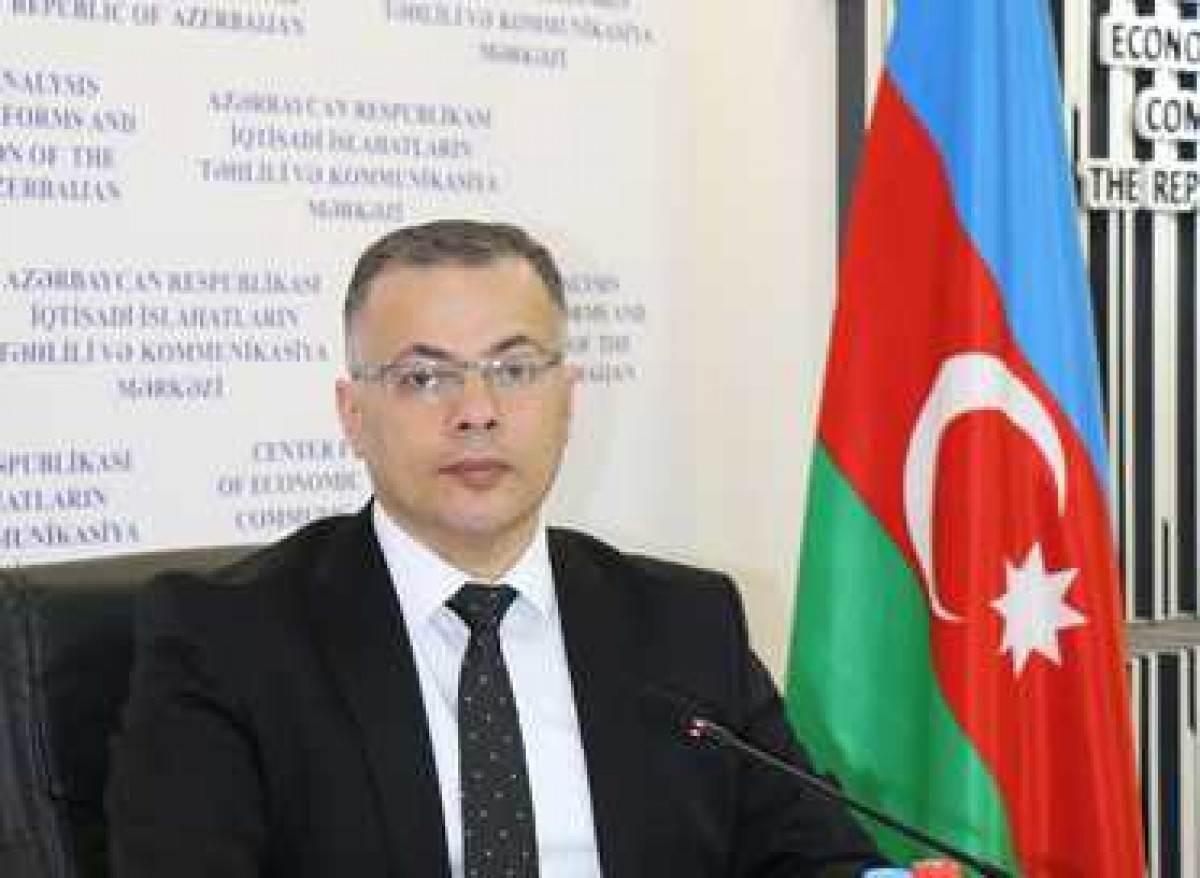
Vusal Qasimli: Measures Are Being Taken to Mitigate the Economic Impact of Coronavirus
Vusal Qasimli, Executive Director of the Center for Analysis and Communication of Economic Reforms (CAERC), answered questions regarding the economic impact of the virus officially known as COVID-19, which has been spreading from China in recent months.
How do you assess the global economic impact of coronavirus?
Even if the virus itself were absent, its psychological and economic effects have already reached pandemic levels worldwide. According to the Organisation for Economic Co-operation and Development (OECD), global economic growth was forecasted at 2.9% this year, but due to the virus, this may decrease by up to half, reaching 1.5%.
China, the origin of the virus, has been most affected. Last year, its GDP grew by 6.1%, but in the first quarter of 2020, growth is expected to fall below 5%. According to Morgan Stanley, depending on how effectively the virus is contained, China’s GDP growth for 2020 may range between 5.6% and 5.9%.
Economic growth is also slowing in Japan, Korea, and Australia. The effects are spreading in a domino pattern from the Asia-Pacific region to Europe and North America.
For comparison, during the SARS outbreak in 2003, China accounted for only 4.3% of the global economy; today, it accounts for 16%. SARS infected 8,000 people, whereas COVID-19 has already infected over 80,000. Therefore, the economic impact of coronavirus is significantly larger than that of SARS.
Last week, financial markets experienced sharp declines. Globally, more than $3 trillion in securities lost value, with emerging markets’ stocks and bonds dropping by $1.1 trillion.
China’s reduced oil demand caused crude prices to fall: Brent crude has decreased by 26% to $51.37 per barrel, and Light crude to $46.15 per barrel.
The International Air Transport Association (IATA) projects a $29.3 billion loss due to decreased air travel. Additionally, Chinese tourists not visiting Europe in January caused roughly €1 billion in losses to the European tourism industry.
What are the macroeconomic implications of falling oil prices for Azerbaijan?
A $1 change per barrel affects the current account by about $250 million annually. Azerbaijan is relatively insulated from oil price drops below $30 per barrel, as seen in 2015. Current institutional and psychological measures by the government, businesses, and citizens allow the country to maintain current account stability even if prices fall to $40–45 per barrel.
The state budget assumes $55 per barrel. Budget rules cap expenditures based on disposable oil revenues, non-oil revenues, and other inflows. If oil prices exceed forecasts, strategic foreign currency reserves increase; if below, reserves cover the gap.
In January 2020, state budget revenues were 1.8 billion AZN and expenditures 1.4 billion AZN, resulting in a surplus of over 400 million AZN. Average oil prices in January–February were above $60 per barrel, increasing Central Bank and SOFAZ reserves. The country’s strategic foreign currency reserves stand at $52 billion, over 8% of GDP, ensuring fiscal stability.
How will the State Oil Fund respond to global shocks?
SOFAZ’s assets increased 12.5% to $43.3 billion in 2019. Its portfolio comprises 56.6% USD, 31.4% EUR, 5.1% GBP, and less than 1% CNY. USD is expected to gradually strengthen in 2020, supporting SOFAZ’s conservative and resilient portfolio. Only 14.1% of the portfolio is in equities, insulating it from recent global market shocks.
What is the outlook for external debt?
Azerbaijan’s public external debt is 17% of GDP, among the lowest globally. State enterprises’ debts, such as SOCAR and the International Bank of Azerbaijan, remain manageable. Government policies and regulations support prudent corporate governance. High savings rates (33% of GDP in 2018) further strengthen fiscal stability.
How prepared is the financial-banking sector?
Institutional reforms, resolution of toxic assets, full deposit insurance, support for cashless transactions, and overall macroeconomic stability have revitalized the sector. Broad money supply is 28.5 billion AZN, 63% in local currency. Commercial banks’ net foreign assets are 5.2 billion AZN. Dollarization of deposits is 55%, reducing pressure compared to 2015. Regulatory reforms have enhanced competitiveness.
How will coronavirus affect Azerbaijan’s trade?
In January 2020, exports totaled $2.1 billion (+66.5% YoY) and imports $720 million (−29.7% YoY), creating a $1.4 billion trade surplus. China and Iran were minor contributors in exports but notable in imports. Trade with Turkey increased 33% in 2019, reaching $4.5 billion, and is targeted to reach $15 billion by 2023. A Preferential Trade Agreement with Turkey will facilitate substitution of some imports and expand non-oil exports.
Impact on non-oil exports?
Non-oil exports in January 2020 reached $141 million (+2.5% YoY). Exports to China were $5.9 million (4.2% of total non-oil exports), indicating resilience despite issues in those markets. Alternative markets, particularly Turkey, provide new opportunities.
Impact on tourism and services?
Global tourism declines affect service exports. In 2019, Azerbaijan received 3.2 million foreign visitors (+11.3% YoY). Visits from Iran and China are minimal relative to total visitors. Reduced outbound travel due to the virus may improve the current account.
Overall outlook for Azerbaijan amid global shocks:
Azerbaijan is integrated into the global economy. Sectors most exposed include trade, transport, logistics, and tourism. The government has established an operational headquarters to mitigate coronavirus impacts. Stable macroeconomic fundamentals, strategic reserves, and institutional reforms provide resilience, while alternative markets and service diversification create opportunities.
Related news

A representative of the CAERC participated in a conference dedicated to the future…
Rashad Najafli, Deputy Director of the Economic Analysis Department of the Center for Analysis of Economic Reforms and Communication (CAERC), participated in the international conference on “New Challenges in Maintaining Financial…

New Opportunities in Technology Parks: Commercialization and Export of Innovations
The Decree of the President of the Republic of Azerbaijan dated October 22, 2026 on Amendments to the “Model Regulation on Technology Parks” provides for important innovations in terms of improving the activities of technoparks,…

Vusal Gasimli spoke at the opening of the Islamic Finance Forum
Vusal Gasimli, Executive Director of the Center for Analysis of Economic Reforms and Communication (CAERC) — a Doctor of Economic Sciences and Professor — delivered a speech at the opening ceremony of the "3rd Islamic…

CAERC expands cooperation with think tanks and universities in Uzbekistan
Ilyas Huseynov, Head of the Turkic World Research Center (TWRC) at the Center for Analysis of Economic Reforms and Communication (CAERC), held meetings with representatives from think tanks and higher education institutions, and delivered…

Meetings regarding preparations for the final monitoring and evaluation of the Socio-Economic…
The Center for Analysis of Economic Reforms and Communication (CAERC) has concluded a series of meetings with representatives from relevant government agencies. These meetings were held to refine outcome indicators for the year 2026—within…

The investment portfolio of “Enterprise Azerbaijan”’s partners exceeds 3 billion…
The global innovation program “Startup School 4: Five Continents – 500 Startups,” implemented by the “Enterprise Azerbaijan” portal of the Center for Analysis of Economic Reforms and Communication (CAERC),…

The establishment of the Karabakh National Park creates new opportunities for ecological…
The Order of the President of the Republic of Azerbaijan, Ilham Aliyev, dated October 20, 2026, "On the Establishment of the Karabakh National Park of the Republic of Azerbaijan," is regarded as a significant step toward…

World Bank: Azerbaijan’s strong financial buffers support economic stability and…
The "Europe and Central Asia Economic Update" and the "Macro-Poverty Outlook" for Azerbaijan, published by the World Bank in October 2026, indicate that the country has maintained its macroeconomic stability, strong…
Op-eds
Ilkin Gasimov
Chief advisor of the Economic analysis division
New Financial Model for Resource Allocation in General Education
Baghish Ahmadov
Advisor to the Executive director of the Center for Analysis of Economic Reforms and Communication
Azerbaijan International Investment Forum: Investment Cooperation and National Development Priorities
Abdulrahim Dadashov
Deputy head of the Monitoring and evaluation division
Environmental Responsibility is One of the Key Conditions in the Development of the Mining Industry
Latif Zeynalli
Head of State Programs Division
Development of Competition Will Create New Opportunities for Sustainable Economic Growth
Orkhan Sadigov
Head of the Monitoring and evaluation division
A New Approach to Managing Off-Budget Funds Will Strengthen Financial Discipline
Elshan Yusifli
Head of the Monitoring of sectoral programs sector
New Changes to Nakhchivan’s State Programme: Export, Logistics and Social Mechanisms Improved
Abdulrahim Dadashov
Deputy head of the Monitoring and evaluation division
New Law Strengthens the Sustainable Development and Digital Monitoring of the Fisheries Sector