
CAERC Representative: “Azerbaijan’s Progress in the Inclusive Development Index 2018 Is the Result of Successful Reforms”
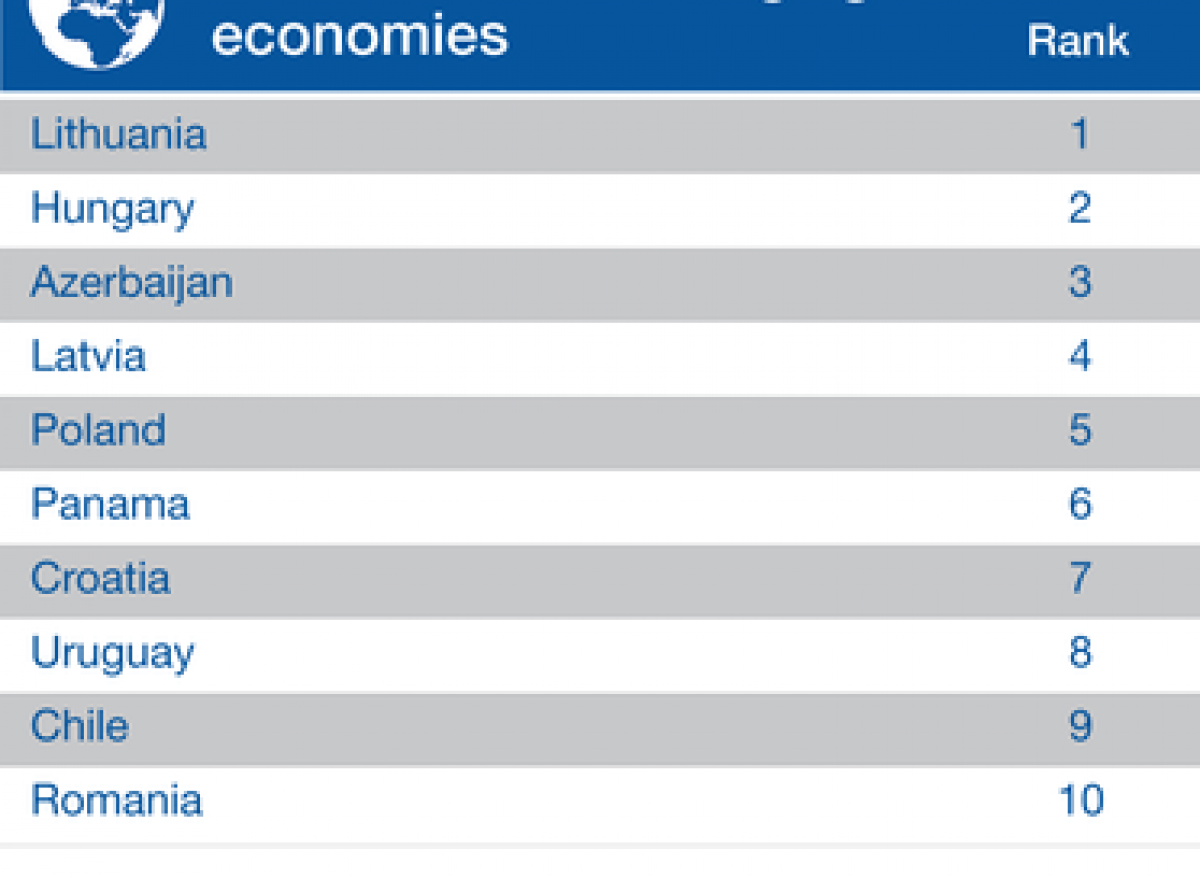
According to the World Economic Forum’s prestigious Inclusive Development Index 2018, Azerbaijan ranked third among the best-performing developing countries worldwide and first within the CIS region. In the Forum’s Inclusive Growth Report, Azerbaijan outperformed all other developing countries except Lithuania and Hungary.
Nicat Hajiyev, manager of the “One Window” Export Support Center under the Center for Analysis of Economic Reforms and Communication (CAERC), stated that Azerbaijan’s placement in the top three among developing countries and its leadership position in the CIS are international recognition of the fast, targeted, and inclusive economic reforms carried out under the leadership of President Ilham Aliyev.
Hajiyev emphasized the significance of Azerbaijan’s progress in the Inclusive Development Index 2018, noting that the core purpose of the report is to assess and measure people’s material and social well-being, including employment, healthy life expectancy, and living standards. Azerbaijan’s top-three ranking reflects the relatively stronger social welfare of its population compared to many other countries and forms an integral part of the socio-economic reforms implemented by the president. A detailed analysis of the report shows that across multiple indicators, Azerbaijan’s performance exceeds that of several European countries and all CIS states.
It should be noted that the Inclusive Development Index is based on three main pillars and 12 sub-indicators. The three core pillars—Growth and Development, Inclusion, and Intergenerational Equity and Sustainability—are used to rank both developed and developing economies. The Index evaluates countries using indicators such as GDP per capita, labor productivity, healthy life expectancy, employment, the Gini coefficient, poverty rate, adjusted net savings, and others.
Under the first pillar, Growth and Development, Azerbaijan received high scores in key macroeconomic sub-indicators, including GDP per capita (a primary measure of living standards), employment levels, labor productivity, and healthy life expectancy. These outcomes are directly linked to the deep economic reforms implemented in recent years. The president's consistent focus on the material and social welfare of all population groups has been objectively and positively recognized by international rankings.
The second main pillar, inclusion, measures income distribution, poverty levels, and income equality among individuals and households (net Gini coefficient). According to the report, Azerbaijan’s results under this pillar are better than those of most developing countries globally. Under the Index methodology, the Gini coefficient ranges from 0 to 100, where 0 indicates perfect equality and 100 represents extreme inequality. Azerbaijan scored 28.6 points, outperforming even Lithuania and ranking just behind Hungary—making it one of the best performers on this indicator. Azerbaijan also achieved strong results in the poverty sub-indicator, which measures the share of the population earning less than USD 3 per day. The country is classified among upper-middle-income economies, ranking ahead of all CIS countries. In contrast, Tajikistan, Kyrgyzstan, and Armenia recorded the weakest poverty-related results in the CIS.
Another inclusion-related sub-indicator is median income, which reflects purchasing power and overall economic capacity. Despite global economic challenges and depreciation pressures on the national currency, Azerbaijan has managed to maintain price stability and protect household purchasing power, preventing serious negative impacts on living standards.
The final pillar, Sustainability and Intergenerational Equity, includes indicators such as public debt and the dependency ratio. Azerbaijan received high scores for the public debt-to-GDP ratio, ranking as a leader in the CIS and the broader region. The methodology considers net public debt, including deposits, bonds, loans payable, insurance obligations, pensions, and other liabilities. Azerbaijan’s substantial strategic foreign exchange reserves further strengthen its fiscal resilience and borrowing capacity. Large-scale international projects implemented under the President’s leadership have consistently attracted the attention of leading global financial institutions due to their profitability and long-term potential, contributing to positive international assessments of Azerbaijan’s debt management.
The final sub-indicator, the dependency ratio, measures the proportion of the economically inactive population relative to the active labor force. A higher ratio implies greater pressure on social protection, healthcare, and public spending. Azerbaijan scored 40.9%, which is lower (and therefore better) than in most developed and developing countries, indicating a relatively strong and productive labor force contributing to economic value creation.
It is also worth noting that Azerbaijan trailed Lithuania and Hungary by only 0.17% and 0.05%, respectively. At the same time, Azerbaijan outperformed countries such as Latvia, Poland, Croatia, Romania, Bulgaria, and North Macedonia by margins of 0.2–0.5%, as well as neighboring countries including Russia (by 0.49%), Turkey (by 0.43%), Georgia (by 0.7%), Iran (by 0.61%), and Armenia (by 1.03%).
Related news

"Certificate of Free Sale" Issued by "Azexport" Portal Fully…
The planned works within the framework of cooperation between the "Azexport" portal, operated by the Center for Analysis of Economic Reforms and Communication (CAERC), and the "Digital Logistics Platform" (DLP)…

State Program for 2027–2030 on the Development of the Mining and Metallurgical Industry…
President Ilham Aliyev has signed an Order on approving the "State Program for 2027–2030 on the Development of the Mining (Metal Ores) and Metallurgical Industry in the Republic of Azerbaijan." The Cabinet of Ministers…

Environmental Responsibility is One of the Key Conditions in the Development of…
At the meeting chaired by the President of the Republic of Azerbaijan, Ilham Aliyev, dedicated to the "State Program for 2027–2030 on the Development of the Mining (Metal Ores) and Metallurgical Industry in the Republic…

Development of the Mining and Metallurgical Industry Forms a New Human Capital Agenda…
The main directions for the new development phase of the industry were presented at the meeting held on September 22 under the chairmanship of the President of the Republic of Azerbaijan, Ilham Aliyev, dedicated to the "State…

A New Stage in the Development of the Mining and Metallurgical Industry
The meeting chaired by President Ilham Aliyev dedicated to the “State Program on the Development of the Mining (Metal Ores) and Metallurgical Industry in the Republic of Azerbaijan for 2027–2030” identified important…

Meeting Held with Authors from AQTA on the Preparation of the “Food Safety” Textbook
Work on the “Food Safety” textbook, being prepared within the framework of cooperation between the Center for Analysis of Economic Reforms and Communication (CAERC) and the Azerbaijan Food Safety Agency (AFSA), is ongoing.…

“Economic Reforms” Journal Added to German Academic Library Catalogues
The scientific and analytical journal “Economic Reforms”, established by the Center for Analysis of Economic Reforms and Communication (CAERC), is expanding its presence in the international academic information space.…

Cooperation Issues Discussed between CAERC and the Islamic Development Bank
Vusal Gasimli, Executive Director of the Center for Analysis of Economic Reforms and Communication (CAERC), met with representatives of the evaluation mission of the Islamic Development Bank (IsDB) Group. The meeting was attended…
Op-eds
Aykhan Gadashov
Head of the Azexport portal
“Geoeconomic Stability Corridor”: The $1 Billion Trade Target with Uzbekistan Opens New Horizons for Business
Isa Gasimov
Head of the “Enterprise Azerbaijan” portal
Crowdfunding: New Perspectives in Startup Financing in Azerbaijan
Elnur Alakbarov
Deputy head of the Economic analysis division
New Action Plan on Employment: Digitalization and Result-Oriented Management
Abdulrahim Dadashov
Deputy head of the Monitoring and evaluation division
Agricultural support mechanisms will create new opportunities for farmers and exporters
Ilyas Huseynov
Head of the Turkic World Research Center
Large-Scale Modernization of the Baku-Tbilisi-Kars Railway: A New Strategic Phase in the Middle Corridor and Eurasian Connectivity
Rashad Najafli
Deputy head of the Economic analysis division
Azerbaijan: A Guarantor of Peace and Security in the South Caucasus
Isa Gasimov
Head of the “Enterprise Azerbaijan” portal
Transition to an Innovation Ecosystem: Azerbaijan’s Strategic Choice