
Armenia’s fiscal capacity is not sufficient to sustain an expensive and prolonged war of resources
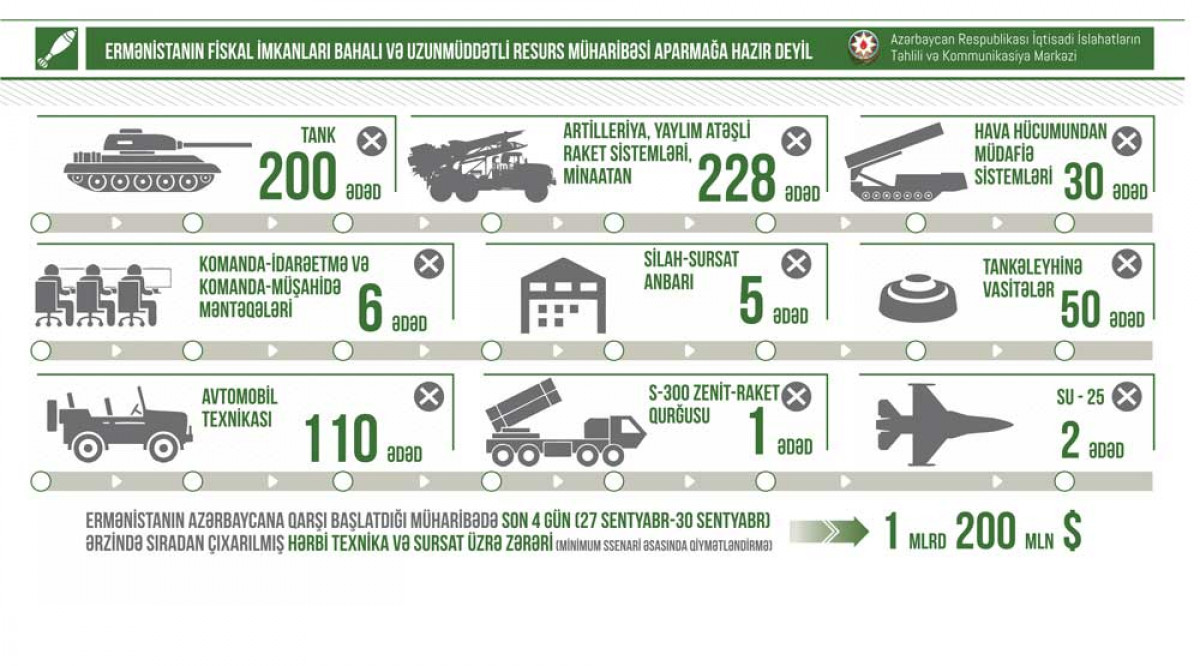
The war waged by Armenia against Azerbaijan is deepening the existing economic recession in Armenia and exhausting all of its resources. In response to Armenia’s aggression, according to official information released by the Ministry of Defense of the Republic of Azerbaijan, from the morning of September 27 until 9:30 p.m. on September 30, the valiant Armed Forces of Azerbaijan destroyed nearly 200 enemy tanks and other armored vehicles, 228 artillery units, multiple-launch rocket systems and mortars, 30 air defense systems, 6 command-and-control and command-observation posts, 5 ammunition depots, more than 110 units of automotive equipment, and one S-300 surface-to-air missile system.
In addition, reports indicate that two Armenian Su-25 military fighter jets crashed into mountainous terrain and were destroyed. Depending on their type, the price of the destroyed S-300 systems ranges from USD 115 million to USD 160 million. According to the military-analytical publication Deagel, the weapons in Armenia’s arsenal belong to the S-300 PMU1 modification, with an estimated unit cost of around USD 160 million, while the price of a single missile is estimated at more than USD 1 million. The estimated value of Su-25 aircraft is approximately USD 11 million each.
Furthermore, the total value of nearly 200 destroyed T-72 tanks and their various modifications is estimated at around USD 300 million. Military experts note that among the destroyed air defense systems, “Osa” complexes were predominant, with the price of each unit ranging between USD 20 million and USD 25 million. In addition, over the past four days alone, the total value of the enemy’s destroyed automotive equipment has exceeded USD 2 million.
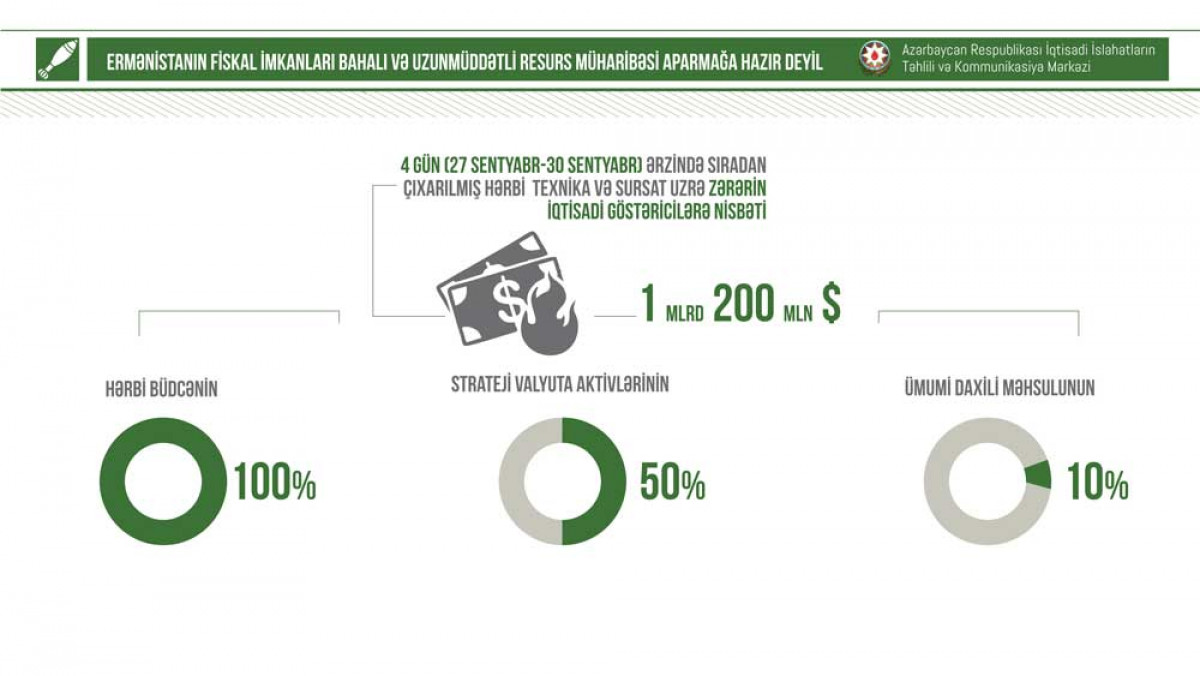
As can be seen, within just four days, as a result of the strikes inflicted by Azerbaijan’s heroic army, military equipment and ammunition worth more than USD 1.2 billion have been destroyed on the opposing side.
According to data from Armenia’s Ministry of Finance, military expenditures envisaged in the state budget for 2020 amount to approximately USD 634 million. Based on data from the World Bank, Armenia’s gross domestic product stood at around USD 13 billion in 2019. According to the Central Intelligence Agency, Armenia allocates close to 5 percent of its GDP annually to military expenditures. Meanwhile, estimates by the authoritative military-analytical center Global Firepower put Armenia’s total military budget at approximately USD 1.385 billion. This means that within just four days, the Azerbaijani army destroyed military assets worth twice the annual military allocations and effectively the entirety of Armenia’s overall military budget.
Taking these factors into account, it is unlikely that the opposing side will be able to sustain a prolonged resource-based war under current conditions. The new economic environment brought about by the pandemic has already significantly worsened the country’s economic situation. In this context, Armenia has no additional capacity to conduct a long-term war of resources. According to data from Armenia’s Statistical Committee, the country’s economy has contracted by 5.7 percent compared to the beginning of the year. In the second quarter of the current year, Armenia experienced its sharpest economic decline since 2009, at 13.7 percent. As of July, the country recorded a trade balance deficit of USD 1 billion, while the fiscal budget deficit stands at around 5 percent of GDP.
The services sector, considered the main driver of Armenia’s economic growth, had already contracted by 10 percent due to the pandemic. Under wartime conditions, it is not difficult to predict the collapse of the services and tourism sectors in Armenia, which will further exacerbate negative economic indicators.
According to official data from the Central Bank of Armenia, the country’s current official reserve assets amount to USD 2.6 billion. In just four days, additional expenditures equivalent to 50 percent of these assets have effectively emerged. The only remaining option for the Armenian government—borrowing—also appears increasingly ineffective. Data released by the Ministry of Finance indicate that the country is sinking deeper into a debt trap. Between January and August 2020, budget revenues declined by 6 percent year-on-year. Armenia’s external debt currently stands at USD 6.048 billion.
Even before the outbreak of hostilities, official projections indicated that public debt would rise to nearly 60 percent of GDP in 2020. According to internationally accepted methodology, a debt-to-GDP ratio exceeding 40 percent is considered dangerous for a country’s financial and economic security. Official forecasts further suggest that Armenia will not exit this debt trap by 2025 and will continue to carry public debt of at least 50 percent of GDP.
Moreover, data published by the Statistical Committee as of August 31, 2020, show that more than 76 percent of Armenia’s public debt is denominated in foreign currency, primarily in US dollars (nearly 40 percent), and around 20 percent of total debt carries floating interest rates. This structure is likely to increase debt servicing costs in the event of further instability. Currently, the total volume of Armenia’s attracted external loans amounts to USD 4.607 billion. The bulk of this debt is owed to a limited number of international organizations and countries, indicating a lack of diversification and increasing the likelihood of capital repatriation.
As a result, Armenia’s destructive and unfounded policies have put not only its military security but also its economic security at serious risk.
In conclusion, statistical economic indicators clearly demonstrate that Armenia’s severe economic condition does not allow it to sustain a prolonged war against Azerbaijan and that it is unprepared for long-term tensions and a resource-based conflict. Beyond statistics, however, the decisive factor remains the unity of the Azerbaijani people and the fact that the moment of truth is on Azerbaijan’s side, making the collapse of the opposing side inevitable.
Related news

A representative of the CAERC participated in a conference dedicated to the future…
Rashad Najafli, Deputy Director of the Economic Analysis Department of the Center for Analysis of Economic Reforms and Communication (CAERC), participated in the international conference on “New Challenges in Maintaining Financial…

New Opportunities in Technology Parks: Commercialization and Export of Innovations
The Decree of the President of the Republic of Azerbaijan dated October 22, 2026 on Amendments to the “Model Regulation on Technology Parks” provides for important innovations in terms of improving the activities of technoparks,…

Vusal Gasimli spoke at the opening of the Islamic Finance Forum
Vusal Gasimli, Executive Director of the Center for Analysis of Economic Reforms and Communication (CAERC) — a Doctor of Economic Sciences and Professor — delivered a speech at the opening ceremony of the "3rd Islamic…

CAERC expands cooperation with think tanks and universities in Uzbekistan
Ilyas Huseynov, Head of the Turkic World Research Center (TWRC) at the Center for Analysis of Economic Reforms and Communication (CAERC), held meetings with representatives from think tanks and higher education institutions, and delivered…

Meetings regarding preparations for the final monitoring and evaluation of the Socio-Economic…
The Center for Analysis of Economic Reforms and Communication (CAERC) has concluded a series of meetings with representatives from relevant government agencies. These meetings were held to refine outcome indicators for the year 2026—within…

The investment portfolio of “Enterprise Azerbaijan”’s partners exceeds 3 billion…
The global innovation program “Startup School 4: Five Continents – 500 Startups,” implemented by the “Enterprise Azerbaijan” portal of the Center for Analysis of Economic Reforms and Communication (CAERC),…

The establishment of the Karabakh National Park creates new opportunities for ecological…
The Order of the President of the Republic of Azerbaijan, Ilham Aliyev, dated October 20, 2026, "On the Establishment of the Karabakh National Park of the Republic of Azerbaijan," is regarded as a significant step toward…

World Bank: Azerbaijan’s strong financial buffers support economic stability and…
The "Europe and Central Asia Economic Update" and the "Macro-Poverty Outlook" for Azerbaijan, published by the World Bank in October 2026, indicate that the country has maintained its macroeconomic stability, strong…
Op-eds
Ilkin Gasimov
Chief advisor of the Economic analysis division
New Financial Model for Resource Allocation in General Education
Baghish Ahmadov
Advisor to the Executive director of the Center for Analysis of Economic Reforms and Communication
Azerbaijan International Investment Forum: Investment Cooperation and National Development Priorities
Abdulrahim Dadashov
Deputy head of the Monitoring and evaluation division
Environmental Responsibility is One of the Key Conditions in the Development of the Mining Industry
Latif Zeynalli
Head of State Programs Division
Development of Competition Will Create New Opportunities for Sustainable Economic Growth
Orkhan Sadigov
Head of the Monitoring and evaluation division
A New Approach to Managing Off-Budget Funds Will Strengthen Financial Discipline
Elshan Yusifli
Head of the Monitoring of sectoral programs sector
New Changes to Nakhchivan’s State Programme: Export, Logistics and Social Mechanisms Improved
Abdulrahim Dadashov
Deputy head of the Monitoring and evaluation division
New Law Strengthens the Sustainable Development and Digital Monitoring of the Fisheries Sector