
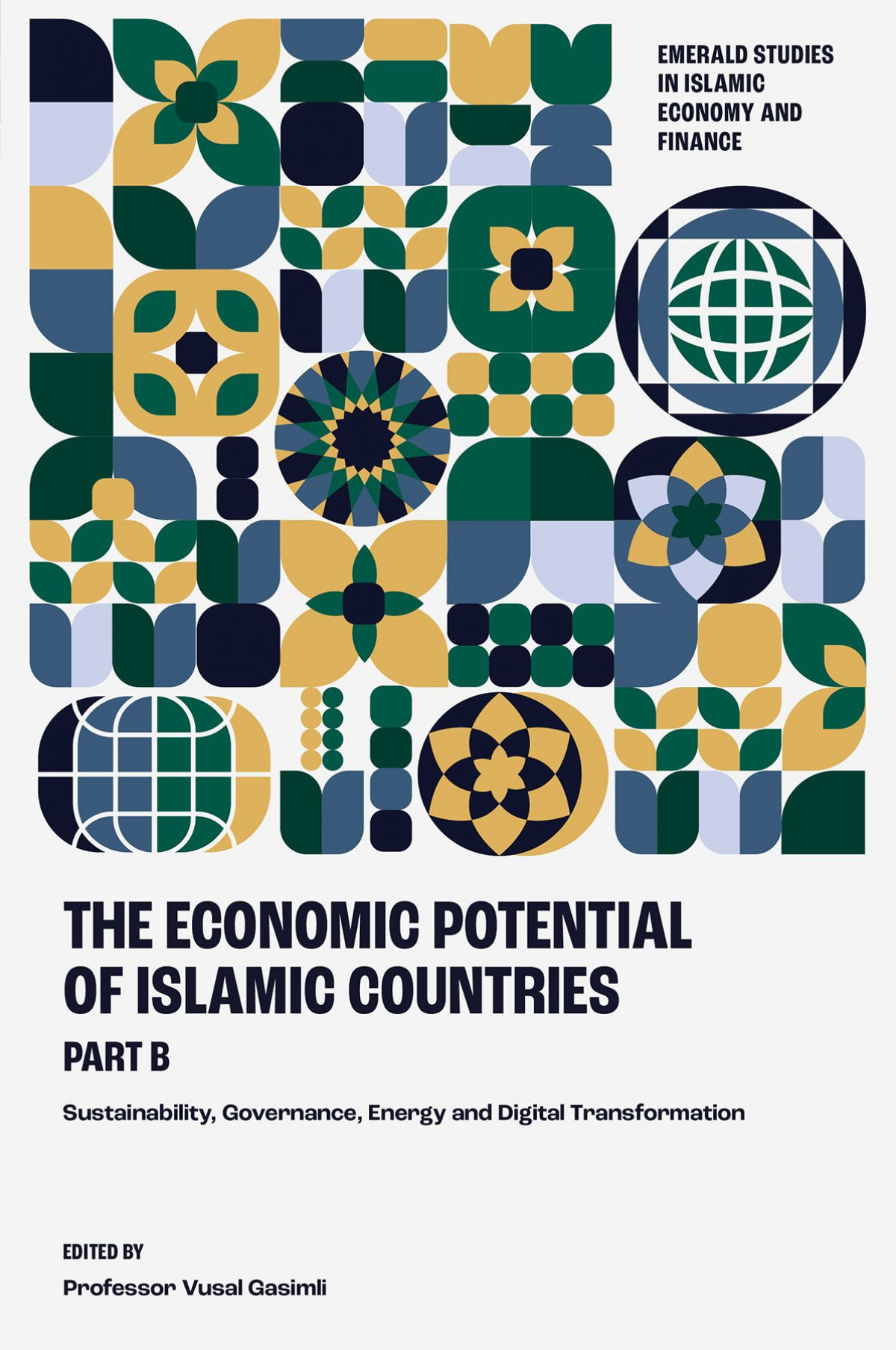
The second volume of "The Economic Potential of Islamic Countries" published by Emerald Publishing
The second volume of the two-volume research work titled “The Economic Potential of Islamic Countries”, prepared by the Center for Analysis of Economic Reforms and Communication (CAERC), has been published by the prestigious British publisher Emerald. The publication, prepared under the editorship of Vusal Gasimli, Executive Director of CAERC, Doctor of Economic Sciences and Professor, has been indexed in the Scopus scientific database and represents a significant academic study of the economic and social development potential of Islamic countries.
The book examines the economic development prospects of Islamic countries in the context of key areas such as sustainable development, governance, energy transition, and the digital economy. At a time when the global economic environment is rapidly evolving and technological progress, geopolitical transformations, and climate change are exerting substantial influence on economic systems, the publication explores opportunities for more effective utilization of the collective economic potential of Islamic countries. It also highlights major challenges facing these countries, including economic diversification, political stability, and infrastructure development.
The book was prepared with the participation of 47 authors representing prominent think tanks from more than 20 Islamic countries. The inclusion of dedicated chapters by international institutions such as ICESCO and OIC SESRIC further strengthens the scientific and institutional significance of the project, making it one of the most comprehensive academic analyses of the economic and social development potential of Islamic countries.
It should be noted that the project was prepared within the framework of the tasks assigned to the Center for Analysis of Economic Reforms and Communication by the Decree of the President of the Republic of Azerbaijan dated November 21, 2023, titled “On the declaration of the city of Shusha as the Cultural Capital of the Islamic World for 2024,” as well as the Order No. 33s of the Cabinet of Ministers dated January 19, 2024.
The first volume of the book, published last year, examined topics such as economic cooperation, fiscal policy, and Islamic finance. Both volumes present the experiences of OIC and D-8 countries from a comparative perspective while also highlighting Azerbaijan’s growing role in regional cooperation and energy diplomacy.
The book is currently available on platforms such as Amazon, Google Books, and Books-A-Million, ensuring broad global accessibility for readers and researchers.
You can explore the second volume of the book via the following link:
https://bookstore.emerald.com/the-economic-potential-of-islamic-countries-part-b-hb-9781837080052.html
Related news

The “Turkish Economic Review” issue covering the first half of 2026 has been published
The "Turkish Economic Review" for the first half of 2026 (January-June No. 2) published by the Center for Analysis of Economic Reforms and Communication (CERACC) in cooperation with the Secretariat of the Organization of…

Meeting Held with Representatives of "The Coca-Cola Company" at CAERC
A meeting was held at the Center for Analysis of Economic Reforms and Communication (CAERC) with a delegation from "The Coca-Cola Company." During the meeting, Vusal Gasimli, Executive Director of CAERC, briefed the delegation…

CAERC Will Create a New Module for Monitoring the State Program on the Mining and…
Prime Minister of the Republic of Azerbaijan Ali Asadov has signed an Order on ensuring the implementation of Order No. 1226 of the President of the Republic of Azerbaijan dated September 23, 2026, "On approving the 'State…

New Pharmaceutical Manufacturing Facility Opens New Opportunities for the Development…
The participation of President of the Republic of Azerbaijan Ilham Aliyev in the inauguration of the pharmaceutical manufacturing facility of "Gen Pharma Caucasus Manufacturing Operations" LLC in the Pirallahi Industrial…

CAERC Honored with Two Awards at the "International Finance Awards 2026"
The Center for Analysis of Economic Reforms and Communication (CAERC) has been honored with awards in two categories at the "International Finance Awards 2026," organized by the UK-based international media publication International…

Increasing Wages and Social Payments May Positively Impact Economic Activity
The statement by President Ilham Aliyev at the 8th Congress of the New Azerbaijan Party announcing that the minimum wage, pensions, and social allowances will be increased next year demonstrates that the social policy aimed at boosting…

Energy Security: Azerbaijan's Growing Role and New Opportunities
During his speech at the 8th Congress of the New Azerbaijan Party, President Ilham Aliyev emphasized Azerbaijan's expanding role in energy security, stating: "...rich in energy resources, Azerbaijan is turning into a very…

The Great Return at a New Stage: Sustainable Settlement and Economic Development
The restoration of the liberated territories and the return of former internally displaced persons (IDPs) to their native homelands are evaluated as an integral part of long-term socio-economic development. Under these circumstances,…
Op-eds
Ilkin Gasimov
Chief advisor of the Economic analysis division
New Financial Model for Resource Allocation in General Education
Baghish Ahmadov
Advisor to the Executive director of the Center for Analysis of Economic Reforms and Communication
Azerbaijan International Investment Forum: Investment Cooperation and National Development Priorities
Abdulrahim Dadashov
Deputy head of the Monitoring and evaluation division
Environmental Responsibility is One of the Key Conditions in the Development of the Mining Industry
Latif Zeynalli
Head of State Programs Division
Development of Competition Will Create New Opportunities for Sustainable Economic Growth
Orkhan Sadigov
Head of the Monitoring and evaluation division
A New Approach to Managing Off-Budget Funds Will Strengthen Financial Discipline
Elshan Yusifli
Head of the Monitoring of sectoral programs sector
New Changes to Nakhchivan’s State Programme: Export, Logistics and Social Mechanisms Improved
Abdulrahim Dadashov
Deputy head of the Monitoring and evaluation division
New Law Strengthens the Sustainable Development and Digital Monitoring of the Fisheries Sector