
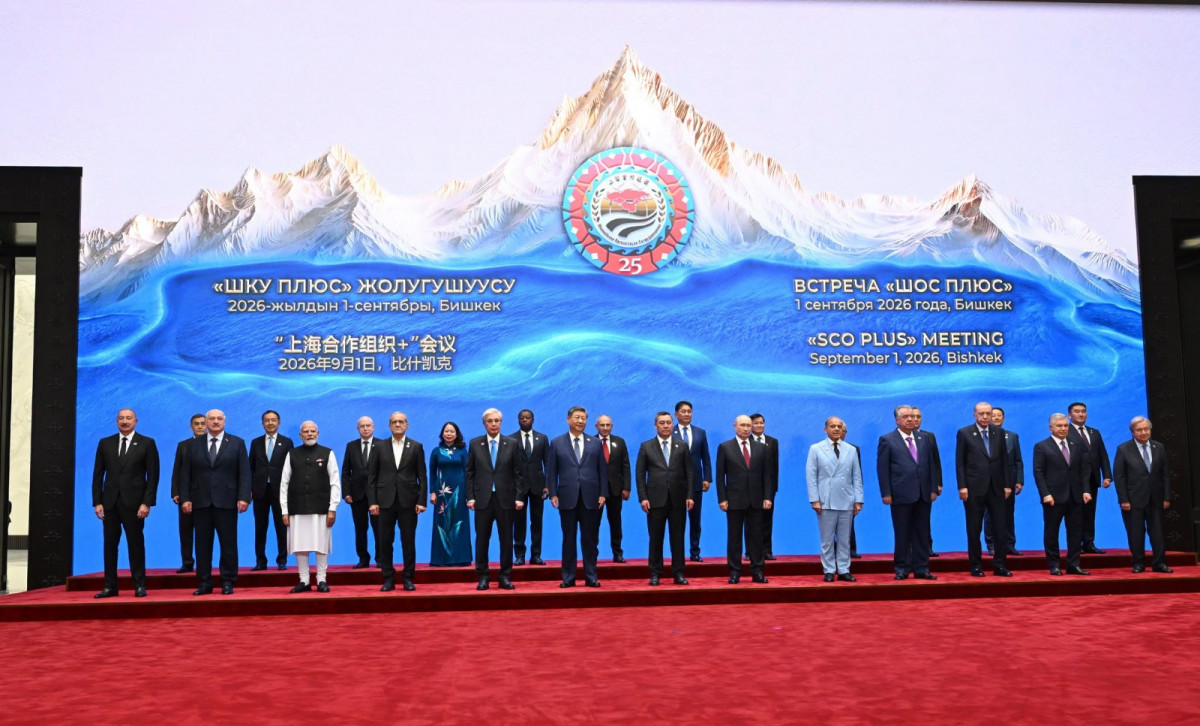
The Bishkek Summit Strengthens Azerbaijan’s Geoeconomic Role in Eurasia
The summit of the Shanghai Cooperation Organisation (SCO), held in Bishkek, is an important event in terms of the changing geoeconomic landscape of Eurasia. Coinciding with the 25th anniversary of the organisation, the Summit is not limited to discussions of security and political issues. The emergence of new opportunities for the development of economic ties, transport and logistics corridors, energy and digital connectivity within the SCO space is of particular importance for Azerbaijan and the Turkic world as a whole.
Ilyas Huseynov, Head of the Turkic World Research Centre (TWRC) at the Center for Analysis of Economic Reforms and Communication, notes that the SCO can no longer be regarded solely as a platform for cooperation on security issues.
The Head of the TWRC stated that, for Azerbaijan, the significance of the SCO is primarily related to the broad economic and geographical space covered by the organisation. The combined economic strength of the SCO’s 10 member states – China, Russia, Kazakhstan, Kyrgyzstan, Tajikistan, Uzbekistan, India, Pakistan, Iran and Belarus – reached approximately USD 30 trillion in 2025. This figure characterises the SCO not only as a platform for security and political dialogue, but also as a multilateral cooperation space with significant economic potential.
Azerbaijan’s participation in this platform as a dialogue partner is an important element of the country’s multifaceted geoeconomic policy. Azerbaijan’s acquisition of dialogue partner status in 2015, President Ilham Aliyev’s participation in the Samarkand Summit in 2022, the formalisation of the Azerbaijan–China strategic partnership in Astana in 2024, and the participation of the head of state in the “SCO Plus” format in 2025 demonstrate the consistent expansion of cooperation between Baku and this platform.
Ilyas Huseynov believes that one of the key issues for Azerbaijan at the Bishkek Summit is aligning the new transport and economic connectivity taking shape within the SCO space with the country’s development strategy. Azerbaijan’s objective is not merely to become a transit country, but to transform itself into one of Eurasia’s major logistics, trade, energy and digital connectivity hubs. The SCO’s expanding economic geography creates additional opportunities for this strategy.
The rapid development of China–Central Asia economic relations is particularly noteworthy from Azerbaijan’s perspective. In 2025, the volume of merchandise trade between China and the five Central Asian countries – Kazakhstan, Kyrgyzstan, Uzbekistan, Turkmenistan and Tajikistan – reached USD 106.3 billion. This represents a 12 percent increase compared with the previous year and indicates that China–Central Asia trade surpassed the USD 100 billion threshold for the first time.
This figure is not merely a trade indicator; it also reflects the growing demand for new transport infrastructure and logistics services in the region. As trade between China and Central Asia expands, the issue of transporting these goods to global markets through various routes is becoming increasingly important. Azerbaijan’s advantage lies in its location on the western coast of the Caspian Sea and its position within a transport system that connects Central Asia with the South Caucasus, Türkiye and Europe.
In this regard, the China–Kyrgyzstan–Uzbekistan railway project is of particular importance for Azerbaijan. The transition of this long-discussed project to the implementation stage demonstrates China’s long-term interest in developing transport infrastructure in Central Asia. The project’s total cost, estimated at approximately USD 4.7 billion, and the establishment of financing mechanisms demonstrate its regional scale.
Once the railway line becomes operational, a new railway connection will be established between China and Central Asia. More importantly, this line has the potential to create an additional cargo base for the Trans-Caspian International Transport Route, also known as the Middle Corridor, in the future. Currently, one of the main routes for cargo entering the Middle Corridor from China passes through Kazakhstan to the ports of Aktau and Kuryk, and from there via the Caspian Sea to Azerbaijan. The China–Kyrgyzstan–Uzbekistan railway could create a new connection from other parts of Central Asia towards the Caspian Sea.
For Azerbaijan, this means economic benefits in several areas. First, increased transit cargo volumes could expand the utilisation of the country’s transport and logistics infrastructure. Second, demand for warehousing, insurance, customs, financial and other services could increase alongside port, railway and road transport. Third, new cargo flows could strengthen Azerbaijan’s position as a regional logistics hub and create conditions for the generation of additional value in the country. Azerbaijan has already become an important participant in actual cargo flows along the Middle Corridor. An important point here is that the economic efficiency of the Middle Corridor should not be measured solely by the volume of transit transportation. The development of logistics centres, industrial and trade zones, warehouse complexes, financial and insurance services around the corridor can generate a broader economic effect. For Azerbaijan, the key objective is precisely to transform transit opportunities into economic activities that generate higher added value.
This process also opens up important prospects for the Turkic world. Strengthening transport connectivity among Azerbaijan, Kazakhstan, Kyrgyzstan, Uzbekistan and Türkiye creates opportunities for the formation of an integrated economic chain between East and West. The transportation of products manufactured in Central Asia to the markets of Türkiye and Europe via Azerbaijan, as well as the transportation of Chinese products along the same route, can generate additional value across the economies of several countries. In this regard, the key issue for the Turkic world is not merely to increase transit revenues. Transport corridors should serve the formation of regional production and supply chains. Alongside the transportation of goods, their packaging, sorting, storage, insurance, financing and customs clearance also create new areas of economic activity. Thus, the Middle Corridor can become a platform that deepens the economic integration of the Turkic world.
The SCO’s activities are also important for Azerbaijan in terms of energy cooperation. Azerbaijan’s energy infrastructure and its position in the Caspian region enable the country to play an important role in Eurasia’s energy connectivity. In the future, alongside conventional energy resources, cooperation in renewable energy, electricity transmission and green energy corridors can be expanded. This could create conditions for Azerbaijan to become not only an energy transit country but also a connectivity hub for new energy systems.
Another important area is digital connectivity. The competitiveness of modern transport corridors is no longer determined solely by the capacity of railways, ports and roads. The digitalisation of customs procedures, electronic documentation, real-time cargo tracking and the acceleration of border procedures also directly affect logistics efficiency. Expanding digital logistics mechanisms along the China–Central Asia–Azerbaijan–Türkiye route could lead to reductions in both time and operational costs in the future.
The long-term significance of the Bishkek Summit of the SCO for the Turkic world lies precisely in strengthening these economic connections. There are broad opportunities for alignment between the agendas of the SCO and the Organization of Turkic States in the fields of transport, energy, the digital economy, trade and investment. Expanding economic dialogue between these two spaces could further increase the role of the Turkic world in economic relations between Central Asia and the South Caucasus, Türkiye and Europe.
For Azerbaijan, the main objective is to translate these opportunities into concrete economic outcomes. To this end, the Port of Alat, railways, highways, the Alat Free Economic Zone, the Zangezur direction, digital logistics and energy infrastructure should be developed as complementary elements of a unified economic strategy.
The Head of the TWRC believes that the Bishkek Summit is an important platform for Azerbaijan to further expand its economic and transport opportunities within the SCO space. At the next stage, the key issue will be to derive maximum economic benefit from growing trade and cargo flows, attract new investments, and develop production and service sectors that generate high added value around transport corridors.
In this regard, the SCO’s expanding economic geography, China’s growing activity in Central Asia, and the deepening integration processes among the Turkic states are factors that further strengthen Azerbaijan’s geoeconomic position. Azerbaijan can strengthen its position in these processes not merely as a transit hub, but as a regional platform connecting economic ties among China, Central Asia, the Caspian region, the South Caucasus, Türkiye and Europe.
Related news

A representative of the CAERC participated in a conference dedicated to the future…
Rashad Najafli, Deputy Director of the Economic Analysis Department of the Center for Analysis of Economic Reforms and Communication (CAERC), participated in the international conference on “New Challenges in Maintaining Financial…

New Opportunities in Technology Parks: Commercialization and Export of Innovations
The Decree of the President of the Republic of Azerbaijan dated October 22, 2026 on Amendments to the “Model Regulation on Technology Parks” provides for important innovations in terms of improving the activities of technoparks,…

Vusal Gasimli spoke at the opening of the Islamic Finance Forum
Vusal Gasimli, Executive Director of the Center for Analysis of Economic Reforms and Communication (CAERC) — a Doctor of Economic Sciences and Professor — delivered a speech at the opening ceremony of the "3rd Islamic…

CAERC expands cooperation with think tanks and universities in Uzbekistan
Ilyas Huseynov, Head of the Turkic World Research Center (TWRC) at the Center for Analysis of Economic Reforms and Communication (CAERC), held meetings with representatives from think tanks and higher education institutions, and delivered…

Meetings regarding preparations for the final monitoring and evaluation of the Socio-Economic…
The Center for Analysis of Economic Reforms and Communication (CAERC) has concluded a series of meetings with representatives from relevant government agencies. These meetings were held to refine outcome indicators for the year 2026—within…

The investment portfolio of “Enterprise Azerbaijan”’s partners exceeds 3 billion…
The global innovation program “Startup School 4: Five Continents – 500 Startups,” implemented by the “Enterprise Azerbaijan” portal of the Center for Analysis of Economic Reforms and Communication (CAERC),…

The establishment of the Karabakh National Park creates new opportunities for ecological…
The Order of the President of the Republic of Azerbaijan, Ilham Aliyev, dated October 20, 2026, "On the Establishment of the Karabakh National Park of the Republic of Azerbaijan," is regarded as a significant step toward…

World Bank: Azerbaijan’s strong financial buffers support economic stability and…
The "Europe and Central Asia Economic Update" and the "Macro-Poverty Outlook" for Azerbaijan, published by the World Bank in October 2026, indicate that the country has maintained its macroeconomic stability, strong…
Op-eds
Ilkin Gasimov
Chief advisor of the Economic analysis division
New Financial Model for Resource Allocation in General Education
Baghish Ahmadov
Advisor to the Executive director of the Center for Analysis of Economic Reforms and Communication
Azerbaijan International Investment Forum: Investment Cooperation and National Development Priorities
Abdulrahim Dadashov
Deputy head of the Monitoring and evaluation division
Environmental Responsibility is One of the Key Conditions in the Development of the Mining Industry
Latif Zeynalli
Head of State Programs Division
Development of Competition Will Create New Opportunities for Sustainable Economic Growth
Orkhan Sadigov
Head of the Monitoring and evaluation division
A New Approach to Managing Off-Budget Funds Will Strengthen Financial Discipline
Elshan Yusifli
Head of the Monitoring of sectoral programs sector
New Changes to Nakhchivan’s State Programme: Export, Logistics and Social Mechanisms Improved
Abdulrahim Dadashov
Deputy head of the Monitoring and evaluation division
New Law Strengthens the Sustainable Development and Digital Monitoring of the Fisheries Sector