
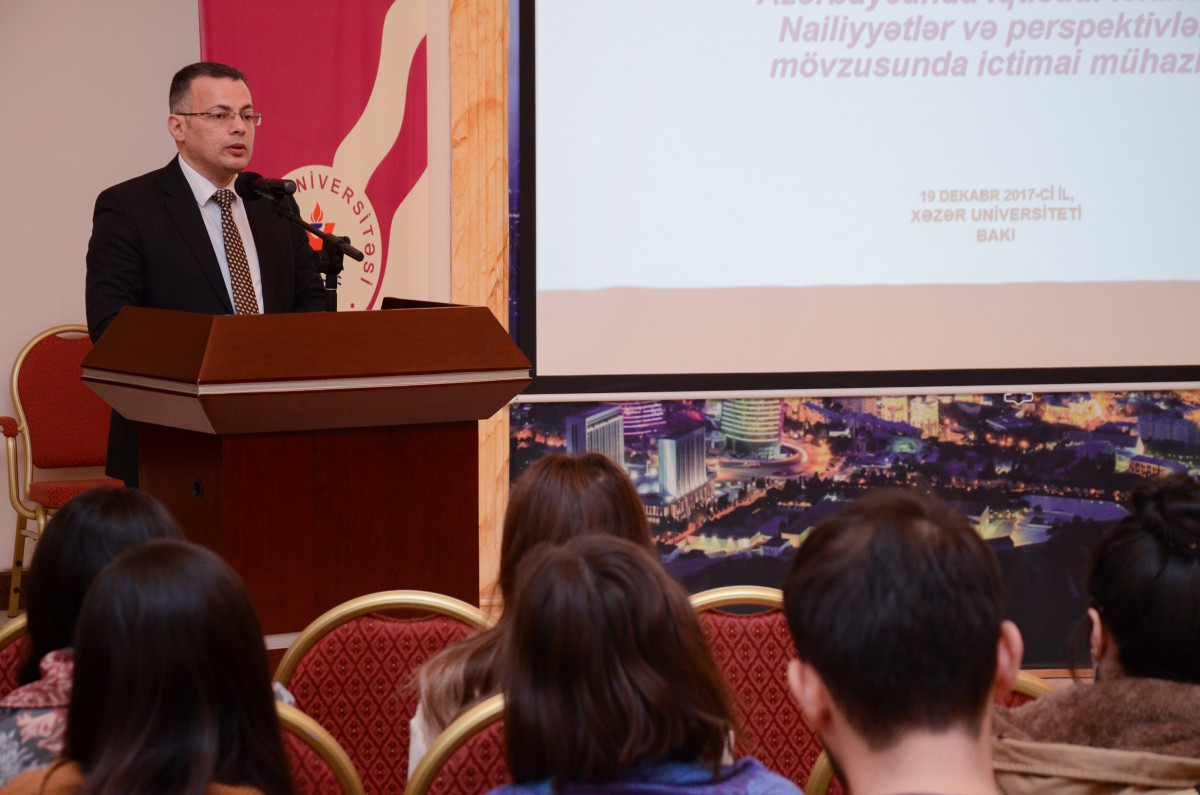
Dr. Vusal Gasimli Delivers Public Lecture at Khazar University
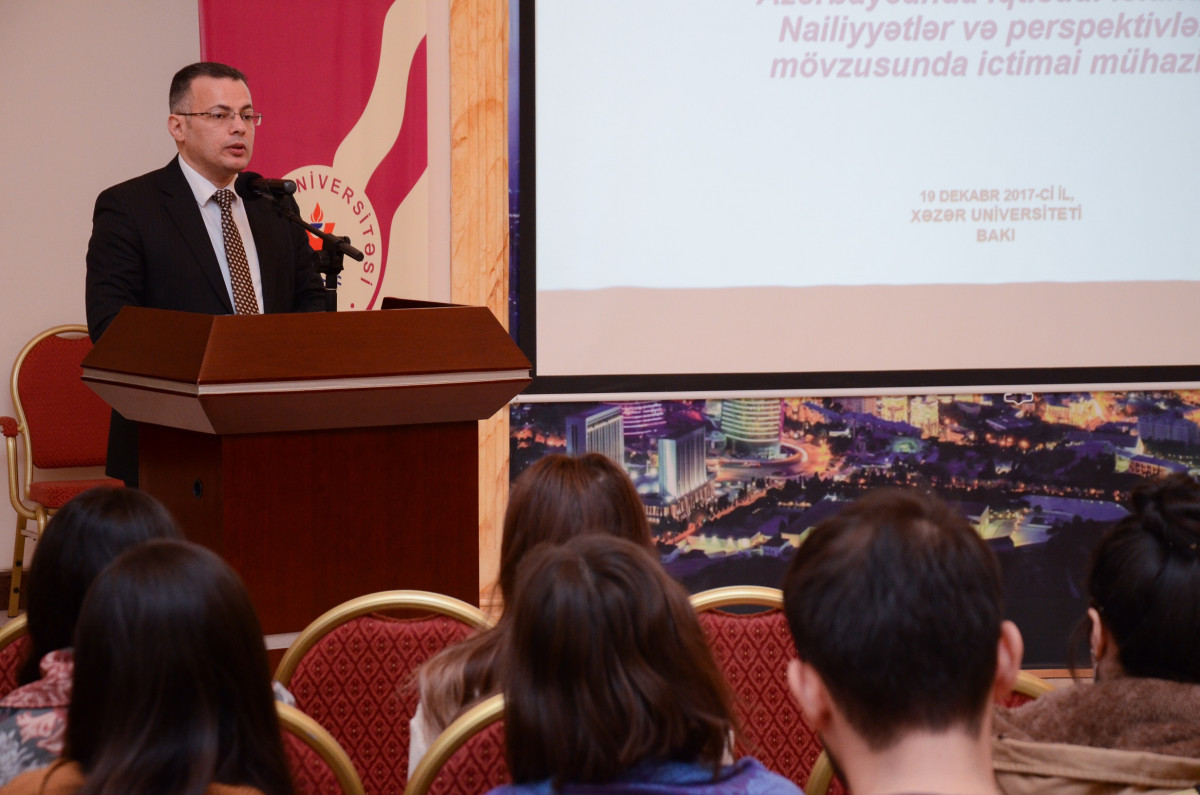
The Economic Reforms Analysis and Communication Center (ERACC) organized a public lecture at Khazar University on the topic “Economic Reforms in Azerbaijan: Achievements and Prospects.”
The event was opened by the Dean of Khazar University, Dr. Jeyhun Mammadov. He noted that the Strategic Roadmaps play a significant role in diversifying the non-oil sector and exports, as well as in developing human capital in Azerbaijan. According to him, organizing such a lecture at Khazar University and providing detailed information about the reform process underway in the country is important for raising awareness among young people.
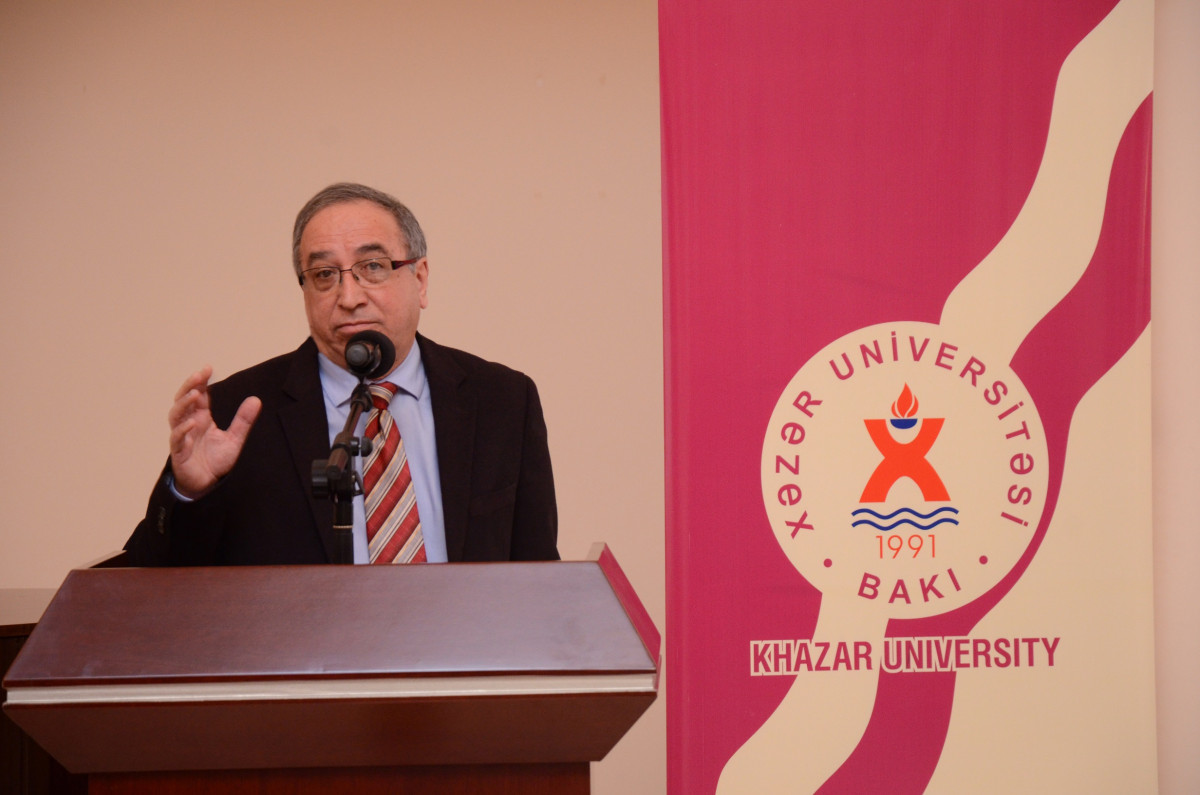
The Rector of Khazar University, Dr. Hassan Niknafs, welcomed the participants and stated that the university’s students actively participate in international programs and projects. Therefore, properly presenting the reforms carried out in the country contributes to shaping Azerbaijan’s positive image abroad.
The Vice-Rector for Academic Affairs, Professor Mahammad Nuriyev, emphasized that theoretical discussions held in educational institutions and classrooms gradually transition into practical implementation within a defined process. He noted that the adoption of the Strategic Roadmaps and the timely launch of reforms enabled Azerbaijan to emerge relatively stable from the global crisis. Most importantly, he stressed that knowledge and human capital occupy a central place in this reform process.
Subsequently, the Executive Director of the Economic Reforms Analysis and Communication Center, Dr. Vusal Gasimli, delivered a public lecture to faculty members and students on “Economic Reforms in Azerbaijan: Achievements and Prospects.” He mentioned that since the beginning of the academic year, similar meetings have been held at nearly ten universities operating in Azerbaijan. At each meeting, strong interest and positive feedback from participants were observed.
Dr. Gasimli highlighted that in the context of the Fourth Industrial Revolution, big data, the Internet of Things, 3D printing, quantum computing, as well as bio, nano, and cognitive technologies are of great importance. To respond to these challenges, Azerbaijan, as noted by President Ilham Aliyev, is developing human capital, improving infrastructure, and continuing reforms. He added that both the World Bank and the International Monetary Fund have acknowledged the positive results of the new generation of reforms carried out under the President’s leadership. This year, growth of 2.5 percent was achieved in the non-oil sector, more than 3 percent in non-oil industry, and over 4 percent in the agricultural sector. Thus, 2017 will go down in history as a year of stabilization, and 2018 as a year of economic development.
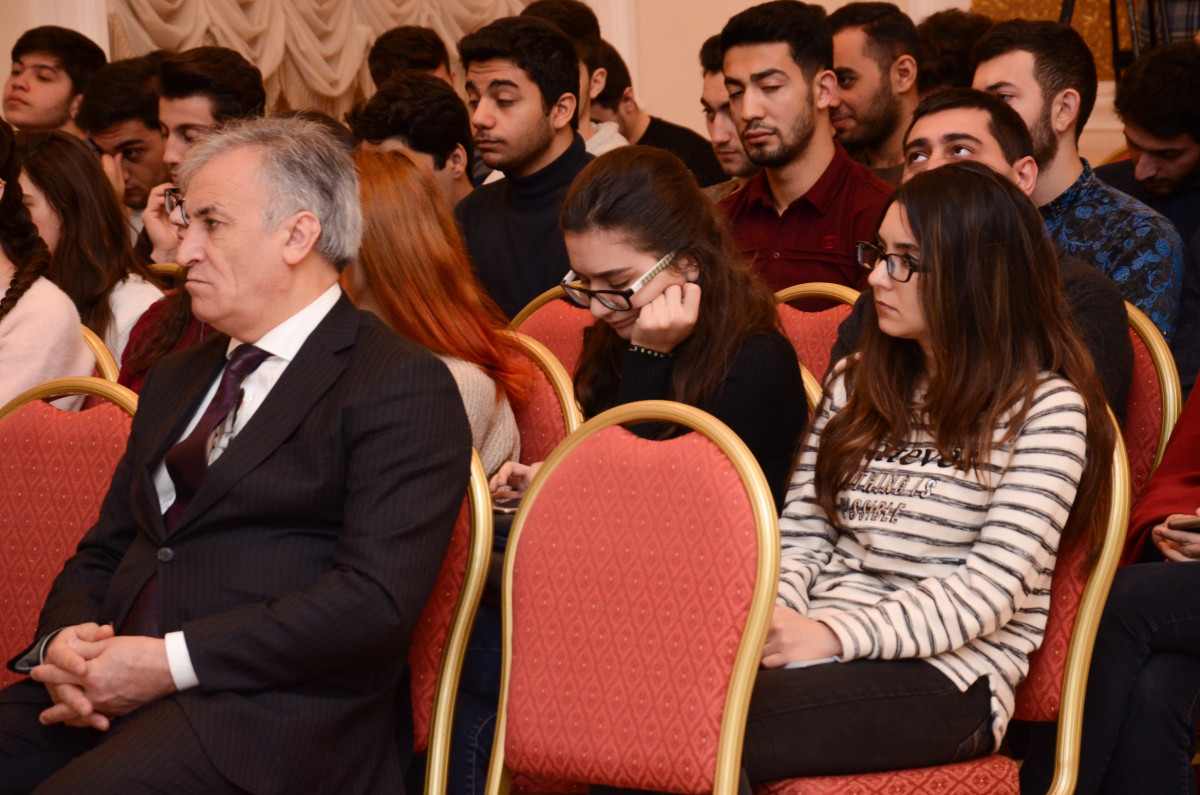
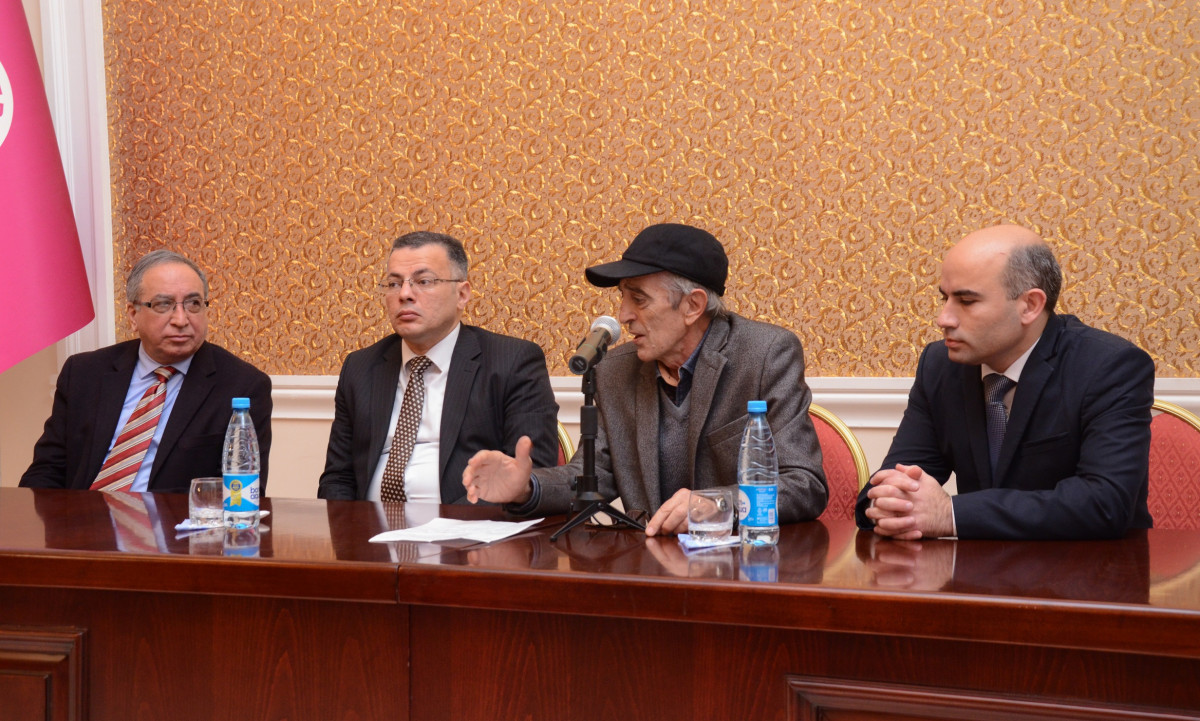
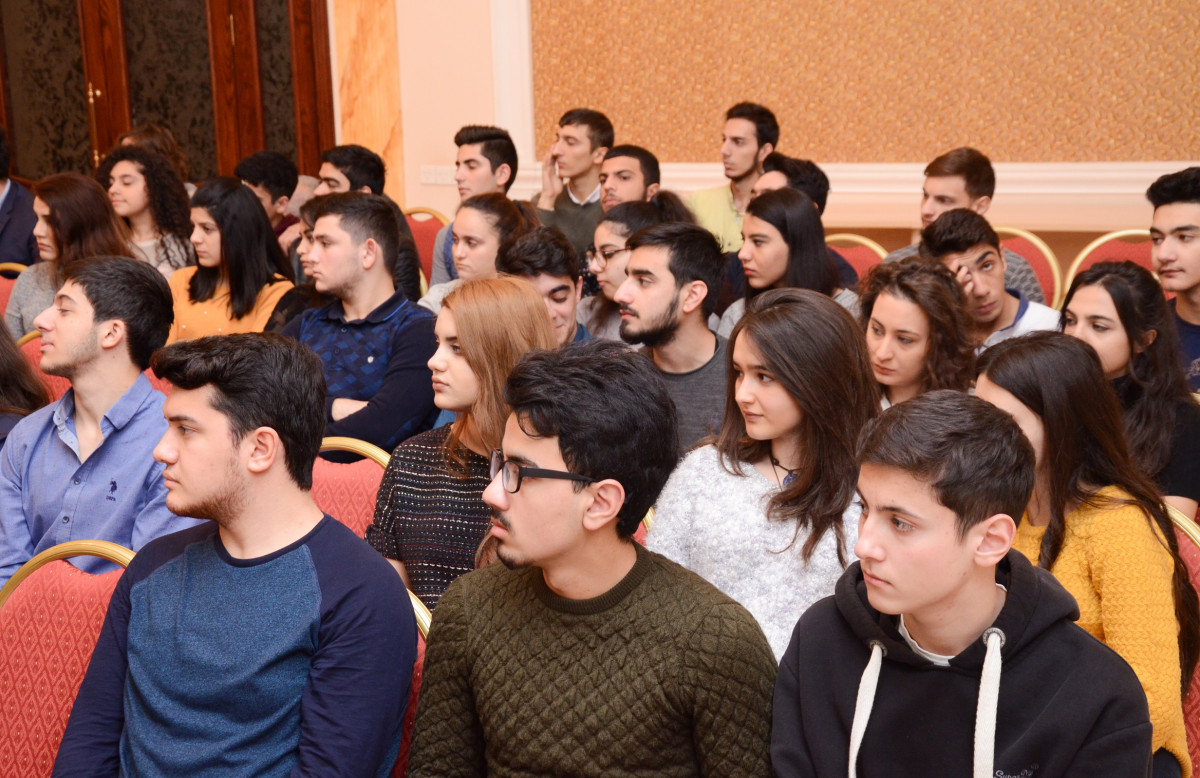
It should be noted that more than 200 professors, lecturers, and students attended the public lecture. After the lecture, faculty members from various departments actively addressed their questions to the speaker.
Related news

“Geoeconomic Stability Corridor”: The $1 Billion Trade Target with Uzbekistan Opens…
The state visit of the President of the Republic of Azerbaijan, Mr. Ilham Aliyev, to Uzbekistan, the signing of the “Treaty on Eternal Friendship” within the framework of the third meeting of the Supreme Interstate Council,…

Vusal Gasimli Discusses the Prospects of the Middle Corridor with the Ambassador…
Vusal Gasimli, Executive Director of the Center for Analysis of Economic Reforms and Communication (CAERC), received Kang Kımgun, Ambassador Extraordinary and Plenipotentiary of the Republic of Korea to the Republic of Azerbaijan.…

CAERC Hosts Meeting with Leadership of the Azerbaijan Trade Union of Public Administration…
A meeting was held at the Center for Analysis of Economic Reforms and Communication (CAERC) with the leadership of the Republican Association of the Azerbaijan Trade Union of Public Administration and Public Service Workers (ATU-PAPSW),…

The Online Training Phase of the “Startup School 4” Programme by the “Enterprise…
The online training phase of “Startup School 4: Five Continents – 500 Startups”, a global innovation programme implemented by the “Enterprise Azerbaijan” portal of the Center for Analysis of Economic…

CAERC to Conduct Monitoring and Evaluation of the State Program on Tourism Development
President of the Republic of Azerbaijan Ilham Aliyev has signed an Order approving the “State Program on the Development of Tourism in the Republic of Azerbaijan for 2026–2030.” According to the Order, the monitoring…

Meeting Held at CAERC on the Implementation of the Action Plan for 2026–2030 on…
A meeting was held at the Center for Analysis of Economic Reforms and Communication (CAERC) on the implementation of the “Action Plan for 2026–2030 on the Implementation of the Employment Strategy.” The meeting addressed…

The “Economic Reforms” Journal Has Been Indexed in the Asian Science Citation Index
The “Economic Reforms” scientific journal, established by the Center for Analysis of Economic Reforms and Communication (CAERC), has been indexed in the ASCI (Asian Science Citation Index) international citation index.…

Indicative Planning for the Implementation of the National Action Plan on Combating…
A meeting was held at the Center for Analysis of Economic Reforms and Communication (CAERC) with representatives of key implementing institutions to discuss indicative planning for 2026 and the identification of target values for…
Op-eds
Aykhan Gadashov
Head of the Azexport portal
“Geoeconomic Stability Corridor”: The $1 Billion Trade Target with Uzbekistan Opens New Horizons for Business
Isa Gasimov
Head of the “Enterprise Azerbaijan” portal
Crowdfunding: New Perspectives in Startup Financing in Azerbaijan
Elnur Alakbarov
Deputy head of the Economic analysis division
New Action Plan on Employment: Digitalization and Result-Oriented Management
Abdulrahim Dadashov
Deputy head of the Monitoring and evaluation division
Agricultural support mechanisms will create new opportunities for farmers and exporters
Ilyas Huseynov
Head of the Turkic World Research Center
Large-Scale Modernization of the Baku-Tbilisi-Kars Railway: A New Strategic Phase in the Middle Corridor and Eurasian Connectivity
Rashad Najafli
Deputy head of the Economic analysis division
Azerbaijan: A Guarantor of Peace and Security in the South Caucasus
Isa Gasimov
Head of the “Enterprise Azerbaijan” portal
Transition to an Innovation Ecosystem: Azerbaijan’s Strategic Choice