
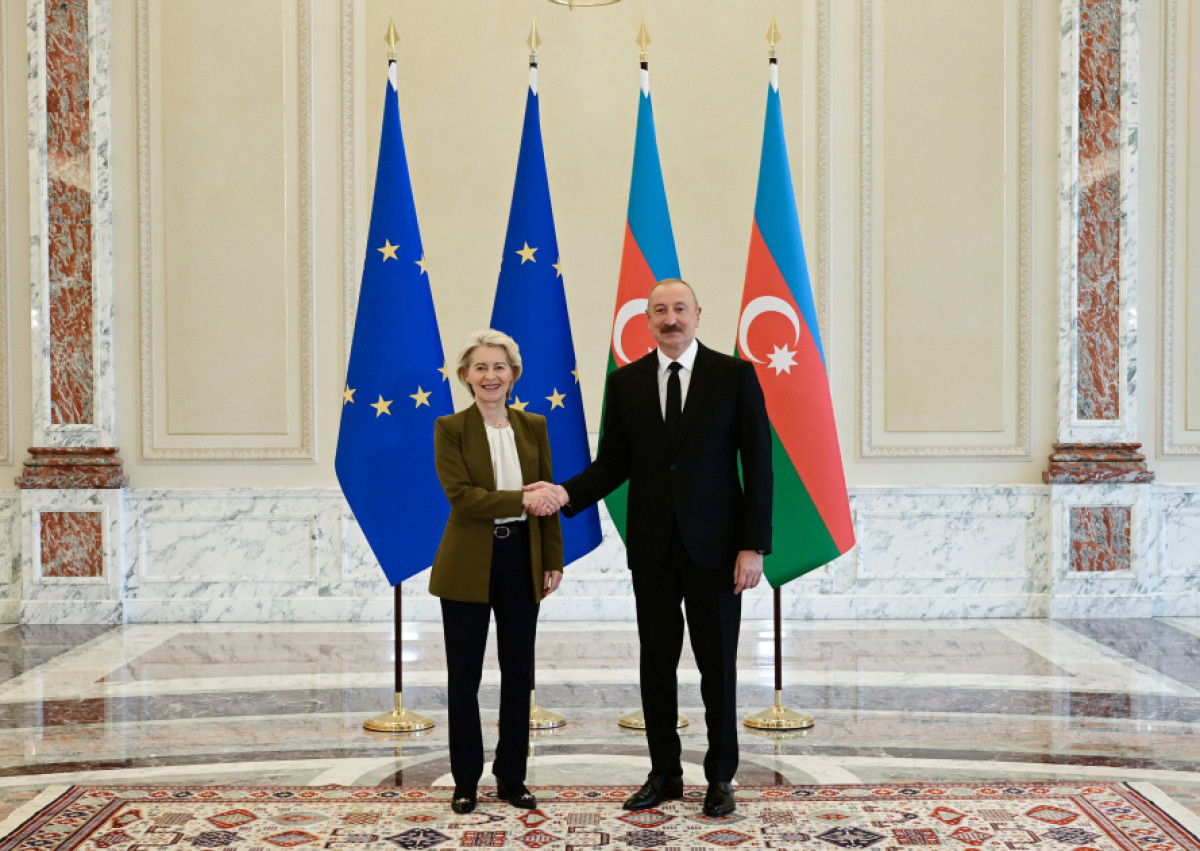
A New Phase in Azerbaijan–European Union Relations: The Strategic Significance of Ursula von der Leyen’s Visits to Azerbaijan
Relations between Azerbaijan and the European Union (EU) have developed progressively since Azerbaijan regained its independence. This cooperation encompasses a broad range of areas, including political dialogue, energy security, trade, transport, digital development, and green energy. Since 2022, Azerbaijan–EU relations have evolved beyond the primary agenda of the "Southern Gas Corridor" and natural gas supplies, moving towards a broader and more diversified framework of cooperation.
According to Aqil Asadov, Head of Department at the Center for Analysis of Economic Reforms and Communication (CAERC), the visits of the President of the European Commission, Ursula von der Leyen, to Azerbaijan represent a significant milestone in strengthening the strategic partnership between the two sides. "The Memorandum of Understanding on a Strategic Partnership in the Field of Energy", signed in 2022, further reinforced Azerbaijan’s role in ensuring Europe’s energy security. The 2026 visit marks the beginning of a new stage of cooperation by complementing energy collaboration with partnerships in transport, digital connectivity, the green economy, and regional peace initiatives. The dynamics of bilateral relations have reached a point where the EU has become one of Azerbaijan’s principal trading partners. As emphasized during the joint press statements by President Ilham Aliyev and President Ursula von der Leyen, “The European Union is Azerbaijan’s main trading partner. More than 40 percent of our trade is conducted with EU member states, while Azerbaijan is the European Union’s principal trading partner in the South Caucasus. Approximately 70 percent of the EU’s trade with the South Caucasus is carried out with Azerbaijan.”
Aqil Asadov notes that another important pillar of bilateral relations is cooperation in transport and logistics. The development of the Middle Corridor further strengthens Azerbaijan’s position as a key transport hub linking Europe and Asia. This route contributes to faster freight transportation and deeper regional economic integration. Ursula von der Leyen’s statement that “Azerbaijan is strategically combining its geographical position with its growing economic, political and regional influence. This is why we propose launching the EU–Azerbaijan Connectivity Partnership. It will cover transport, energy and digital connectivity and will be closely linked to the High-Level Connectivity Dialogue,” demonstrates the EU’s growing interest in Azerbaijan’s transport and logistics potential.
Overall, Ursula von der Leyen’s latest visit to Azerbaijan stands out for two key reasons. First, it provided an opportunity to assess the outcomes of the strategic energy partnership launched in 2022. Second, it reflected the expansion of cooperation beyond the energy sector towards broader areas of economic and regional integration. In addition to energy cooperation, the development of the Middle Corridor, digital connectivity, green energy projects, and regional transport infrastructure have become central pillars of bilateral relations. The European Commission has announced a new financial package worth €200 million to support the development of transport, energy, and digital connectivity in the South Caucasus. Furthermore, additional financial assistance is planned for the development of border communities, mine action, healthcare, and small business initiatives, reinforcing confidence that Azerbaijan–EU relations will continue to deepen in the coming years. This initiative demonstrates that the EU increasingly views Azerbaijan not only as a reliable energy supplier but also as a strategic transport and logistics hub connecting Europe with Central Asia.
Today, Azerbaijan is recognized as one of the EU’s key partners in ensuring Europe’s energy security. Through the Southern Gas Corridor, Azerbaijani natural gas is supplied to several European countries, with ten EU member states currently importing Azerbaijani gas. Azerbaijan also possesses significant potential in the field of renewable energy. Expanding cooperation in this area is expected to further strengthen economic relations between the parties in the years ahead. As President Ilham Aliyev stated during the joint press conference, “Renewable energy represents a relatively new dimension of our cooperation with the European Commission… We extensively discussed Azerbaijan’s solar, wind and hydropower potential, as well as the existing and planned transmission infrastructure. In this respect, we can also become strategic partners.”
It is also important to underline that during the years of Armenia’s occupation of Azerbaijani territories, Azerbaijan frequently faced double standards and the distortion of facts by certain European politicians and organizations. Today, however, the European Union has expressed its commitment to supporting peace in the region while strengthening relations with victorious Azerbaijan. In this regard, Ursula von der Leyen stated: “Congratulations on launching the historic peace agreement with Armenia. You have demonstrated personal leadership in promoting peace and cooperation in the region. This creates new opportunities for stability, trust and shared prosperity. The European Union firmly supports this process, and we will continue to do so. Together, we can transform peace on paper into lasting peace. That is why we are here today, working together.” These remarks reflect international recognition of President Ilham Aliyev’s leadership and the tangible outcomes of Azerbaijan’s achievements.
In conclusion, the discussions and official statements made during the visit indicate that Azerbaijan continues to consolidate its position as a strategic partner in the European Union’s policy toward the South Caucasus. Ursula von der Leyen’s visits to Baku demonstrate that bilateral cooperation now extends well beyond the energy sector, encompassing regional stability, economic integration, connectivity, and sustainable development. This creates a solid political and economic foundation for the further deepening of Azerbaijan–EU relations in the years to come
Related news

A representative of the CAERC participated in a conference dedicated to the future…
Rashad Najafli, Deputy Director of the Economic Analysis Department of the Center for Analysis of Economic Reforms and Communication (CAERC), participated in the international conference on “New Challenges in Maintaining Financial…

New Opportunities in Technology Parks: Commercialization and Export of Innovations
The Decree of the President of the Republic of Azerbaijan dated October 22, 2026 on Amendments to the “Model Regulation on Technology Parks” provides for important innovations in terms of improving the activities of technoparks,…

Vusal Gasimli spoke at the opening of the Islamic Finance Forum
Vusal Gasimli, Executive Director of the Center for Analysis of Economic Reforms and Communication (CAERC) — a Doctor of Economic Sciences and Professor — delivered a speech at the opening ceremony of the "3rd Islamic…

CAERC expands cooperation with think tanks and universities in Uzbekistan
Ilyas Huseynov, Head of the Turkic World Research Center (TWRC) at the Center for Analysis of Economic Reforms and Communication (CAERC), held meetings with representatives from think tanks and higher education institutions, and delivered…

Meetings regarding preparations for the final monitoring and evaluation of the Socio-Economic…
The Center for Analysis of Economic Reforms and Communication (CAERC) has concluded a series of meetings with representatives from relevant government agencies. These meetings were held to refine outcome indicators for the year 2026—within…

The investment portfolio of “Enterprise Azerbaijan”’s partners exceeds 3 billion…
The global innovation program “Startup School 4: Five Continents – 500 Startups,” implemented by the “Enterprise Azerbaijan” portal of the Center for Analysis of Economic Reforms and Communication (CAERC),…

The establishment of the Karabakh National Park creates new opportunities for ecological…
The Order of the President of the Republic of Azerbaijan, Ilham Aliyev, dated October 20, 2026, "On the Establishment of the Karabakh National Park of the Republic of Azerbaijan," is regarded as a significant step toward…

World Bank: Azerbaijan’s strong financial buffers support economic stability and…
The "Europe and Central Asia Economic Update" and the "Macro-Poverty Outlook" for Azerbaijan, published by the World Bank in October 2026, indicate that the country has maintained its macroeconomic stability, strong…
Op-eds
Ilkin Gasimov
Chief advisor of the Economic analysis division
New Financial Model for Resource Allocation in General Education
Baghish Ahmadov
Advisor to the Executive director of the Center for Analysis of Economic Reforms and Communication
Azerbaijan International Investment Forum: Investment Cooperation and National Development Priorities
Abdulrahim Dadashov
Deputy head of the Monitoring and evaluation division
Environmental Responsibility is One of the Key Conditions in the Development of the Mining Industry
Latif Zeynalli
Head of State Programs Division
Development of Competition Will Create New Opportunities for Sustainable Economic Growth
Orkhan Sadigov
Head of the Monitoring and evaluation division
A New Approach to Managing Off-Budget Funds Will Strengthen Financial Discipline
Elshan Yusifli
Head of the Monitoring of sectoral programs sector
New Changes to Nakhchivan’s State Programme: Export, Logistics and Social Mechanisms Improved
Abdulrahim Dadashov
Deputy head of the Monitoring and evaluation division
New Law Strengthens the Sustainable Development and Digital Monitoring of the Fisheries Sector