
Azerbaijan–Germany economic partnership: Priorities of the President's visit to Berlin
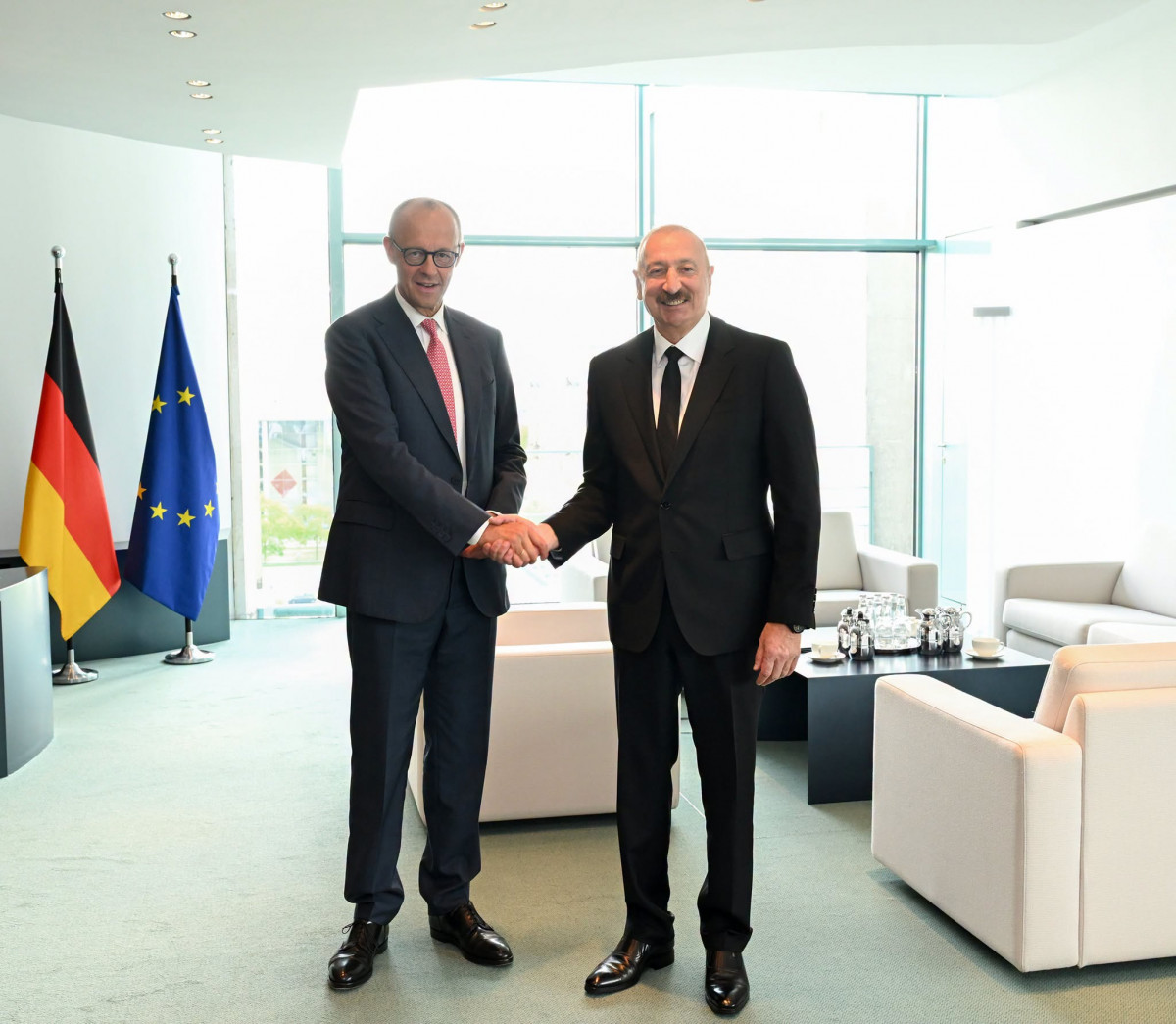
The official visit of İlham Aliyev, President of the Republic of Azerbaijan, to the Federal Republic of Germany demonstrates that relations between the two countries have elevated to a new strategic level. The meetings held during the visit with President Frank-Walter Steinmeier and Federal Chancellor Friedrich Merz, as well as the signing of the "Joint Declaration on the Strategic Agenda for Bilateral Partnership between the Republic of Azerbaijan and the Federal Republic of Germany," establish a new institutional framework for a more systematic development of cooperation in the areas of energy, trade, industry, transport-logistics, digital transformation, and investment. Furthermore, the signing of the Joint Declaration on the establishment of the Azerbaijan–Germany Business Council holds special significance in terms of expanding ties between the private sectors and building a business dialogue on a sustainable platform. The meeting between President İlham Aliyev and Michael Harms, Chairman of the German Eastern Business Association, in Berlin announces the transition of traditional economic relations between the two countries to a deeper technological and institutional level in line with new global challenges.
Commenting on the subject, Aykhan Gadashov, Head of the "Azexport.az" portal of the Center for Analysis of Economic Reforms and Communication, stated that against the backdrop of the current situation in global supply chains, the role of the Middle Corridor is of great importance for industrial giants like Germany. We characterize the Middle Corridor not merely as physical transport infrastructure, but as a unified digital ecosystem synchronized through the modeling of business processes and the implementation of advanced enterprise resource planning (ERP) architectures. The integration of German business into this progressive digital corridor could fundamentally increase connectivity and the efficiency of logistical operations.
On the other hand, against the background of these strategic visions, Azerbaijan–Germany trade relations have entered a special stage in terms of both quantity and quality. According to official statistics for the first six months of the current year, Germany ranked 7th among Azerbaijan's main trading partners with a 2.32 percent share in total trade turnover, and 5th in total imports with 4.05 percent. It should be particularly emphasized that Germany is Azerbaijan's largest import partner among European Union countries, while constituting one of the most important strategic directions in exports. Additionally, Germany ranks among the top ten destination countries for Azerbaijani crude oil exports, which demonstrates our Republic's reliable position in Europe's energy security.
An analysis of the import-export structure proves that these relations are not merely a consumer exchange, but are directly tied to our country's course of rapid technological development. Thus, during the first 5 months, imports from Germany were dominated by refractory bricks for industrial needs, carbon, contrast preparations for radiological examinations, titanium dioxide-based chemicals, as well as complex devices, equipment, and various types of meters. At the same time, the import of high-precision specialized lubricants—which may sometimes be superficially understood as simple lubricating materials, but are actually products of advanced German technology designed for specific processing steps and complex chemical conversions—directly serves the modernization of local production.
As for exports, along with petroleum products and kerosene fuel for jet engines, the inclusion of products such as corrosion-resistant steel, special lubricants, as well as hazelnuts, fruit juices, canned fruits, tobacco, tea, and fresh quinces proves that both Azerbaijan's heavy industry and food sectors are competitive enough to meet German standards.
Aykhan Gadashov noted that the application of Germany's leading technologies, especially in the establishment of modern orchards, intensive tree cultivation practices, and mechanisms for scientifically monitoring productivity, could create a major breakthrough in our agro-industrial complex.
Currently, specialized fungicides for plants and aromatic substances used in the food industry imported from Germany, as well as products such as cheese, butter, and baby food, align both local production and consumer quality with global requirements.
In parallel, through the proper modeling of digital sales channels, the "Azexport.az" portal plays an active role in bringing our non-oil products and services to the German market. The growing interest of German entrepreneurs and companies in our country, combined with steps taken to evaluate agricultural and tourism potential, alongside the application of advanced technologies, can make a significant contribution to the sustainable, long-term development of the Azerbaijani economy.
Related news

Vusal Gasimli spoke at the opening of the Islamic Finance Forum
Vusal Gasimli, Executive Director of the Center for Analysis of Economic Reforms and Communication (CAERC) — a Doctor of Economic Sciences and Professor — delivered a speech at the opening ceremony of the "3rd Islamic…

CAERC expands cooperation with think tanks and universities in Uzbekistan
Ilyas Huseynov, Head of the Turkic World Research Center (TWRC) at the Center for Analysis of Economic Reforms and Communication (CAERC), held meetings with representatives from think tanks and higher education institutions, and delivered…

Meetings regarding preparations for the final monitoring and evaluation of the Socio-Economic…
İqtisadi İslahatların Təhlili və Kommunikasiya Mərkəzində (İİTKM) “Azərbaycan Respublikasının 2022–2026-cı illərdə sosial-iqtisadi inkişaf Strategiyası” çərçivəsində 2026-cı ilin yekunları üzrə…

The investment portfolio of “Enterprise Azerbaijan”’s partners exceeds 3 billion…
The global innovation program “Startup School 4: Five Continents – 500 Startups,” implemented by the “Enterprise Azerbaijan” portal of the Center for Analysis of Economic Reforms and Communication (CAERC),…

The establishment of the Karabakh National Park creates new opportunities for ecological…
The Order of the President of the Republic of Azerbaijan, Ilham Aliyev, dated October 20, 2026, "On the Establishment of the Karabakh National Park of the Republic of Azerbaijan," is regarded as a significant step toward…

World Bank: Azerbaijan’s strong financial buffers support economic stability and…
The "Europe and Central Asia Economic Update" and the "Macro-Poverty Outlook" for Azerbaijan, published by the World Bank in October 2026, indicate that the country has maintained its macroeconomic stability, strong…

The new healthcare management model aims to improve the quality and accessibility…
The Decree “On a Number of Measures Related to the Improvement of Management in the Healthcare Sector,” signed by President of the Republic of Azerbaijan Ilham Aliyev on 19 October 2026, represents the next stage of reforms…

An event dedicated to the Day of Restoration of Independence - October 18, was held…
An educational meeting titled “Azerbaijan’s State Independence Is Eternal, Primordial and Irreversible” was held at the Center for Analysis of Economic Reforms and Communication on the initiative of Reform Volunteers…
Op-eds
Ilkin Gasimov
Chief advisor of the Economic analysis division
New Financial Model for Resource Allocation in General Education
Baghish Ahmadov
Advisor to the Executive director of the Center for Analysis of Economic Reforms and Communication
Azerbaijan International Investment Forum: Investment Cooperation and National Development Priorities
Abdulrahim Dadashov
Deputy head of the Monitoring and evaluation division
Environmental Responsibility is One of the Key Conditions in the Development of the Mining Industry
Latif Zeynalli
Head of State Programs Division
Development of Competition Will Create New Opportunities for Sustainable Economic Growth
Orkhan Sadigov
Head of the Monitoring and evaluation division
A New Approach to Managing Off-Budget Funds Will Strengthen Financial Discipline
Elshan Yusifli
Head of the Monitoring of sectoral programs sector
New Changes to Nakhchivan’s State Programme: Export, Logistics and Social Mechanisms Improved
Abdulrahim Dadashov
Deputy head of the Monitoring and evaluation division
New Law Strengthens the Sustainable Development and Digital Monitoring of the Fisheries Sector