
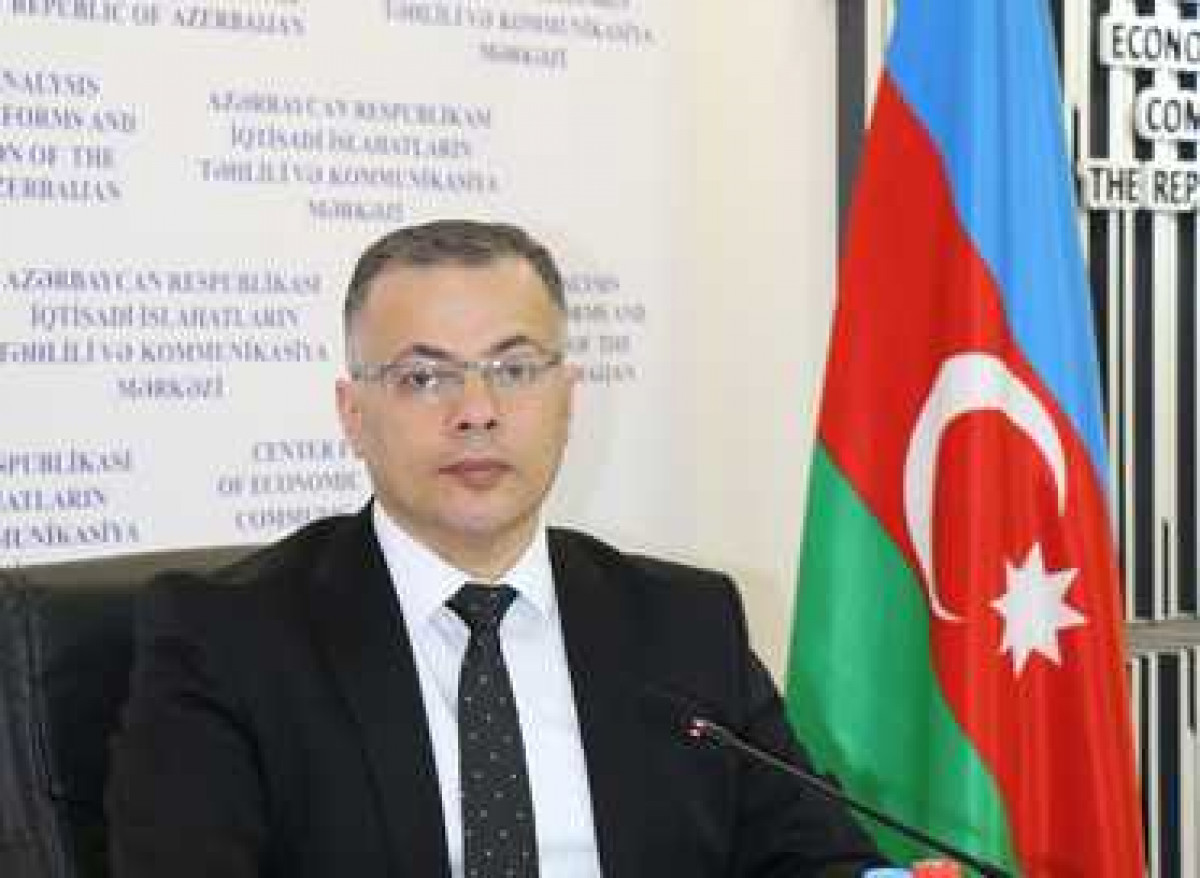
Vusal Gasimli: Support Will Be Provided to Affected Entrepreneurs, Wage Earners, and Low-Income Groups
A decree has been signed by the President of the Republic of Azerbaijan on a set of measures aimed at mitigating the negative impact of the coronavirus (COVID-19) pandemic and the resulting sharp fluctuations in global energy and stock markets on Azerbaijan’s economy, macroeconomic stability, employment, and business entities.
Commenting on the decree, Vusal Gasimli, Executive Director of the Center for Analysis of Economic Reforms and Communication, stated that the objective of the “support program” is to preserve macroeconomic stability, ensure social welfare, and promote economic development.
“Since the funds are allocated from the state budget, they do not have an emissionary nature and do not lead to an increase in the money supply. Therefore, while easing monetary conditions, they do not exert pressure on the exchange rate of the manat or on prices. The allocated 1 billion manats amount to 1.2 percent of GDP and 3.7 percent of the state budget, giving the program a significant economic impact. In terms of its share in GDP and the state budget, Azerbaijan’s support program is the largest among CIS countries.
Last year, according to projections, 34.1 billion manats, or 53.5 percent, of the revenues of the consolidated financial balance were generated by the resources of enterprises and organizations. Analysis of the consolidated financial balance shows that 86 percent of enterprise resources consist of profits, while 14 percent are depreciation allowances. The support program must primarily ensure the sustainability of enterprises so that businesses can survive. Saving businesses is less costly than addressing the socio-economic consequences arising from their bankruptcy. The implementation of the support program will also contribute to reducing the shadow economy, as businesses seeking state support will need to formalize their financial statements. In particular, support should be broader for businesses that provide employment on a larger scale.
Sectors that ensure 14.5 percent of employment, such as trade and repair of motor vehicles, 4.2 percent in transport and warehousing, 1.6 percent in accommodation and food services, and 1.6 percent in recreation, entertainment, and arts activities, will be at the core of the support program. In all cases, expanding the coverage of projects such as paid public works, self-employment, and targeted social assistance remains on the agenda. Analysis of the ‘product and services account’ shows that subsidies to products and imports, which amounted to 203.7 million manats last year, can be further increased this year to support priority sectors.
Under the impact of global shocks, problems related to non-payments and debt emerge at both household and enterprise levels. The support program envisages assistance to affected sectors, entrepreneurs, wage earners, and low-income citizens.
The Azerbaijani state is combating the coronavirus crisis solely through its own resources, without relying on any external assistance, while international institutions, including the International Monetary Fund and the World Bank, have begun providing support to countries in need in response to the pandemic. Azerbaijan has also demonstrated its global social responsibility by making a voluntary financial contribution of 5 million US dollars to the World Health Organization’s COVID-19 Response Fund.”
Related news

A representative of the CAERC participated in a conference dedicated to the future…
Rashad Najafli, Deputy Director of the Economic Analysis Department of the Center for Analysis of Economic Reforms and Communication (CAERC), participated in the international conference on “New Challenges in Maintaining Financial…

New Opportunities in Technology Parks: Commercialization and Export of Innovations
The Decree of the President of the Republic of Azerbaijan dated October 22, 2026 on Amendments to the “Model Regulation on Technology Parks” provides for important innovations in terms of improving the activities of technoparks,…

Vusal Gasimli spoke at the opening of the Islamic Finance Forum
Vusal Gasimli, Executive Director of the Center for Analysis of Economic Reforms and Communication (CAERC) — a Doctor of Economic Sciences and Professor — delivered a speech at the opening ceremony of the "3rd Islamic…

CAERC expands cooperation with think tanks and universities in Uzbekistan
Ilyas Huseynov, Head of the Turkic World Research Center (TWRC) at the Center for Analysis of Economic Reforms and Communication (CAERC), held meetings with representatives from think tanks and higher education institutions, and delivered…

Meetings regarding preparations for the final monitoring and evaluation of the Socio-Economic…
The Center for Analysis of Economic Reforms and Communication (CAERC) has concluded a series of meetings with representatives from relevant government agencies. These meetings were held to refine outcome indicators for the year 2026—within…

The investment portfolio of “Enterprise Azerbaijan”’s partners exceeds 3 billion…
The global innovation program “Startup School 4: Five Continents – 500 Startups,” implemented by the “Enterprise Azerbaijan” portal of the Center for Analysis of Economic Reforms and Communication (CAERC),…

The establishment of the Karabakh National Park creates new opportunities for ecological…
The Order of the President of the Republic of Azerbaijan, Ilham Aliyev, dated October 20, 2026, "On the Establishment of the Karabakh National Park of the Republic of Azerbaijan," is regarded as a significant step toward…

World Bank: Azerbaijan’s strong financial buffers support economic stability and…
The "Europe and Central Asia Economic Update" and the "Macro-Poverty Outlook" for Azerbaijan, published by the World Bank in October 2026, indicate that the country has maintained its macroeconomic stability, strong…
Op-eds
Ilkin Gasimov
Chief advisor of the Economic analysis division
New Financial Model for Resource Allocation in General Education
Baghish Ahmadov
Advisor to the Executive director of the Center for Analysis of Economic Reforms and Communication
Azerbaijan International Investment Forum: Investment Cooperation and National Development Priorities
Abdulrahim Dadashov
Deputy head of the Monitoring and evaluation division
Environmental Responsibility is One of the Key Conditions in the Development of the Mining Industry
Latif Zeynalli
Head of State Programs Division
Development of Competition Will Create New Opportunities for Sustainable Economic Growth
Orkhan Sadigov
Head of the Monitoring and evaluation division
A New Approach to Managing Off-Budget Funds Will Strengthen Financial Discipline
Elshan Yusifli
Head of the Monitoring of sectoral programs sector
New Changes to Nakhchivan’s State Programme: Export, Logistics and Social Mechanisms Improved
Abdulrahim Dadashov
Deputy head of the Monitoring and evaluation division
New Law Strengthens the Sustainable Development and Digital Monitoring of the Fisheries Sector