
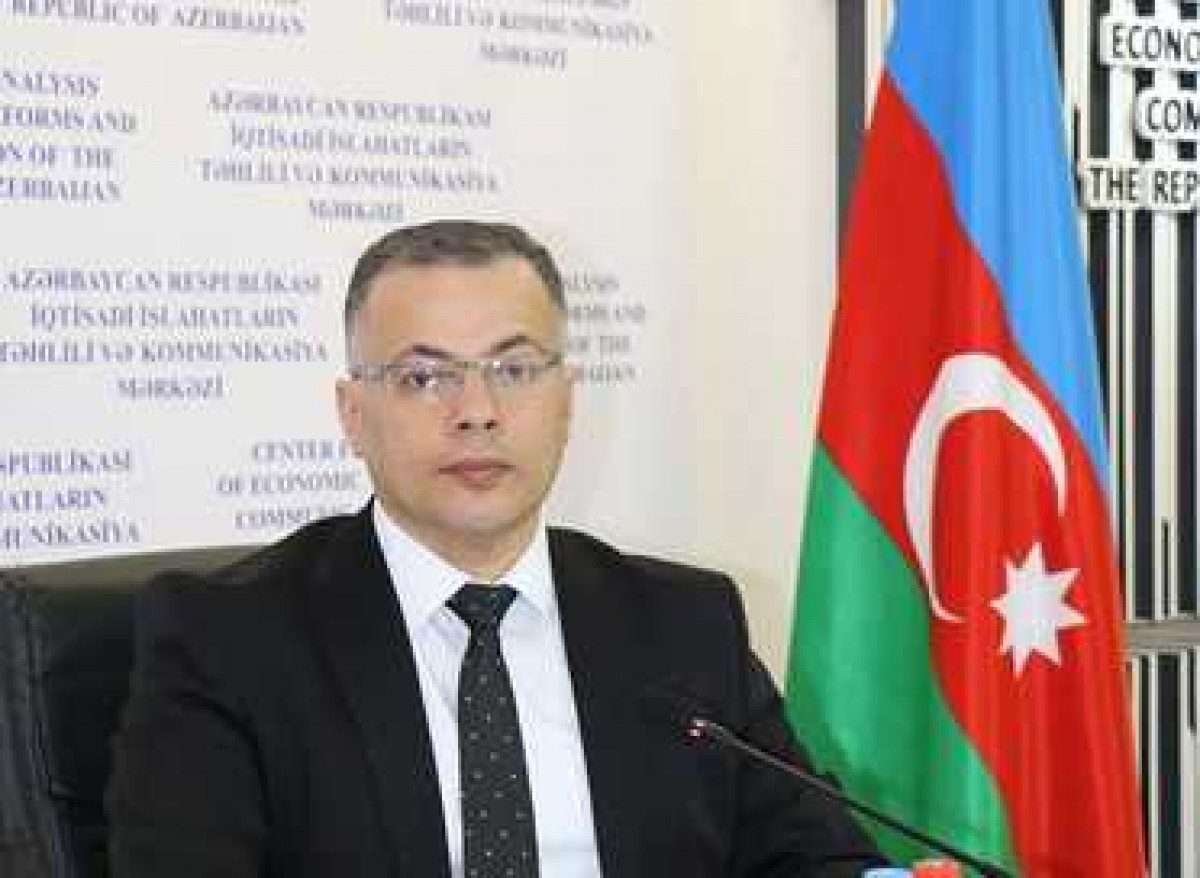
Vusal Gasimli: There Will Be Two Phases in Combating the Economic Impact of the Pandemic
According to the forecast of the International Monetary Fund (IMF), while the global economy is expected to contract by 3 percent in 2020 as a result of the pandemic, and the economies of oil-exporting countries in the Middle East and Central Asia are projected to shrink by 3.9 percent, Azerbaijan’s economy is expected to decline by only 2.2 percent. Providing this information, Vusal Gasimli, Executive Director of the Center for Analysis of Economic Reforms and Communication (CAERC), stated that among the 11 oil and gas exporting countries of the Middle East and Central Asia, Azerbaijan ranks among the top three least affected by the pandemic.
“Azerbaijan is also reducing oil production within the framework of OPEC+ and is suffering losses from low oil prices. However, thanks to the rapid growth of the non-oil industry under the leadership of President Ilham Aliyev and the government’s effective anti-crisis measures, the economic downturn in our country is being prevented more efficiently. It is enough to note that among post-Soviet countries, Azerbaijan is one of those with the smallest difference between the IMF’s economic growth forecasts before and after the pandemic, meaning that the pandemic has had a relatively smaller impact on our economic growth compared to others. This is because Azerbaijan’s pandemic response budget amounts to approximately 3.5 billion manats, timely anti-crisis measures have been identified, and more than 3 billion manats have been injected into the foreign exchange market to ensure the stability of the manat. Uniquely in the post-Soviet space, the Azerbaijani government assumed the main risks by ensuring the stability of the national currency and preserved macroeconomic stability. By the way, due to the impact of the pandemic, the currencies of all oil-exporting countries with fully floating exchange rate regimes have depreciated,” he said.
Vusal Gasimli noted that there will be two phases in combating the economic impact of the pandemic: “At present, the deepening of the crisis is being prevented and stability is being maintained. In the second phase, economic recovery will begin. For economic recovery, affordable financing, a lighter tax burden, and access to markets that generate demand will be more important.”
Speaking about the impact on sovereign wealth funds worldwide, Vusal Gasimli emphasized that there are three main channels of influence: low oil prices reduce the revenues of sovereign funds, a 20–25 percent decline in securities markets devalues assets, and expenditures of sovereign funds have increased in the fight against the pandemic. “According to JPMorgan estimates, due to the impact of the global pandemic, sovereign wealth funds worldwide have suffered capital losses of approximately 1 trillion US dollars. It is projected that the assets of sovereign funds in the Gulf region will decrease by 296 billion US dollars by the end of this year. The world’s largest sovereign fund, Norway’s Pension Fund, lost 113 billion US dollars in the first quarter of this year, which is almost three times the size of the assets of the State Oil Fund of Azerbaijan. As a result of global shocks, the negative difference arising from short-term market value volatility related to the revaluation of the assets of the State Oil Fund of Azerbaijan amounted to 2.1 billion manats in the first quarter of this year. Since more than 80 percent of the investment portfolio of the State Oil Fund consists of liquid and fixed-income instruments, it is possible to minimize the impact of global shocks on the fund’s assets. At the same time, the fact that 66 percent of the fund’s investment portfolio is denominated in US dollars, and that the real effective exchange rate of this currency has appreciated by 8.5 percent since the beginning of the year, is significant for asset values. It should also be noted that the real effective exchange rate of the euro, in which 22.8 percent of the State Oil Fund’s assets are held, has appreciated by 3 percent since the beginning of the year.”
Vusal Gasimli also stated that the fact that 37.8 percent of the State Oil Fund’s bond and money market instruments have a maturity of up to one year allows liquidity needs to be met in a short period of time. “In any case, combating the crisis in Azerbaijan through internal resources without resorting to external borrowing or devaluation will have a positive impact on the economic recovery process in the post-pandemic period,” he concluded.
Related news

A representative of the CAERC participated in a conference dedicated to the future…
Rashad Najafli, Deputy Director of the Economic Analysis Department of the Center for Analysis of Economic Reforms and Communication (CAERC), participated in the international conference on “New Challenges in Maintaining Financial…

New Opportunities in Technology Parks: Commercialization and Export of Innovations
The Decree of the President of the Republic of Azerbaijan dated October 22, 2026 on Amendments to the “Model Regulation on Technology Parks” provides for important innovations in terms of improving the activities of technoparks,…

Vusal Gasimli spoke at the opening of the Islamic Finance Forum
Vusal Gasimli, Executive Director of the Center for Analysis of Economic Reforms and Communication (CAERC) — a Doctor of Economic Sciences and Professor — delivered a speech at the opening ceremony of the "3rd Islamic…

CAERC expands cooperation with think tanks and universities in Uzbekistan
Ilyas Huseynov, Head of the Turkic World Research Center (TWRC) at the Center for Analysis of Economic Reforms and Communication (CAERC), held meetings with representatives from think tanks and higher education institutions, and delivered…

Meetings regarding preparations for the final monitoring and evaluation of the Socio-Economic…
The Center for Analysis of Economic Reforms and Communication (CAERC) has concluded a series of meetings with representatives from relevant government agencies. These meetings were held to refine outcome indicators for the year 2026—within…

The investment portfolio of “Enterprise Azerbaijan”’s partners exceeds 3 billion…
The global innovation program “Startup School 4: Five Continents – 500 Startups,” implemented by the “Enterprise Azerbaijan” portal of the Center for Analysis of Economic Reforms and Communication (CAERC),…

The establishment of the Karabakh National Park creates new opportunities for ecological…
The Order of the President of the Republic of Azerbaijan, Ilham Aliyev, dated October 20, 2026, "On the Establishment of the Karabakh National Park of the Republic of Azerbaijan," is regarded as a significant step toward…

World Bank: Azerbaijan’s strong financial buffers support economic stability and…
The "Europe and Central Asia Economic Update" and the "Macro-Poverty Outlook" for Azerbaijan, published by the World Bank in October 2026, indicate that the country has maintained its macroeconomic stability, strong…
Op-eds
Ilkin Gasimov
Chief advisor of the Economic analysis division
New Financial Model for Resource Allocation in General Education
Baghish Ahmadov
Advisor to the Executive director of the Center for Analysis of Economic Reforms and Communication
Azerbaijan International Investment Forum: Investment Cooperation and National Development Priorities
Abdulrahim Dadashov
Deputy head of the Monitoring and evaluation division
Environmental Responsibility is One of the Key Conditions in the Development of the Mining Industry
Latif Zeynalli
Head of State Programs Division
Development of Competition Will Create New Opportunities for Sustainable Economic Growth
Orkhan Sadigov
Head of the Monitoring and evaluation division
A New Approach to Managing Off-Budget Funds Will Strengthen Financial Discipline
Elshan Yusifli
Head of the Monitoring of sectoral programs sector
New Changes to Nakhchivan’s State Programme: Export, Logistics and Social Mechanisms Improved
Abdulrahim Dadashov
Deputy head of the Monitoring and evaluation division
New Law Strengthens the Sustainable Development and Digital Monitoring of the Fisheries Sector