
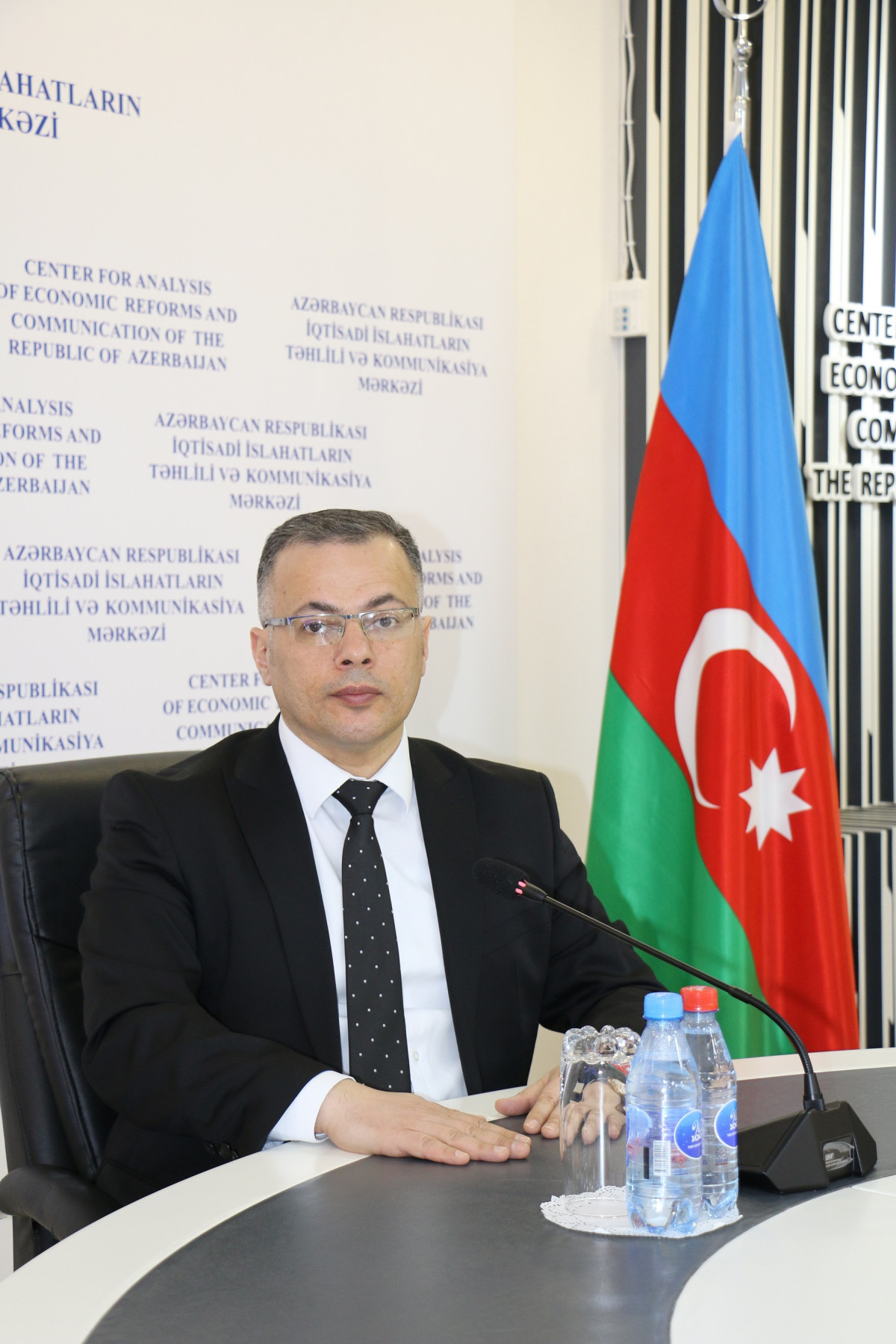
Vusal Qasimli Comments on the Government’s Global Shock Response Plan
Vusal Qasimli, Executive Director of the Center for Analysis and Communication of Economic Reforms (CAERC), provided details on the Azerbaijani government’s actions to mitigate the impact of global shocks on the country.
Following the collapse in oil prices and the global crisis triggered by COVID-19, the government, under the directive of President Ilham Aliyev, identified key policy priorities. These measures fall into two groups: first, preventing the spread of COVID-19, and second, reducing the impact of the global economic crisis on Azerbaijan.
For public health, the Operational Headquarters under the Cabinet of Ministers is working to protect citizens’ health. A dedicated Action Plan has been approved, and intensive cooperation is ongoing with the World Health Organization (WHO) to prevent the spread of the virus and ensure the effective implementation of all recommended preventive measures.
Economic measures focus on regulating supply and demand in the currency market, maintaining the stability of the manat, controlling inflation, and preventing speculative activity in markets. Full deposit insurance will also be resolved in the near term. Currency auctions conducted this week at the Central Bank, with participation from the State Oil Fund, have fully met market demand. Maintaining the manat’s stability is supported by the social reforms implemented in 2019, strengthening their effect.
The government has issued instructions for the full execution of the state budget, optimizing spending, and ensuring effective use of funds. Social programs are under special supervision, including targeted social assistance, public works, self-employment, rental housing, compulsory health insurance, and social mortgage initiatives. Social spending in the state budget this year is projected at 10.4 billion AZN, an increase of 2.6 billion AZN or 33.5% compared to last year.
Following the President’s guidance, the private sector is expected to actively maintain existing jobs and create new ones. Measures to expand support for small and medium-sized enterprises and increase investment in the country are aimed at ensuring sustainable economic growth. In the first two months of this year, capital expenditures increased by 12.7%, and the government aims to maintain this pace.
The government’s plan also includes support for sectors most affected by the global crisis, especially tourism, which is the largest non-oil revenue-generating sector. Stability will also be ensured for systemically important economic enterprises. Forecast scenarios for oil price effects on the balance of payments have been prepared, with measures in place to maintain overall balance.
Finally, cooperation with the private sector, civil society, and international organizations is planned to enhance the effectiveness of the government’s anti-crisis measures.
Related news

A representative of the CAERC participated in a conference dedicated to the future…
Rashad Najafli, Deputy Director of the Economic Analysis Department of the Center for Analysis of Economic Reforms and Communication (CAERC), participated in the international conference on “New Challenges in Maintaining Financial…

New Opportunities in Technology Parks: Commercialization and Export of Innovations
The Decree of the President of the Republic of Azerbaijan dated October 22, 2026 on Amendments to the “Model Regulation on Technology Parks” provides for important innovations in terms of improving the activities of technoparks,…

Vusal Gasimli spoke at the opening of the Islamic Finance Forum
Vusal Gasimli, Executive Director of the Center for Analysis of Economic Reforms and Communication (CAERC) — a Doctor of Economic Sciences and Professor — delivered a speech at the opening ceremony of the "3rd Islamic…

CAERC expands cooperation with think tanks and universities in Uzbekistan
Ilyas Huseynov, Head of the Turkic World Research Center (TWRC) at the Center for Analysis of Economic Reforms and Communication (CAERC), held meetings with representatives from think tanks and higher education institutions, and delivered…

Meetings regarding preparations for the final monitoring and evaluation of the Socio-Economic…
The Center for Analysis of Economic Reforms and Communication (CAERC) has concluded a series of meetings with representatives from relevant government agencies. These meetings were held to refine outcome indicators for the year 2026—within…

The investment portfolio of “Enterprise Azerbaijan”’s partners exceeds 3 billion…
The global innovation program “Startup School 4: Five Continents – 500 Startups,” implemented by the “Enterprise Azerbaijan” portal of the Center for Analysis of Economic Reforms and Communication (CAERC),…

The establishment of the Karabakh National Park creates new opportunities for ecological…
The Order of the President of the Republic of Azerbaijan, Ilham Aliyev, dated October 20, 2026, "On the Establishment of the Karabakh National Park of the Republic of Azerbaijan," is regarded as a significant step toward…

World Bank: Azerbaijan’s strong financial buffers support economic stability and…
The "Europe and Central Asia Economic Update" and the "Macro-Poverty Outlook" for Azerbaijan, published by the World Bank in October 2026, indicate that the country has maintained its macroeconomic stability, strong…
Op-eds
Ilkin Gasimov
Chief advisor of the Economic analysis division
New Financial Model for Resource Allocation in General Education
Baghish Ahmadov
Advisor to the Executive director of the Center for Analysis of Economic Reforms and Communication
Azerbaijan International Investment Forum: Investment Cooperation and National Development Priorities
Abdulrahim Dadashov
Deputy head of the Monitoring and evaluation division
Environmental Responsibility is One of the Key Conditions in the Development of the Mining Industry
Latif Zeynalli
Head of State Programs Division
Development of Competition Will Create New Opportunities for Sustainable Economic Growth
Orkhan Sadigov
Head of the Monitoring and evaluation division
A New Approach to Managing Off-Budget Funds Will Strengthen Financial Discipline
Elshan Yusifli
Head of the Monitoring of sectoral programs sector
New Changes to Nakhchivan’s State Programme: Export, Logistics and Social Mechanisms Improved
Abdulrahim Dadashov
Deputy head of the Monitoring and evaluation division
New Law Strengthens the Sustainable Development and Digital Monitoring of the Fisheries Sector