
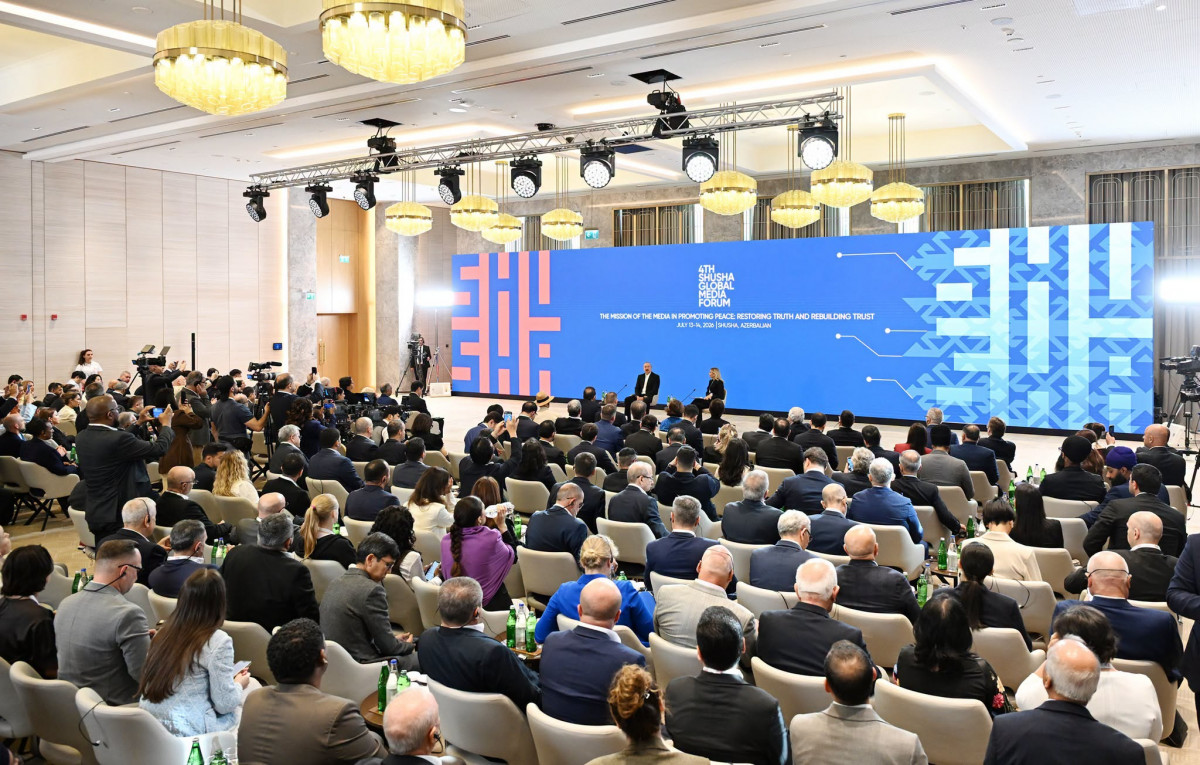
IV Shusha Global Media Forum: A New Stage in the Institutional Development of Strategic Communication
The 4th Shusha Global Media Forum once again demonstrates that strategic communication has become an integral component of state governance in the modern global information environment.
In a comment to AZERTAC, Zanura Talibova, Head of the Public Relations division at the Center for Analysis of Economic Reforms and Communication (CAERC), stated that while in previous periods geopolitical advantage was mainly determined by military, economic, and demographic indicators, in the modern era, information management, strategic communication, and institutional trust have become fundamental factors shaping the international standing of states. According to her, from this perspective, the 4th Shusha Global Media Forum should be evaluated not merely as an international event dedicated to the media sector, but as an institutional platform demonstrating the communication potential of states and forming new cooperation mechanisms under global information governance.
Zanura Talibova noted that in modern political communication theory, a state's international legitimacy is measured not only by the substance of its decisions, but also by how those decisions are justified to various audiences, through which communication channels they are presented, and how public trust is managed.
“In this regard, the Shusha Global Media Forum differs from the classic conference model by creating a multilateral communication environment among the state, international media, expert community, and analytical centers. Such platforms transform the explanation of political decisions from a one-way information transmission model into a mutual dialogue and institutional interaction model, which is considered one of the core features of modern governance concepts.
Another important feature of the Forum relates to the opportunities it creates in terms of institutionalizing states' soft power resources. In international relations theory, soft power is not limited to cultural and humanitarian potential; it also encompasses states' ability to establish open communication with the international community, create a transparent dialogue environment, and bring diverse stakeholders together on a single discussion platform. In this context, the Shusha Global Media Forum becomes a functional element of communication diplomacy, serving as an institutional tool that aids in establishing sustainable ties with international media institutions, expanding professional networks, and developing multilateral cooperation mechanisms,” she stated.
The CAERC Department Head emphasized that the deepening crisis of trust in the global information ecosystem places new demands on the content of strategic communication: “The algorithmic structure of digital platforms, the rapid development of artificial intelligence technologies, and the intensity of information flows necessitate that states build their communication policies not only on speed, but also on the principles of reliability, accountability, and institutional sustainability. In this regard, the Shusha Global Media Forum plays the role of an important epistemic platform for organizing professional dialogue and strengthening mutual understanding among various actors against the backdrop of new challenges in global information governance. The primary value of the Forum lies not only in discussing specific topics, but also in contributing to the development of shared communication standards and an environment of mutual trust among media entities from different countries.
Ultimately, the 4th Shusha Global Media Forum can be characterized as a significant global platform reflecting the institutional development of strategic communication in modern international relations. Its importance is not limited to the geography of the event or the number of participants. The Forum demonstrates in practical terms the transformation of communication policy in state governance, new formats of international dialogue, and mechanisms for building institutional trust. These features provide a solid foundation to characterize the Shusha Global Media Forum not merely as a venue for exchanging ideas in the global communication architecture, but also as an analytical platform contributing to the development of international cooperation, strategic communication, and institutional resilience.”
Related news

Vusal Gasimli spoke at the opening of the Islamic Finance Forum
Vusal Gasimli, Executive Director of the Center for Analysis of Economic Reforms and Communication (CAERC) — a Doctor of Economic Sciences and Professor — delivered a speech at the opening ceremony of the "3rd Islamic…

CAERC expands cooperation with think tanks and universities in Uzbekistan
Ilyas Huseynov, Head of the Turkic World Research Center (TWRC) at the Center for Analysis of Economic Reforms and Communication (CAERC), held meetings with representatives from think tanks and higher education institutions, and delivered…

Meetings regarding preparations for the final monitoring and evaluation of the Socio-Economic…
İqtisadi İslahatların Təhlili və Kommunikasiya Mərkəzində (İİTKM) “Azərbaycan Respublikasının 2022–2026-cı illərdə sosial-iqtisadi inkişaf Strategiyası” çərçivəsində 2026-cı ilin yekunları üzrə…

The investment portfolio of “Enterprise Azerbaijan”’s partners exceeds 3 billion…
The global innovation program “Startup School 4: Five Continents – 500 Startups,” implemented by the “Enterprise Azerbaijan” portal of the Center for Analysis of Economic Reforms and Communication (CAERC),…

The establishment of the Karabakh National Park creates new opportunities for ecological…
The Order of the President of the Republic of Azerbaijan, Ilham Aliyev, dated October 20, 2026, "On the Establishment of the Karabakh National Park of the Republic of Azerbaijan," is regarded as a significant step toward…

World Bank: Azerbaijan’s strong financial buffers support economic stability and…
The "Europe and Central Asia Economic Update" and the "Macro-Poverty Outlook" for Azerbaijan, published by the World Bank in October 2026, indicate that the country has maintained its macroeconomic stability, strong…

The new healthcare management model aims to improve the quality and accessibility…
The Decree “On a Number of Measures Related to the Improvement of Management in the Healthcare Sector,” signed by President of the Republic of Azerbaijan Ilham Aliyev on 19 October 2026, represents the next stage of reforms…

An event dedicated to the Day of Restoration of Independence - October 18, was held…
An educational meeting titled “Azerbaijan’s State Independence Is Eternal, Primordial and Irreversible” was held at the Center for Analysis of Economic Reforms and Communication on the initiative of Reform Volunteers…
Op-eds
Ilkin Gasimov
Chief advisor of the Economic analysis division
New Financial Model for Resource Allocation in General Education
Baghish Ahmadov
Advisor to the Executive director of the Center for Analysis of Economic Reforms and Communication
Azerbaijan International Investment Forum: Investment Cooperation and National Development Priorities
Abdulrahim Dadashov
Deputy head of the Monitoring and evaluation division
Environmental Responsibility is One of the Key Conditions in the Development of the Mining Industry
Latif Zeynalli
Head of State Programs Division
Development of Competition Will Create New Opportunities for Sustainable Economic Growth
Orkhan Sadigov
Head of the Monitoring and evaluation division
A New Approach to Managing Off-Budget Funds Will Strengthen Financial Discipline
Elshan Yusifli
Head of the Monitoring of sectoral programs sector
New Changes to Nakhchivan’s State Programme: Export, Logistics and Social Mechanisms Improved
Abdulrahim Dadashov
Deputy head of the Monitoring and evaluation division
New Law Strengthens the Sustainable Development and Digital Monitoring of the Fisheries Sector