
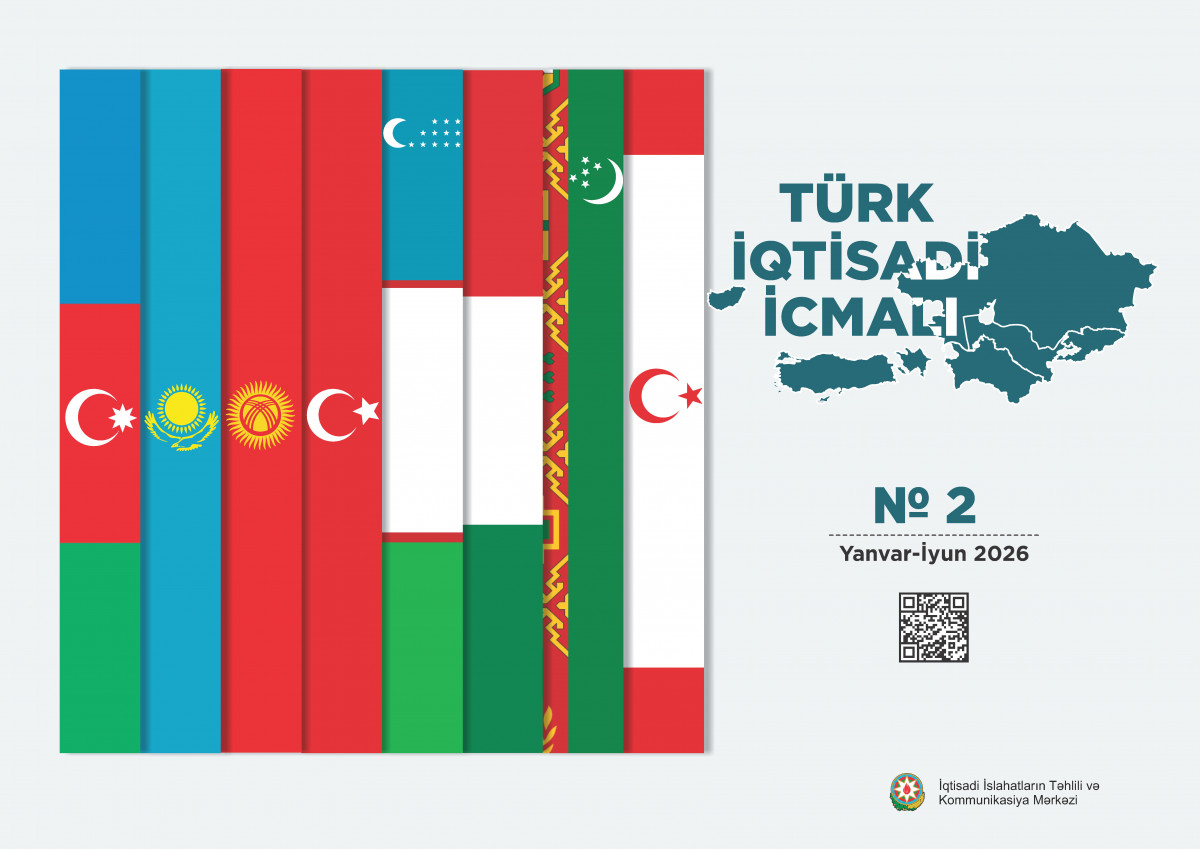
The “Turkish Economic Review” issue covering the first half of 2026 has been published
The "Turkish Economic Review" for the first half of 2026 (January-June No. 2) published by the Center for Analysis of Economic Reforms and Communication (CERACC) in cooperation with the Secretariat of the Organization of Turkic States (OTS) in 8 languages has been published.
The review, prepared by the Center for Turkic World Studies of the CERACC, presents an analysis of the economic indicators of the member countries of the Organization of Turkic States (OTS) - Azerbaijan, Kazakhstan, Kyrgyzstan, Turkey and Uzbekistan, as well as the observer members Hungary, Turkmenistan and the Turkish Republic of Northern Cyprus (TRNC) - for the first half of 2026. The review assesses the potential of the OTS members and their impact on the global economy based on the latest economic development indicators.
In the first half of 2026, the Turkic states had a 2.11% share in the global economy with a GDP of 1.33 trillion USD, and their population of 178.8 million constituted 2.8% of the global population. These indicators indicate that the Turkic states occupy an important place both economically and demographically.
During the reporting period, the Turkic states demonstrated faster development with a GDP growth of 5.86% compared to the global growth rate of 1.51% (quarterly cumulative). Kyrgyzstan, Uzbekistan and Turkmenistan demonstrated growth rates of 11.9%, 8.5% and 6.3%, respectively, ensuring sustainable development in the industrial and agricultural sectors. Economic growth in the TRNC was 6.0%, and in Kazakhstan 4.1%. Turkey, having the largest economy in the organization, achieved economic growth of 2.5%. The GDP growth rate in Azerbaijan was 0.8%.
Trade is important for both global integration and economic integration among TCT countries. In the first half of 2026, the total trade turnover of TCT member states was approximately 679.7 billion USD, which is approximately 3.58% of the estimated global trade turnover of 18.96 trillion USD.
Turkey leads the way with the highest trade turnover, with 325,036 million USD. Hungary, Kazakhstan, Uzbekistan and Azerbaijan traded 187,905 million USD, 71,791.8 million USD, 41,011.2 million USD and 26,054.2 million USD, respectively.
Kyrgyzstan, TRNC, Uzbekistan, Kazakhstan, Turkey, Turkmenistan and Azerbaijan have seen sustained export growth in the agricultural and industrial sectors. These figures show the diversity of trade dynamics in the region and the strong export performance of the Turkic states.
In the industrial sector, Kyrgyzstan and Uzbekistan led the way with growth of 12.7% and 8%, respectively. Meanwhile, the industrial sectors of TRNC and Kazakhstan grew by 6.7% and 3.3%. This growth was influenced by large-scale manufacturing and infrastructure projects. The industrial sectors in Turkmenistan and Hungary grew by 2.7% and 2.1%.
On the other hand, in the agricultural sector, Turkey showed the strongest growth with 10%. Agriculture grew by 6.2% in TRNC, 4.7% in Uzbekistan, 4.4% in Kazakhstan, 4.3% in Kyrgyzstan, 2.2% in Azerbaijan, and 2.0% in Turkmenistan.
Investment in fixed capital is crucial for long-term growth. In the first half of 2026, Kyrgyzstan and TRNC recorded a 64.3% and 43.77% increase in fixed capital investment, respectively, supported by large investments in infrastructure, energy and manufacturing. Uzbekistan, Azerbaijan, Kazakhstan and Hungary recorded healthy growth in fixed capital investment of 17.5%, 13.8%, 9.6% and 7.4%, respectively, increasing their foreign direct investment and achieving positive developments in their business environments.
The banking sector in the Turkic countries also showed significant growth. During the reporting period, the total assets of the banking sector in Kyrgyzstan increased by 55.9%, in TRNC by 38.81%, in Turkey by 32.9%, in Uzbekistan by 25.7%, in Kazakhstan by 14.4% and in Hungary by 10.2%. These indicators are based on the strengthening of financial services that support economic development and investment. Azerbaijan's banking sector showed a more moderate (7.4%) growth.
The performance of the state budget is another important indicator of economic health. Uzbekistan recorded the highest growth in state budget revenues, with 43.7% and state budget expenditures, with 51.5%, Kyrgyzstan recorded the highest growth in state budget revenues, with 48.8% and state budget expenditures, with 41.3%. The TRNC recorded a high growth in state budget revenues, with 40.75% and 34.66%, respectively. Turkey recorded a high growth in state budget revenues, with 39.4% and 31.8%, respectively. Kazakhstan and Hungary demonstrated effective financial management, showing stable growth in both revenues and expenditures.
The Turkic states outperformed global growth in terms of GDP growth and trade turnover, and achieved significant investments.
The “Turkic Economic Review” is traditionally presented in a total of 8 languages: the languages of the OTS member and observer states, as well as English. You can access the publications in these languages via the links below:
In Azerbaijani: Türk İqtisadi İcmalı: yanvar-iyun 2026
In English language: Turkic Economic Outlook: January - June 2026
In Russin language: Тюркский Экономический Обзор: январь-июнь 2026
In Turkish language: Türk Cumhuriyetleri Ekonomik Görünümü: Ocak-Temmuz 2026
In Hungarian labguage: Türk Gazdasági Helyzetkép: január-június 2026
in the Uzbek language: Turkiy Davlatlarning Iqtisodiy Ko'rishi: 2026 yil yanvar-Iyun
in the Kazakh language: Түркі Mемлекеттерінің Экономикалық Көзқарасы: Қаңтар - Маусым 2026
in the Kyrgyz language: Түрк өлкөлөрүнүн экономикалык болжолдоосу: 2026-жылдын январь-июнь
Related news

Meeting Held with Representatives of "The Coca-Cola Company" at CAERC
A meeting was held at the Center for Analysis of Economic Reforms and Communication (CAERC) with a delegation from "The Coca-Cola Company." During the meeting, Vusal Gasimli, Executive Director of CAERC, briefed the delegation…

CAERC Will Create a New Module for Monitoring the State Program on the Mining and…
Prime Minister of the Republic of Azerbaijan Ali Asadov has signed an Order on ensuring the implementation of Order No. 1226 of the President of the Republic of Azerbaijan dated September 23, 2026, "On approving the 'State…

New Pharmaceutical Manufacturing Facility Opens New Opportunities for the Development…
The participation of President of the Republic of Azerbaijan Ilham Aliyev in the inauguration of the pharmaceutical manufacturing facility of "Gen Pharma Caucasus Manufacturing Operations" LLC in the Pirallahi Industrial…

CAERC Honored with Two Awards at the "International Finance Awards 2026"
The Center for Analysis of Economic Reforms and Communication (CAERC) has been honored with awards in two categories at the "International Finance Awards 2026," organized by the UK-based international media publication International…

Increasing Wages and Social Payments May Positively Impact Economic Activity
The statement by President Ilham Aliyev at the 8th Congress of the New Azerbaijan Party announcing that the minimum wage, pensions, and social allowances will be increased next year demonstrates that the social policy aimed at boosting…

Energy Security: Azerbaijan's Growing Role and New Opportunities
During his speech at the 8th Congress of the New Azerbaijan Party, President Ilham Aliyev emphasized Azerbaijan's expanding role in energy security, stating: "...rich in energy resources, Azerbaijan is turning into a very…

The Great Return at a New Stage: Sustainable Settlement and Economic Development
The restoration of the liberated territories and the return of former internally displaced persons (IDPs) to their native homelands are evaluated as an integral part of long-term socio-economic development. Under these circumstances,…

The final “Demo Day” of the “Startup School 4” programme of the Enterprise Azerbaijan…
The “Demo Day” event, the final stage of the “Startup School 4: Five Continents – 500 Startups” global innovation programme of the Enterprise Azerbaijan portal of the Center for Analysis of Economic…
Op-eds
Ilkin Gasimov
Chief advisor of the Economic analysis division
New Financial Model for Resource Allocation in General Education
Baghish Ahmadov
Advisor to the Executive director of the Center for Analysis of Economic Reforms and Communication
Azerbaijan International Investment Forum: Investment Cooperation and National Development Priorities
Abdulrahim Dadashov
Deputy head of the Monitoring and evaluation division
Environmental Responsibility is One of the Key Conditions in the Development of the Mining Industry
Latif Zeynalli
Head of State Programs Division
Development of Competition Will Create New Opportunities for Sustainable Economic Growth
Orkhan Sadigov
Head of the Monitoring and evaluation division
A New Approach to Managing Off-Budget Funds Will Strengthen Financial Discipline
Elshan Yusifli
Head of the Monitoring of sectoral programs sector
New Changes to Nakhchivan’s State Programme: Export, Logistics and Social Mechanisms Improved
Abdulrahim Dadashov
Deputy head of the Monitoring and evaluation division
New Law Strengthens the Sustainable Development and Digital Monitoring of the Fisheries Sector