
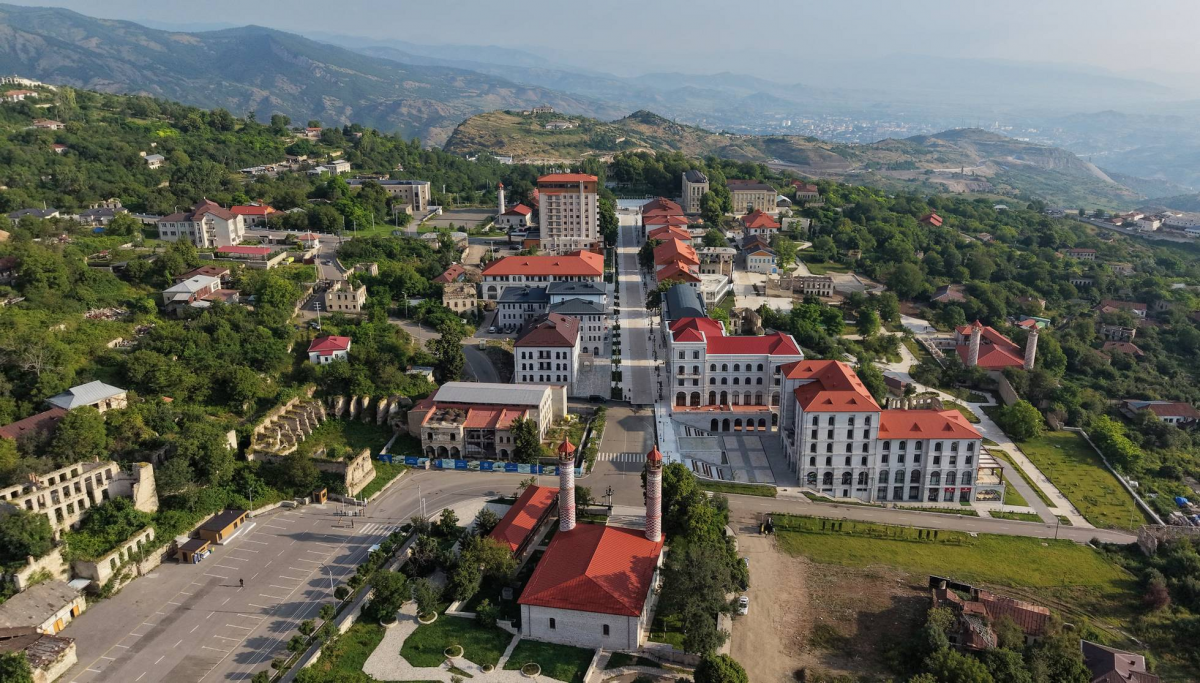
The Great Return at a New Stage: Sustainable Settlement and Economic Development
The restoration of the liberated territories and the return of former internally displaced persons (IDPs) to their native homelands are evaluated as an integral part of long-term socio-economic development. Under these circumstances, state success is determined not only by infrastructural reconstruction, but also by the sustainable settlement of the returning population, provision of employment, and reintegration of the region into the national economy. These precise criteria distinguish the First State Program on the Great Return as a distinct model of post-conflict recovery in international practice.
During his address at the 8th Congress of the New Azerbaijan Party, President Ilham Aliyev stated that 96,000 people currently live, work, and study in Karabakh and Eastern Zangezur. To date, 28 billion manats have been allocated toward the development of these regions, and former IDPs have already settled across 48 residential areas.
Commenting on the subject, Tarana Salifova, Deputy Executive Director of the Center for Analysis of Economic Reforms and Communication (CAERC), stated that the Great Return has transitioned from the construction phase into a stage of sustainable settlement and the revitalization of economic life. While this process primarily entails the physical return of displaced persons to their native lands, it can simultaneously be regarded as the formation of long-term socio-economic development, institutional governance, and a sustainable settlement model. The Great Return is executed in a planned and phased manner under the State Program, where demining in the initial phase, followed by the establishment of the road and transport network and the restoration of energy, water, and telecommunication lines, were defined as fundamental prerequisites for return.
In the subsequent phase, one of the central priorities is expanding the geographical scope of the return and reinforcing the socio-economic welfare of the returning population. Resettlement has been carried out for: 118 families (365 individuals) to the city of Aghdam; 2 families (10 individuals) to the village of Sarijali; 4 families (11 individuals) to the village of Chapar in the Aghdara district; 4 families (9 individuals) to the village of Ashaghi Oratagh; 5 families (18 individuals) to the village of Vangli; 1 family (4 individuals) to the city of Jabrayil; 58 families (362 individuals) to the village of Shukurbayli; 3 families (13 individuals) to the city of Khankendi; 5 families (22 individuals) to the settlement of Karkijahan; 17 families (78 individuals) to the city of Khojaly; 1 family (4 individuals) to the village of Ballija; 3 families (15 individuals) to the village of Khanabad; 5 families (22 individuals) to the village of Khanyurdu; 7 families (31 individuals) to the village of Tazabina; 49 families (190 individuals) to the city of Khojavend; 9 families (44 individuals) to the settlement of Girmizi Bazar; 8 families (41 individuals) to the village of Quzeykhirman; 1 family (4 individuals) to the village of Guneykhirman; 1 family (4 individuals) to the village of Khojavendkand; and 1 family (4 individuals) to the city of Lachin. In total, the resettlement of 302 families comprising 1,251 individuals was executed during September 2026.
Tarana Salifova emphasized that the process is currently regarded as comprehensive socio-economic rehabilitation. The employment, social protection, and access to education and healthcare services of the returning population are among top state priorities. The returning population builds a dignified life by being provided with employment in their native lands. Tangible results of this approach are visible across the industrial landscape as well. Production hubs such as the Aghdam Industrial Park and the Araz Valley Economic Zone, smart village and smart city projects, and investment and tax incentives expand economic activity in the region. This year, with the participation of President Ilham Aliyev, inauguration ceremonies were held for the work glove manufacturing enterprise of "GP Safety" LLC in Khankendi and "Karabakh Textile House" LLC in Khojaly. Operating in the Asgaran settlement of the Khojaly district, the "AzCement" facility manufactures cement with an annual capacity of 60,000 tons, envisaging employment for 70 individuals.
Within the framework of mining industry development, the "Damirli" Ore Processing Complex commenced operations in the village of Janyatag in the Aghdara district. This marks the first operational mining project in the liberated territories, projecting the export of 85,000 tons of copper metal. Permanent employment has been provided to 980 people at the complex, 260 of whom are former IDPs and returning residents, with the workforce slated to expand to 1,250 in subsequent years.
As the Head of State underscored, the Great Return will proceed at an accelerated pace in the coming years. Return does not conclude solely with homebuilding; its sustainability is secured through employment, social services, and the restoration of economic activity. From an economic perspective, the Great Return signifies the reactivation of regional potential, aiming to elevate social welfare while transforming the region into an active, dynamic contributor to the national economy.
Related news

A representative of the CAERC participated in a conference dedicated to the future…
Rashad Najafli, Deputy Director of the Economic Analysis Department of the Center for Analysis of Economic Reforms and Communication (CAERC), participated in the international conference on “New Challenges in Maintaining Financial…

New Opportunities in Technology Parks: Commercialization and Export of Innovations
The Decree of the President of the Republic of Azerbaijan dated October 22, 2026 on Amendments to the “Model Regulation on Technology Parks” provides for important innovations in terms of improving the activities of technoparks,…

Vusal Gasimli spoke at the opening of the Islamic Finance Forum
Vusal Gasimli, Executive Director of the Center for Analysis of Economic Reforms and Communication (CAERC) — a Doctor of Economic Sciences and Professor — delivered a speech at the opening ceremony of the "3rd Islamic…

CAERC expands cooperation with think tanks and universities in Uzbekistan
Ilyas Huseynov, Head of the Turkic World Research Center (TWRC) at the Center for Analysis of Economic Reforms and Communication (CAERC), held meetings with representatives from think tanks and higher education institutions, and delivered…

Meetings regarding preparations for the final monitoring and evaluation of the Socio-Economic…
The Center for Analysis of Economic Reforms and Communication (CAERC) has concluded a series of meetings with representatives from relevant government agencies. These meetings were held to refine outcome indicators for the year 2026—within…

The investment portfolio of “Enterprise Azerbaijan”’s partners exceeds 3 billion…
The global innovation program “Startup School 4: Five Continents – 500 Startups,” implemented by the “Enterprise Azerbaijan” portal of the Center for Analysis of Economic Reforms and Communication (CAERC),…

The establishment of the Karabakh National Park creates new opportunities for ecological…
The Order of the President of the Republic of Azerbaijan, Ilham Aliyev, dated October 20, 2026, "On the Establishment of the Karabakh National Park of the Republic of Azerbaijan," is regarded as a significant step toward…

World Bank: Azerbaijan’s strong financial buffers support economic stability and…
The "Europe and Central Asia Economic Update" and the "Macro-Poverty Outlook" for Azerbaijan, published by the World Bank in October 2026, indicate that the country has maintained its macroeconomic stability, strong…
Op-eds
Ilkin Gasimov
Chief advisor of the Economic analysis division
New Financial Model for Resource Allocation in General Education
Baghish Ahmadov
Advisor to the Executive director of the Center for Analysis of Economic Reforms and Communication
Azerbaijan International Investment Forum: Investment Cooperation and National Development Priorities
Abdulrahim Dadashov
Deputy head of the Monitoring and evaluation division
Environmental Responsibility is One of the Key Conditions in the Development of the Mining Industry
Latif Zeynalli
Head of State Programs Division
Development of Competition Will Create New Opportunities for Sustainable Economic Growth
Orkhan Sadigov
Head of the Monitoring and evaluation division
A New Approach to Managing Off-Budget Funds Will Strengthen Financial Discipline
Elshan Yusifli
Head of the Monitoring of sectoral programs sector
New Changes to Nakhchivan’s State Programme: Export, Logistics and Social Mechanisms Improved
Abdulrahim Dadashov
Deputy head of the Monitoring and evaluation division
New Law Strengthens the Sustainable Development and Digital Monitoring of the Fisheries Sector