
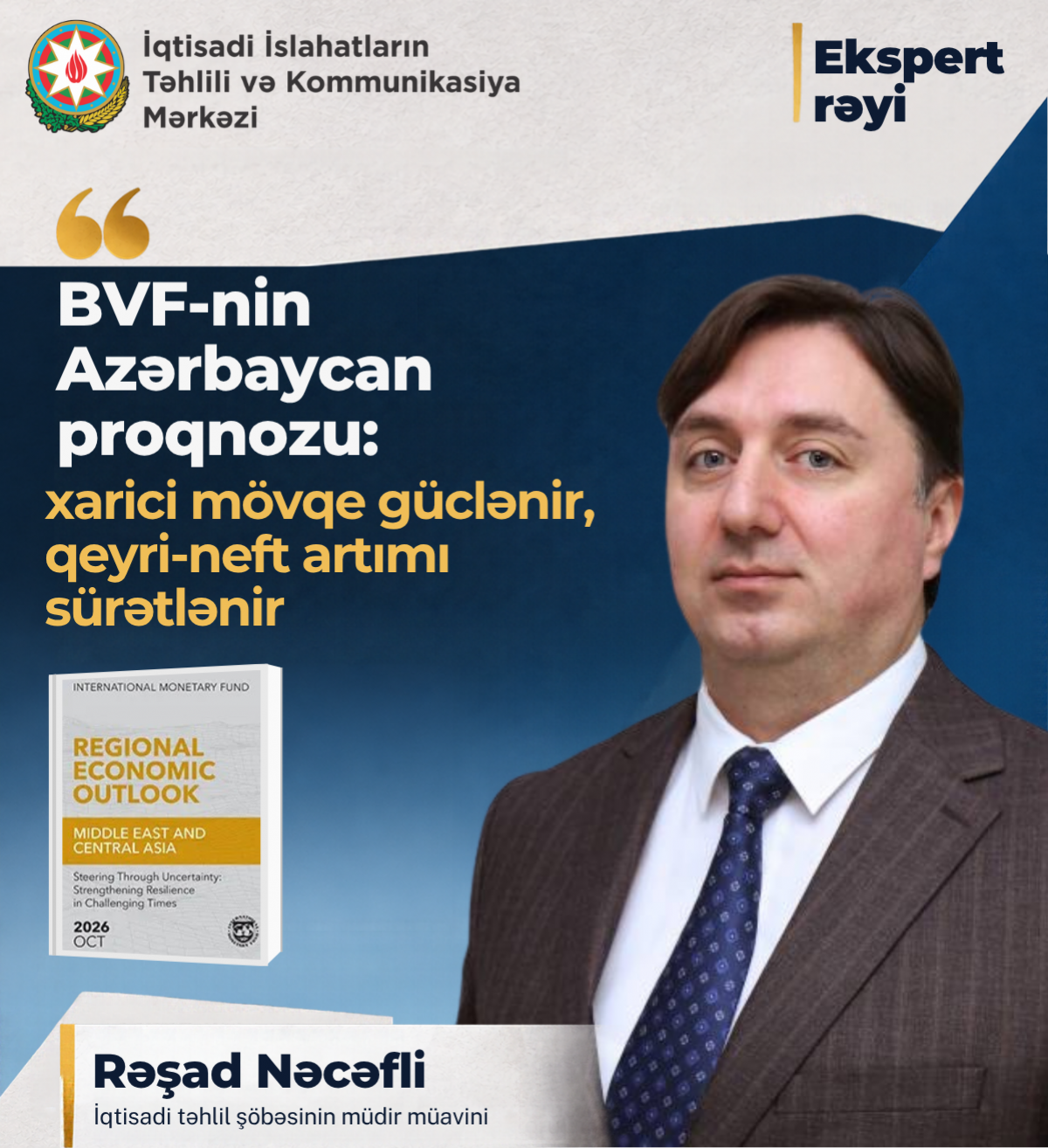
COMMENTARY: IMF’s outlook for Azerbaijan: external position strengthens, non-oil growth accelerates
According to the International Monetary Fund’s October forecast, Azerbaijan’s current account surplus will rise to 11.3% of GDP in 2026, while the ratio of total public debt to GDP will decline to 16.5%. The Fund expects the non-oil sector to grow by 3.3% in 2027. These three indicators capture the report’s key message regarding Azerbaijan’s external financial resilience and economic diversification prospects.
In its report entitled “Regional Economic Outlook: Middle East and Central Asia – Steering Through Uncertainty: Strengthening Resilience in Challenging Times”, the International Monetary Fund (IMF) assessed the economic prospects of 32 countries and territories. Unless otherwise specified, the forecasts are based on statistical data available as of the end of September 2026.
Rashad Najafli, Deputy Head of the Economic Analysis Department at the Center for Analysis of Economic Reforms and Communication (CAERC), stated that a notable finding of the report regarding Azerbaijan is the simultaneous emergence of two trends: although the Fund revised its real economic growth forecast downwards compared to April, it indicates that the country’s external position will improve more rapidly than previously expected in 2026. This difference highlights the importance of assessing the impact of oil prices and production volumes on the economy separately. Higher export prices increase the country’s foreign currency revenues, while declining production volumes may constrain real GDP growth.
The IMF identifies Azerbaijan as one of the oil exporters in the Caucasus and Central Asia whose external position is expected to improve more rapidly in 2026 than projected in the April forecast. The Fund attributes this to higher oil revenues. According to the statistical appendix, Azerbaijan’s current account surplus amounted to 4.6% of GDP in 2025. This figure is projected to rise to 11.3% in 2026 and remain at 9.8% in 2027 amid moderating energy prices.
Positive dynamics are also reflected in official reserves. The IMF expects them to increase from USD 11.5 billion in 2025 to USD 15.4 billion in 2026 and USD 17.7 billion in 2027. The number of months of imports covered by reserves is also projected to rise from 5.9 months in 2025 to 7.7 months in 2026 and 8.6 months in 2027. In other words, under the Fund’s baseline scenario, although the current account surplus narrows in 2027, reserves increase both in value and in their capacity to cover imports.
The IMF’s statistical appendix shows Azerbaijan’s general government fiscal surplus at 2.6% of GDP in 2025. The Fund forecasts that this figure will rise to 3.7% in 2026 and amount to 3.1% in 2027. This calculation includes not only the state budget but also the Nakhchivan Autonomous Republic, the State Oil Fund and the State Social Protection Fund.
The ratio of total public debt to GDP is expected to decline from 20.1% in 2025 to 16.5% in 2026 and 16.4% in 2027. This represents a decrease of 3.7 percentage points compared to 2025. The Fund expects fiscal consolidation in Azerbaijan to continue beyond 2026. A declining debt ratio and the maintenance of a fiscal surplus support the country’s capacity to respond to external shocks.
The Fund forecasts that Azerbaijan’s real GDP growth will increase from 1.4% in 2025 to 1.7% in 2026 and 2.3% in 2027. Growth in the non-oil sector is higher: 2.7% in 2025, 2.8% in 2026 and 3.3% in 2027. Over the same period, real value added in the oil sector is expected to decline, although the contraction is projected to ease from 1.6% in 2025 to 1.5% in 2026 and 0.5% in 2027.
Regarding price dynamics, the IMF expects inflation to moderate in 2027. Average annual inflation is projected to rise from 5.6% in 2025 to 5.8% in 2026, before declining to 5.6% again in 2027. The year-end inflation forecast stands at 6.0% for 2026 and 5.6% for 2027.
The IMF expects real economic growth in the Caucasus and Central Asia to decline from 6.2% in 2025 to 5.2% in 2026 and 5.0% in 2027. The Fund notes that the region has demonstrated a relatively resilient response to external shocks, with economic activity and remittances supporting this resilience. Meanwhile, the baseline scenario for the Middle East, North Africa, Afghanistan and Pakistan group envisages a contraction of 1.3% in 2026, followed by growth of 6.6% in 2027. This recovery depends on the normalisation of security and trade conditions.
Source: https://data.imf.org/en/datasets/IMF.MCD%3AMCDREO
https://www.elibrary.imf.org/display/book/9798229056908/9798229056908.xml
Related news

An employee of the CAERC delivered a presentation on issues related to the indicative…
Sevinj Jabbarova, a leading consultant at the Monitoring and Evaluation Division of the Center for Analysis of Economic Reforms and Communication (CAERC), participated in a meeting held at the Ministry of Health. The meeting focused…

Strategic rapprochement and new cooperation opportunities in Azerbaijan–Vietnam…
Relations between Azerbaijan and Vietnam have entered a new phase in recent years, marked by stronger political dialogue, expanded economic cooperation and the development of humanitarian ties. The adoption of the Joint Declaration…

Indicative planning under the State Programme for Baku’s transport infrastructure…
Discussions are ongoing at the Center for Analysis of Economic Reforms and Communication (CAERC) on clarifying the target values for measures planned for implementation under state programmes in 2027 and their performance indicators.…

The status of implementation of the State Program for the socio-economic development…
The improvement of the business and investment climate in Nakhchivan and the development of its industrial potential were discussed during an online meeting of the Coordination Group for the “State Program on the Socio-Economic…

Ramil Huseyn spoke about the economic dividends of lasting peace in the South Caucasus…
A conference titled “Peace and Security: In the Context of New Geopolitical Realities in the South Caucasus” was held to mark the 80th anniversary of Baku Slavic University (BSU) and the 80th anniversary of the commencement…

The 2027 targets for water resources and water supply were discussed
Online meetings were held under the organisation of the Center for Analysis of Economic Reforms and Communication (CAERC) to conduct indicative planning for 2027 and уточ clarify target values for performance indicators related to…

Azerbaijan will expand new investment opportunities amid global economic changes…
Isa Gasimov, Head of the “Enterprise Azerbaijan” portal, operated by the Center for Analysis of Economic Reforms and Communication (CAERC), commented on the impact of geopolitical and technological changes in the global…

A department head from the CAERC participated in an international training in China
Zanura Talibova, Head of the Public Relations Division at the Center for Analysis of Economic Reforms and Communication, participated in an international training held in the People's Republic of China. Organized by the Ministry…
Op-eds
Aykhan Gadashov
Head of the Azexport portal
Azerbaijan and Great Britain: New Economic and Political Horizons of a Strategic Alliance
Abdulrahim Dadashov
Deputy head of the Monitoring and evaluation division
Reforms in the area of construction permits contribute to improving the quality indicators of the business environment
Ilyas Huseynov
Head of the Turkic World Research Center
Azerbaijan’s Chairmanship of the OTS: Deepening Economic and Trade Cooperation and Strengthening the Regional Economic Power…
Isa Gasimov
Head of the “Enterprise Azerbaijan” portal
New Opportunities in Technology Parks: Commercialization and Export of Innovations
Abdulrahim Dadashov
Deputy head of the Monitoring and evaluation division
The establishment of the Karabakh National Park creates new opportunities for ecological restoration and sustainable tourism…
Sevinj Jabbarova
Leading consultant of the Monitoring and evaluation division
New Pharmaceutical Manufacturing Facility Opens New Opportunities for the Development of Local Pharmaceutical Industry
Tarana Salifova
Advisor to the Executive Director of the CAERC
The Great Return at a New Stage: Sustainable Settlement and Economic Development