
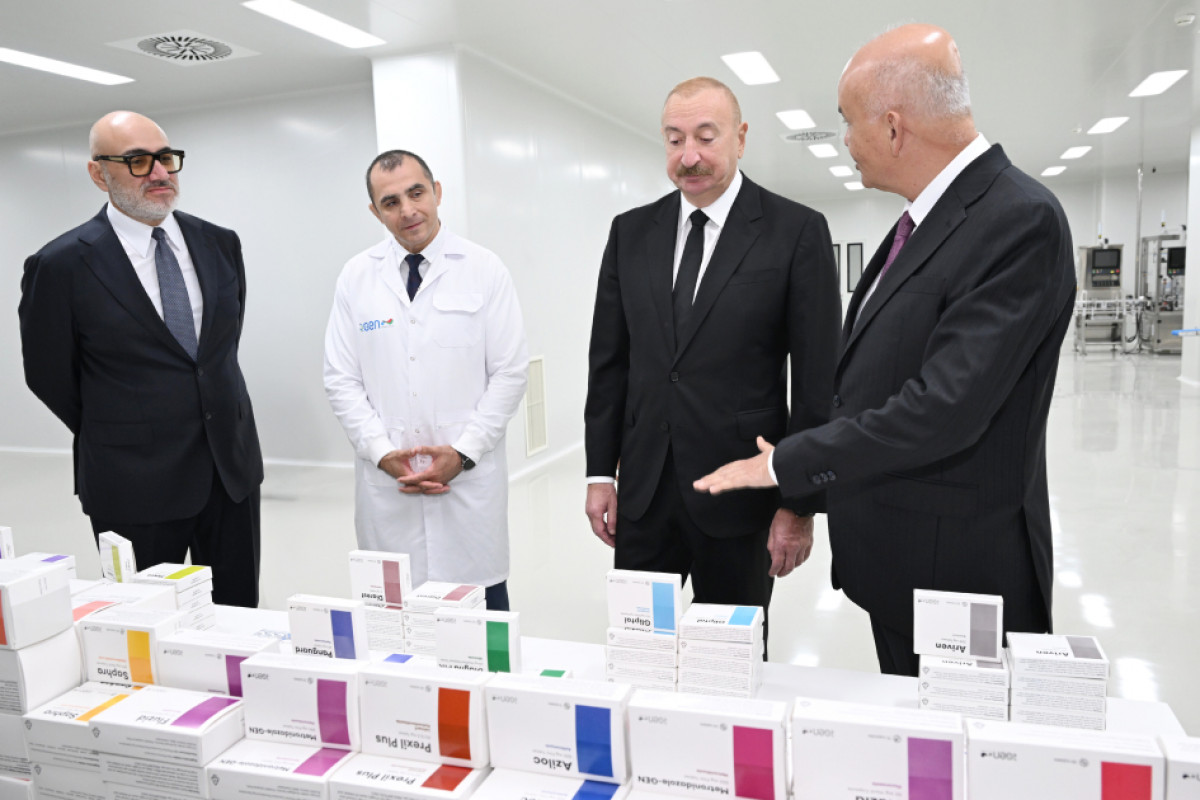
New Pharmaceutical Manufacturing Facility Opens New Opportunities for the Development of Local Pharmaceutical Industry
The participation of President of the Republic of Azerbaijan Ilham Aliyev in the inauguration of the pharmaceutical manufacturing facility of "Gen Pharma Caucasus Manufacturing Operations" LLC in the Pirallahi Industrial Park on October 5 holds significant importance as a continuation of measures implemented toward developing the pharmaceutical industry in the country, expanding domestic production capabilities of pharmaceuticals, and reducing import dependency.
Sevinj Jabbarova, an employee of the Monitoring and Evaluation Division of the Center for Analysis of Economic Reforms and Communication (CAERC), stated that positive dynamics have been observed in domestic pharmaceutical production in recent years. In the first six months of 2026, pharmaceutical production in Azerbaijan increased by 35.5 percent compared to the corresponding period of the previous year. Along with this, expanding the product assortment of domestic production, increasing production capacity, and meeting a greater portion of domestic demand through local manufacturing remain key developmental directions. The current dynamics indicate additional growth potential in this sector.
According to her, the "Socio-Economic Development Strategy of the Republic of Azerbaijan for 2022–2026" designated "Supporting the organization of the production of pharmaceuticals, medical supplies, and active pharmaceutical ingredients in the country, testing their quality, and issuing relevant registration certificates" as a distinct measure. Within the scope of this measure, the targets set for expanding the production of new pharmaceutical products and active substances envisage broadening domestic production capacities and product diversification.
In this regard, the production potential of the "Gen Pharma Caucasus Manufacturing Operations" facility is of particular importance. With a total investment value of 113.9 million manats, an annual production capacity of 60 million packs of pharmaceuticals—including 2.5 billion tablets and capsules—and the planned localization of more than 500 formulations over the next five years, the facility creates substantial potential for scaling production capabilities and diversifying the product portfolio of the domestic pharmaceutical industry.
"Expanding domestic production is especially critical against the backdrop of the population's rising demand for pharmaceuticals. A 70 percent increase in consumer expenditures directed toward purchasing medicines and medical supplies between 2021 and 2025 demonstrates the upward trajectory of spending on these products. Under such circumstances, expanding domestic manufacturing, broadening the production of high-quality generic drugs, and strengthening competition in the market are vital directions for enhancing the sustainability of pharmaceutical supply," she stated.
The significance of the project is not limited solely to supplying the domestic market. The planned export of products manufactured at the facility to Uzbekistan, Kazakhstan, Georgia, and other countries is crucial for expanding the export potential of the local pharmaceutical industry and enhancing foreign market access for Azerbaijani-made pharmaceuticals. The application of modern technologies and aligning manufacturing processes with international quality standards are also essential for bolstering the competitiveness of local products in foreign markets.
Furthermore, the establishment of the new facility demonstrates the significance of public-private partnerships in advancing the pharmaceutical industry, while holding strong potential to contribute to human capital development, the training of qualified local personnel, and the adoption of modern production technologies.
Sevinj Jabbarova emphasized that the primary focus in the subsequent phase is translating the created production capacity into tangible economic and social outcomes. To achieve this, it is essential to regularly evaluate the share of domestic production in overall pharmaceutical provision, the number of localized formulations, import substitution levels, export volumes, and the affordability and accessibility of domestically produced medicines for the population. Reaching the facility's full operational capacity will contribute to broadening drug manufacturing in both variety and volume, satisfying a larger portion of domestic demand through local production, and reinforcing the position of the pharmaceutical industry within the non-oil industrial sector.
Related news

A CAERC representative participates in international training on financial crisis…
Rashad Najafli, Deputy Head of the Economic Analysis Department at the Center for Analysis of Economic Reforms and Communication (CAERC), participated in an international training programme on “Financial Crisis Management”…

World Economic Forum: Azerbaijan could become a digital trade hub for the Middle…
The World Economic Forum (WEF), in collaboration with the Center for Analysis and Coordination of the Fourth Industrial Revolution (C4IR Azerbaijan), operating under the Ministry of Economy of the Republic of Azerbaijan, has published…

A unified coordination mechanism for construction projects will strengthen execution…
The Decree signed by President Ilham Aliyev on “Establishing a Commission for Improving Administrative Procedures in the Implementation of Construction Projects and Coordinating the Activities of State Bodies (Institutions)…

Presidential Order Assigns Monitoring and Evaluation of Construction Projects to…
President Ilham Aliyev has signed an Order "On Establishing a Commission on the Improvement of Administrative Procedures in the Implementation of Construction Projects and Coordination of the Activities of State Bodies (Institutions)…

New Legislative Amendments to Foster the Expansion of Digital Services Exports
A legislative package signed by the President of the Republic of Azerbaijan on October 22, 2026, comprising amendments to the Regulations on Technology Parks, the Tax Code, the Migration Code, and the Laws "On Public Procurement,"…

A representative of the CAERC participated in a conference dedicated to the future…
Rashad Najafli, Deputy Director of the Economic Analysis Department of the Center for Analysis of Economic Reforms and Communication (CAERC), participated in the international conference on “New Challenges in Maintaining Financial…

New Opportunities in Technology Parks: Commercialization and Export of Innovations
The Decree of the President of the Republic of Azerbaijan dated October 22, 2026 on Amendments to the “Model Regulation on Technology Parks” provides for important innovations in terms of improving the activities of technoparks,…

Vusal Gasimli spoke at the opening of the Islamic Finance Forum
Vusal Gasimli, Executive Director of the Center for Analysis of Economic Reforms and Communication (CAERC) — a Doctor of Economic Sciences and Professor — delivered a speech at the opening ceremony of the "3rd Islamic…
Op-eds
Ilkin Gasimov
Chief advisor of the Economic analysis division
New Financial Model for Resource Allocation in General Education
Baghish Ahmadov
Advisor to the Executive director of the Center for Analysis of Economic Reforms and Communication
Azerbaijan International Investment Forum: Investment Cooperation and National Development Priorities
Abdulrahim Dadashov
Deputy head of the Monitoring and evaluation division
Environmental Responsibility is One of the Key Conditions in the Development of the Mining Industry
Latif Zeynalli
Head of State Programs Division
Development of Competition Will Create New Opportunities for Sustainable Economic Growth
Orkhan Sadigov
Head of the Monitoring and evaluation division
A New Approach to Managing Off-Budget Funds Will Strengthen Financial Discipline
Elshan Yusifli
Head of the Monitoring of sectoral programs sector
New Changes to Nakhchivan’s State Programme: Export, Logistics and Social Mechanisms Improved
Abdulrahim Dadashov
Deputy head of the Monitoring and evaluation division
New Law Strengthens the Sustainable Development and Digital Monitoring of the Fisheries Sector