
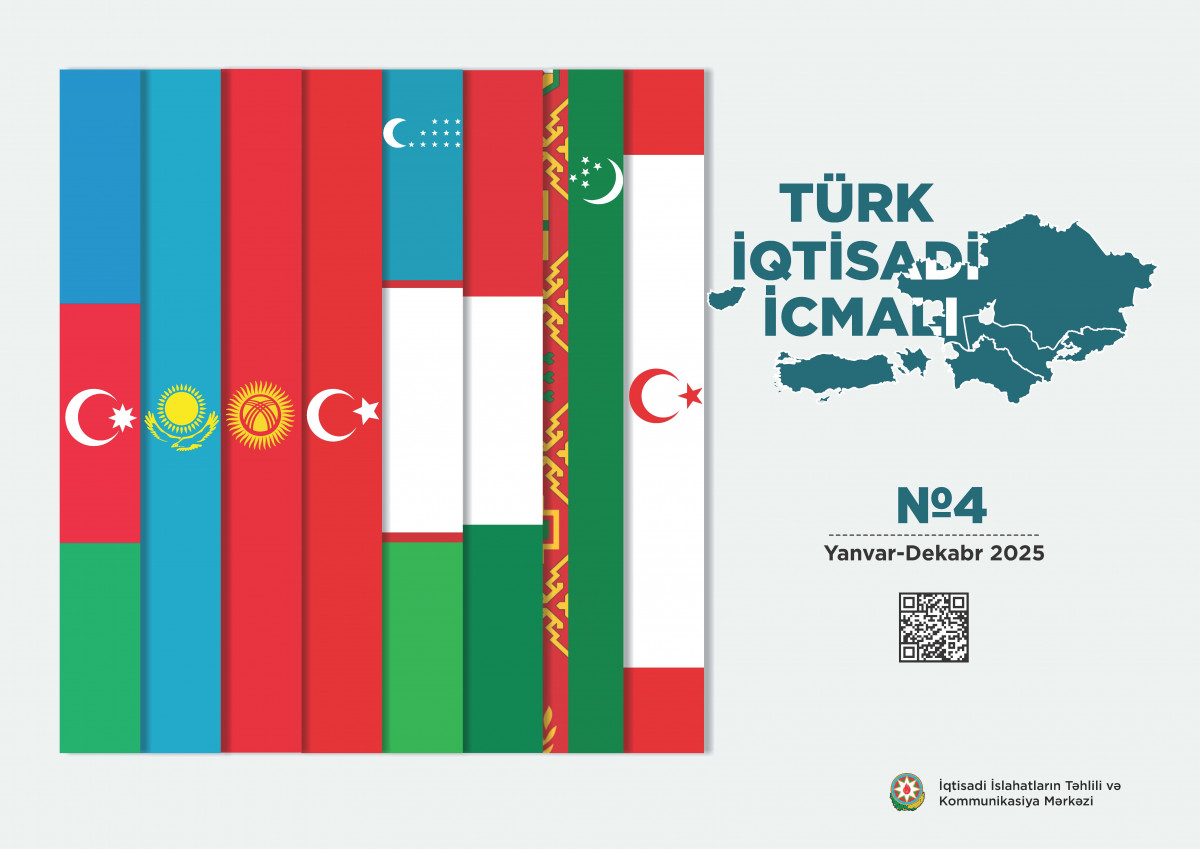
The 2025 year-end issue of the "Turkic Economic Review" has been published
The 2025 year-end issue of the "Turkic Economic Review," presented in eight languages by the Center for Analysis of Economic Reforms and Communication (CAERC) in cooperation with the Secretariat of the Organization of Turkic States (OTS), has been published.
Prepared by the Turkic World Research Center (TWRC) at CAERC based on preliminary statistics, the review provides an economic indicator analysis for 2025 of the OTS member states - Azerbaijan, Kazakhstan, Kyrgyzstan, Türkiye, and Uzbekistan - as well as observer states Hungary, Turkmenistan, and the Turkish Republic of Northern Cyprus (TRNC). Drawing on recent economic development indicators, the review assesses the potential of OTS members and their impact on the global economy.
In 2025, the Turkic states accounted for a 2% share of the global economy with a GDP of 2.11 trillion USD, while their combined population of 178.8 million constituted 2.8% of the global population. These indicators demonstrate that the Turkic states hold a significant position both economically and demographically.
During the report period, based on preliminary indicators, the Turkic states demonstrated faster development with a 5.2% GDP growth rate, compared to the global growth rate of 3.2%. Kyrgyzstan, Uzbekistan, and Kazakhstan achieved growth rates of 11.1%, 7.7%, and 6.5% respectively, ensuring sustainable development in their industrial and agricultural sectors. Economic growth stood at 6.3% in Turkmenistan and 4.5% in the TRNC. Meanwhile, Türkiye, which possesses the organization's largest economy, achieved an economic expansion of 3.6%. The GDP growth rate was 1.4% in Azerbaijan and 0.4% in Hungary.
Trade turnover holds substantial importance for both global integration and economic integration among OTS countries. In 2025, the total trade turnover of the Turkic states reached 1.12 trillion USD, accounting for approximately 3.6% of the global trade turnover, which stands at 34 trillion USD.
Türkiye recorded the highest trade turnover at 638.731 billion USD. Meanwhile, Kazakhstan and Uzbekistan conducted trade worth 143.888 billion USD and 81.160 billion USD, respectively.
According to preliminary figures, Kazakhstan and Uzbekistan experienced sustained export growth in their agricultural and industrial sectors. These metrics highlight the diverse trade dynamics in the region and show that Turkic states are capitalizing on strong export performances.
In the industrial sector, Kyrgyzstan and Kazakhstan led with growth rates of 10.6% and 7.4%, respectively. Concurrently, the industrial sector expanded by 6.8% in both Uzbekistan and Turkmenistan. This growth was driven by large-scale manufacturing and infrastructure projects. In Türkiye, the industrial sector grew by 4.5%.
On the other hand, Turkmenistan demonstrated the strongest growth in the agricultural sector at 7%. Agriculture expanded by 5.9% in Kazakhstan, while Uzbekistan, Hungary, and the TRNC each achieved a 4.4% increase.
Investments, particularly in fixed capital, are vital for long-term growth. In 2025, Kyrgyzstan and Türkiye showed robust increases in fixed capital investments of 18.4% and 15.1% respectively, backed by heavy investments in infrastructure, energy, and manufacturing. Kazakhstan and Uzbekistan also posted healthy growth in fixed capital investments at 13% and 10.5% respectively, boosting their foreign direct investments and achieving positive developments in their business environments.
The banking sector across the Turkic states also exhibited substantial growth. During the report period, total assets in the banking sector increased by 44.9% in Kyrgyzstan, 41% in Türkiye, 25.5% in Uzbekistan, and 11% in the TRNC, Kazakhstan, and Hungary alike. These figures stem from the strengthening of financial services that support economic development and investments. The banking sector of Azerbaijan showed a more moderate growth of 7.7%.
State budget performance serves as another vital indicator of economic health. The TRNC recorded the highest increases, with state budget revenues rising by 51.8% and expenditures by 52.4%. Kyrgyzstan also registered high growth, with state budget revenues up by 44% and expenditures by 41%. Azerbaijan, Türkiye, and Uzbekistan demonstrated effective fiscal management, showing stable growth in both revenue and expenditure fields.
Overall, the Turkic states outperformed global averages in terms of GDP growth and trade turnover, and achieved substantial investment milestones.
The "Turkic Economic Review" is traditionally presented in a total of eight languages, including English and the respective native languages of the OTS member and observer states. You can access the publications in these languages via the links below:
Azerbaijani: https://ereforms.gov.az/az.pdf
English: https://ereforms.gov.az/en.pdf
Russian: https://ereforms.gov.az/ru.pdf
Turkish: https://ereforms.gov.az/tr.pdf
Hungarian: https://ereforms.gov.az/hu.pdf
Uzbek: https://ereforms.gov.az/uz.pdf
Kazakh: https://ereforms.gov.az/kz.pdf
Kyrgyz: https://ereforms.gov.az/kr.pdf
Related news

Food Safety Programme for 2027–2032: Strategic Importance for Businesses and Consumers
The approval, by the Order of President Ilham Aliyev, of the “State Programme for 2027–2032 on Ensuring Food Safety in the Republic of Azerbaijan” marks the beginning of a new strategic stage in the integration of…

The next meeting of the working group on the “Green Energy Space” was held
The next meeting of the “Green Energy Space” working group, established to ensure the implementation of the measures envisaged in the “Strategy for the Socio-Economic Development of the Republic of Azerbaijan for…

A New Approach to Managing Off-Budget Funds Will Strengthen Financial Discipline
The President of the Republic of Azerbaijan, Ilham Aliyev, has signed a Decree “On additional measures regarding the use of targeted budget funds established within the state budget and the extra-budgetary funds of organizations…

CAERC to Monitor and Evaluate the Implementation of the State Program on Food Safety
President of the Republic of Azerbaijan Ilham Aliyev has signed an Order approving the “State Program for Ensuring Food Safety in the Republic of Azerbaijan for 2027–2032.” According to the Order, the monitoring…

Meeting Held at CAERC on the Implementation of the State Program on Tourism Development
A meeting was held at the Center for Analysis of Economic Reforms and Communication (CERC) regarding the implementation of the “State Programme for 2026–2030 on the Development of Tourism in the Republic of Azerbaijan”.…

Meeting of the “Healthy Lifestyle” Working Group Held
The next meeting of the “Healthy Lifestyle” Working Group was held in connection with the implementation of the targets envisaged in the “Socio-Economic Development Strategy of the Republic of Azerbaijan for 2022–2026”.…

Azexport Portal Brings Local Art Supplies to International Markets
The Azexport portal, operated by the Center for Analysis of Economic Reforms and Communication (CAERC), continues its efforts to expand non-oil exports and support local producers in accessing global markets. As part of these efforts,…

Meeting of the “Human Capital and Education” Working Group Held
The next meeting of the “Human Capital and Education” Working Group was held to review the results of the work carried out during the first half of 2026 under the “Education Meeting the Requirements of the 21st Century”…
Op-eds
Aykhan Gadashov
Head of the Azexport portal
“Geoeconomic Stability Corridor”: The $1 Billion Trade Target with Uzbekistan Opens New Horizons for Business
Isa Gasimov
Head of the “Enterprise Azerbaijan” portal
Crowdfunding: New Perspectives in Startup Financing in Azerbaijan
Elnur Alakbarov
Deputy head of the Economic analysis division
New Action Plan on Employment: Digitalization and Result-Oriented Management
Abdulrahim Dadashov
Deputy head of the Monitoring and evaluation division
Agricultural support mechanisms will create new opportunities for farmers and exporters
Ilyas Huseynov
Head of the Turkic World Research Center
Large-Scale Modernization of the Baku-Tbilisi-Kars Railway: A New Strategic Phase in the Middle Corridor and Eurasian Connectivity
Rashad Najafli
Deputy head of the Economic analysis division
Azerbaijan: A Guarantor of Peace and Security in the South Caucasus
Isa Gasimov
Head of the “Enterprise Azerbaijan” portal
Transition to an Innovation Ecosystem: Azerbaijan’s Strategic Choice