
According to the Economic Freedom Index 2020 Report, Azerbaijan Has Advanced by 16 Positions
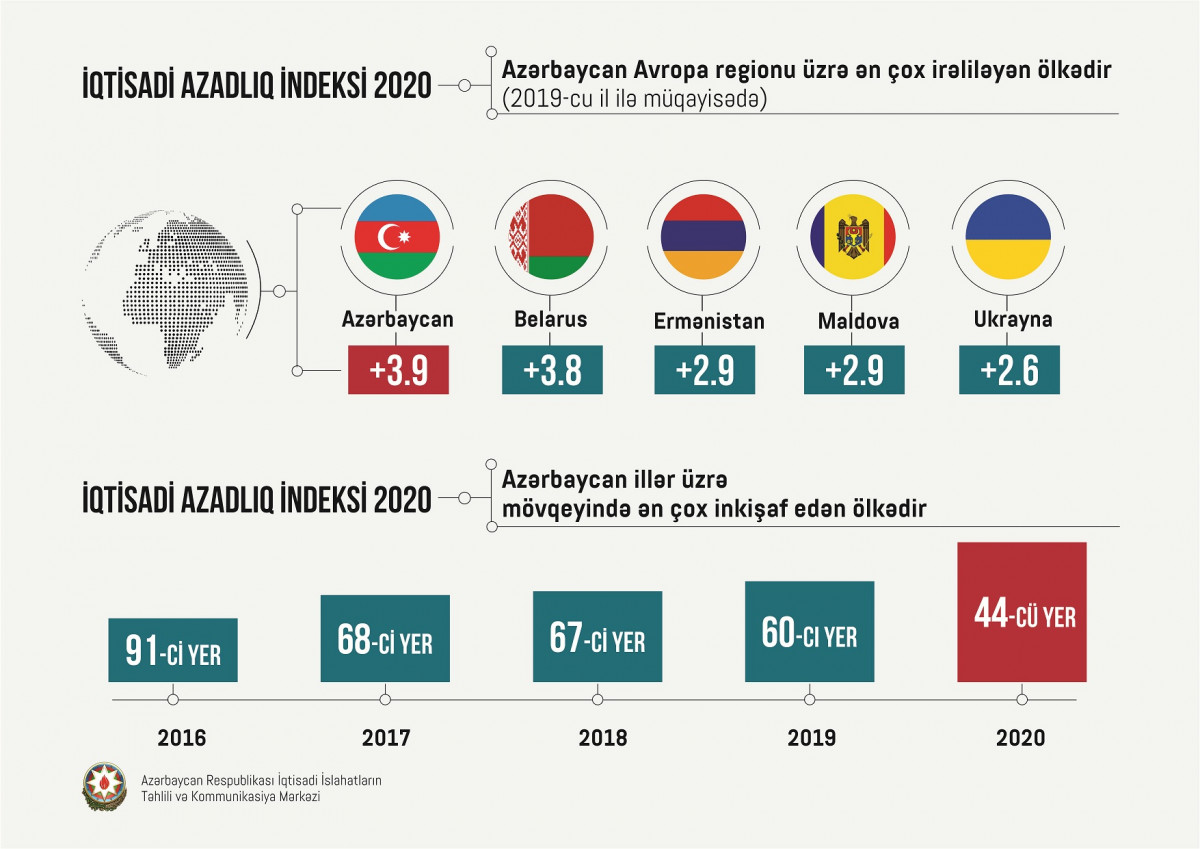
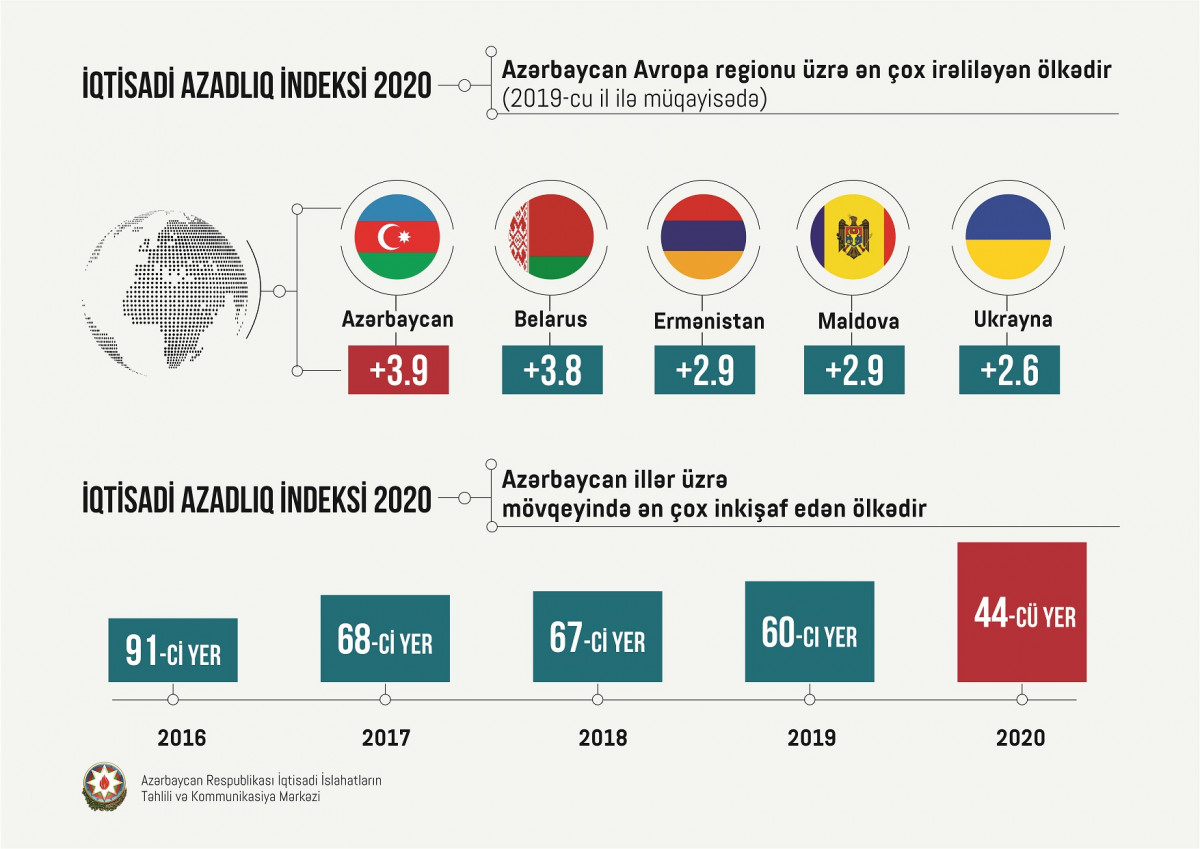
According to the Economic Freedom Index 2020 report prepared by one of the world’s largest think tanks, the Heritage Foundation, Azerbaijan has advanced by 16 positions and ranked 44th among 180 countries. In this year’s report, Azerbaijan was removed from the Asia-Pacific region group and included in the European region. In terms of economic freedom, Azerbaijan scored above the global average (61.6) and was only 0.5 points below the regional average. Azerbaijan also ranked 24th among 45 countries in the European region and was the top country in the region in terms of improvement. Moreover, according to the index, Azerbaijan ranked ahead of countries such as Poland, Belgium, Spain, France, Turkey, and Italy.
It is well known that there is a strong correlation between the development of economic freedom and the development of human capital, and Azerbaijan is among the 11 countries that have made the greatest progress in the Economic Freedom Index. This progress has primarily been achieved through improvements in business freedom, investment freedom, and fiscal health indicators. The strengthening of the country’s position is an international assessment of the purposeful, comprehensive, and deep economic reforms implemented under the leadership of the President of the Republic of Azerbaijan, Ilham Aliyev.
The Economic Freedom Index evaluates factors affecting economic freedom based on 12 indicators, including key pillars such as the rule of law, government effectiveness, government size, and market openness, along with their sub-indicators, and presents the results in the form of a single score and ranking. Each country is scored between 0 and 100 for each indicator. The higher the score, the higher the level of economic freedom. Thus, a completely free economy is characterized by a score of 100, while the absence of economic freedom is reflected by a score of 0. Based on the final report, all countries are classified into five conditional groups:
Free economies (80–100 points);
Mostly free economies (70–79.9 points);
Moderately free economies (60–69.9 points);
Mostly unfree economies (50–59.9 points);
Repressed economies (below 49.9 points).
Azerbaijan’s score of 69.3 places it in the category of a moderately free economy, indicating a reduction in state intervention in the economy and an increase in the role of the private sector in economic growth. Countries that pursue economic freedom policies create favorable conditions for trade and entrepreneurship, which in turn contributes to economic growth and increased public welfare.
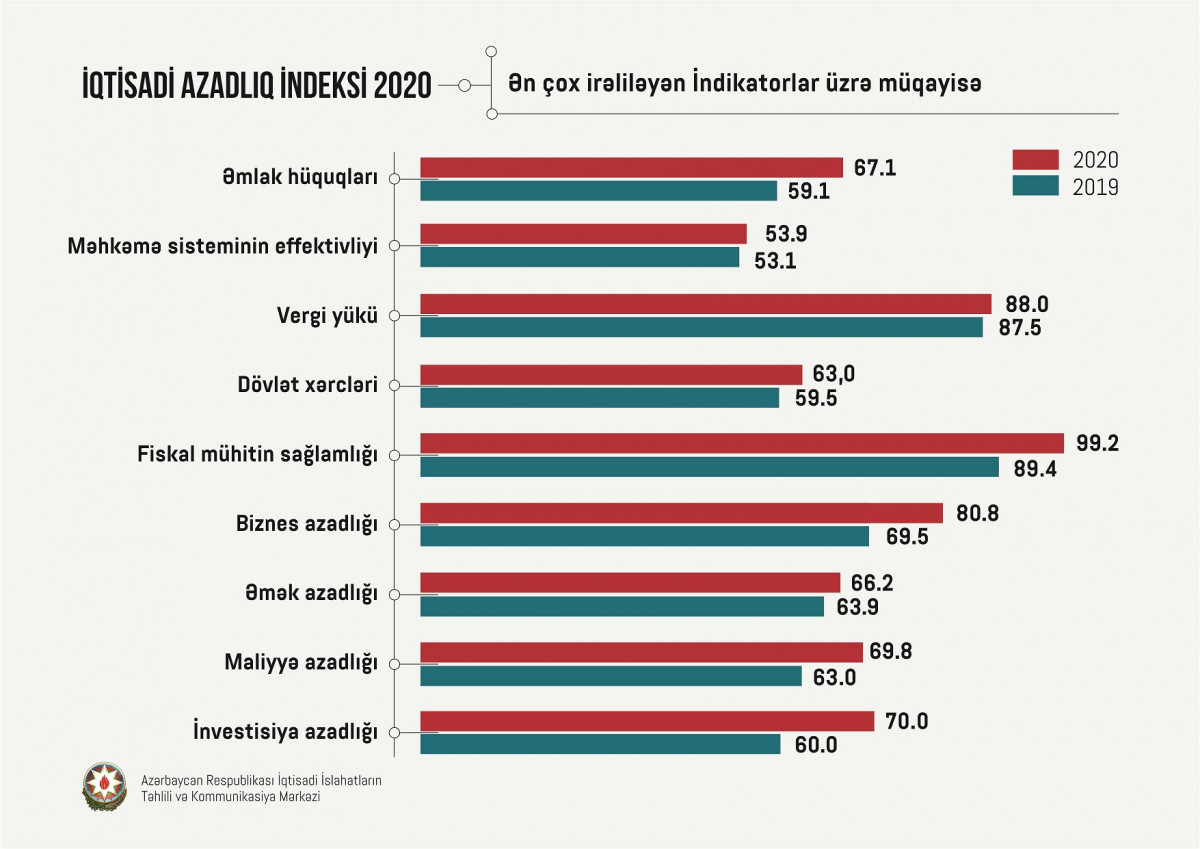
In the 2020 report, under the rule of law indicator, Azerbaijan recorded an 8-point improvement in the property rights sub-indicator, achieving a score of 67.1. As a result of reforms implemented in recent years, electronic application options in the field of state registration of real estate have been further improved, and more than 20 electronic services have been launched. At the same time, applications for obtaining ownership certificates and the issuance of these documents are now conducted electronically. In accordance with the decree signed by President Ilham Aliyev on February 19, 2019, on simplifying the issuance of permits for the operation of certain multi-apartment buildings, mobile campaigns titled “Register Your Property and Secure Your Ownership” are regularly conducted to further intensify apartment registration procedures.
In the judicial effectiveness sub-indicator, an improvement of 0.8 points was observed. A number of important measures are being implemented to increase the efficiency of justice and court proceedings within the framework of the decree on deepening reforms in the judicial and legal system. The Electronic Court information system has been further improved, and the Law on Mediation has been adopted, providing effective dispute resolution mechanisms without requiring court or third-party decisions. The newly introduced Mobile Electronic Court software allows users to submit claims electronically, send documents, receive notifications about court hearings, and access other services. Amendments to the Law of the Republic of Azerbaijan on State Forensic Expertise and other legal acts have established new provisions regarding the conduct and duration of forensic examinations in civil, administrative, economic, and administrative dispute cases. As of January 1, 2020, several commercial and administrative courts have begun operating.
Under the government size indicator, the tax burden sub-indicator improved by 0.5 points. In recent years, tax reforms have taken on a systematic character, optimizing the tax burden for entrepreneurs. Equal treatment, the transition from coercion to voluntary compliance, improved tax administration, and increased transparency have strengthened taxpayer satisfaction. Reforms have led to changes in factors such as the time required to prepare tax reports, pay taxes, complete VAT refund documentation, and the number of tax rates. In addition, amendments to the Tax Code based on economic objectives and key priorities can be grouped into seven main areas: ensuring a fair and transparent fiscal environment; improving VAT administration; reducing the administrative burden on entrepreneurs and promoting entrepreneurship; reducing the financial burden on the population through social incentives; reducing the tax burden on business entities and expanding the tax base; and fulfilling obligations related to international taxation and information exchange.
New provisions have been introduced into the Code to strengthen the fight against taxpayers conducting non-commodity and high-risk transactions.
The application of the cash method in VAT calculations has improved tax administration while also enabling taxpayers to save financial resources. Overall, the comprehensive tax reforms implemented in the country will have a significant impact on the development of entrepreneurship and the business environment.
Regarding the government spending sub-indicator, Azerbaijan recorded a 3.5-point increase, bringing it closer to the global average. In 2019, comprehensive social reforms were implemented, and the Social Reform Package included increases in the minimum wage, minimum pension, scholarships, and allowances, as well as measures related to the repayment and restructuring of problematic and overdue loans. This reform package covers more than two million people.
Under the fiscal health sub-indicator, Azerbaijan achieved a significant improvement of 9.8 points, reaching a score of 99.2. As part of comprehensive reform measures aimed at developing the financial and banking sector, the adoption of regulations on risk management in banks, credit risk management, and the opening, maintenance, and closure of bank accounts has resulted in substantial progress. The banking sector’s loan portfolio has expanded, profits, assets, deposits, and capital have increased, digitalization has been enhanced, and the transition to prudential management has been ensured. In addition, residents and non-residents, both legal entities and individuals, can now open bank accounts remotely without visiting a bank.
Significant progress has been observed across all sub-indicators of government effectiveness. As a result of comprehensive business reforms implemented in recent years, Azerbaijan achieved an 11.3-point increase in the business freedom sub-indicator, reaching a score of 80.8. Business reform measures carried out under the leadership of President Ilham Aliyev have aimed to improve the business environment and create more transparent and efficient opportunities. As a result of these reforms, procedures related to construction permits, electricity connections, property registration, and public procurement are now conducted electronically, marking an important transition to the digital era. Reforms have also been implemented in foreign trade to ensure more efficient and transparent customs control and clearance and to strengthen export potential. Following the approval of rules governing the permanent use of the Green Corridor system by foreign trade participants, entrepreneurs have benefited from more favorable conditions. Under the new rules, export customs declarations and related documents are submitted electronically one hour before goods are loaded, and notifications are sent via SMS within one hour.
To further develop the business environment and improve Azerbaijan’s position in the Economic Freedom Index and other international rankings, the working groups of the Commission on Business Environment and International Rankings regularly implement measures in line with their action plans.
As a result of reforms, Azerbaijan achieved a 2.3-point increase in the labor freedom sub-indicator. Within the framework of Social Reform Packages, the average monthly pension increased by 15 percent, old-age pensions by 15 percent, and disability pensions by 22 percent. The number of participants in the self-employment program reached 10,354, while the number of families receiving targeted state social assistance increased by 70 percent to 72,000. At the same time, nearly 3,400 individuals, including 3,168 people through the State Employment Service and 227 people through the Vocational Rehabilitation Center for Persons with Disabilities under the State Social Protection Fund, were involved in vocational training programs.
In the financial freedom sub-indicator, a 6.8-point improvement was recorded in the Economic Freedom Index 2020 report. This indicator measures inflation by assessing various government activities that distort prices. In Azerbaijan, inflation remained almost stable in 2019 at 2.6 percent.
The investment freedom sub-indicator under market openness evaluates practical and legal restrictions on the movement of investment capital. It assesses whether individuals and firms are allowed to operate freely within and across borders without undue restrictions. In this indicator as well, Azerbaijan achieved a 10-point increase.
Overall, the Economic Freedom Index published by the Heritage Foundation serves as an international benchmark for tracking changes across countries worldwide. The results of this index are important not only for academic research but also as a valuable source of information for investors, particularly with regard to developing countries and changes affecting economic freedom. Under the leadership of President Ilham Aliyev, significant achievements have been made in improving the current situation, ensuring financial stability, promoting sustainable economic development, and strengthening Azerbaijan’s economic position. Azerbaijan’s advancement in the Economic Freedom Index ranking is one of the key examples of these achievements.
Narmin Kazimli
Analyst at the Center for Analysis of Economic Reforms and Communication

Related news

A representative of the CAERC participated in a conference dedicated to the future…
Rashad Najafli, Deputy Director of the Economic Analysis Department of the Center for Analysis of Economic Reforms and Communication (CAERC), participated in the international conference on “New Challenges in Maintaining Financial…

New Opportunities in Technology Parks: Commercialization and Export of Innovations
The Decree of the President of the Republic of Azerbaijan dated October 22, 2026 on Amendments to the “Model Regulation on Technology Parks” provides for important innovations in terms of improving the activities of technoparks,…

Vusal Gasimli spoke at the opening of the Islamic Finance Forum
Vusal Gasimli, Executive Director of the Center for Analysis of Economic Reforms and Communication (CAERC) — a Doctor of Economic Sciences and Professor — delivered a speech at the opening ceremony of the "3rd Islamic…

CAERC expands cooperation with think tanks and universities in Uzbekistan
Ilyas Huseynov, Head of the Turkic World Research Center (TWRC) at the Center for Analysis of Economic Reforms and Communication (CAERC), held meetings with representatives from think tanks and higher education institutions, and delivered…

Meetings regarding preparations for the final monitoring and evaluation of the Socio-Economic…
The Center for Analysis of Economic Reforms and Communication (CAERC) has concluded a series of meetings with representatives from relevant government agencies. These meetings were held to refine outcome indicators for the year 2026—within…

The investment portfolio of “Enterprise Azerbaijan”’s partners exceeds 3 billion…
The global innovation program “Startup School 4: Five Continents – 500 Startups,” implemented by the “Enterprise Azerbaijan” portal of the Center for Analysis of Economic Reforms and Communication (CAERC),…

The establishment of the Karabakh National Park creates new opportunities for ecological…
The Order of the President of the Republic of Azerbaijan, Ilham Aliyev, dated October 20, 2026, "On the Establishment of the Karabakh National Park of the Republic of Azerbaijan," is regarded as a significant step toward…

World Bank: Azerbaijan’s strong financial buffers support economic stability and…
The "Europe and Central Asia Economic Update" and the "Macro-Poverty Outlook" for Azerbaijan, published by the World Bank in October 2026, indicate that the country has maintained its macroeconomic stability, strong…
Op-eds
Ilkin Gasimov
Chief advisor of the Economic analysis division
New Financial Model for Resource Allocation in General Education
Baghish Ahmadov
Advisor to the Executive director of the Center for Analysis of Economic Reforms and Communication
Azerbaijan International Investment Forum: Investment Cooperation and National Development Priorities
Abdulrahim Dadashov
Deputy head of the Monitoring and evaluation division
Environmental Responsibility is One of the Key Conditions in the Development of the Mining Industry
Latif Zeynalli
Head of State Programs Division
Development of Competition Will Create New Opportunities for Sustainable Economic Growth
Orkhan Sadigov
Head of the Monitoring and evaluation division
A New Approach to Managing Off-Budget Funds Will Strengthen Financial Discipline
Elshan Yusifli
Head of the Monitoring of sectoral programs sector
New Changes to Nakhchivan’s State Programme: Export, Logistics and Social Mechanisms Improved
Abdulrahim Dadashov
Deputy head of the Monitoring and evaluation division
New Law Strengthens the Sustainable Development and Digital Monitoring of the Fisheries Sector