
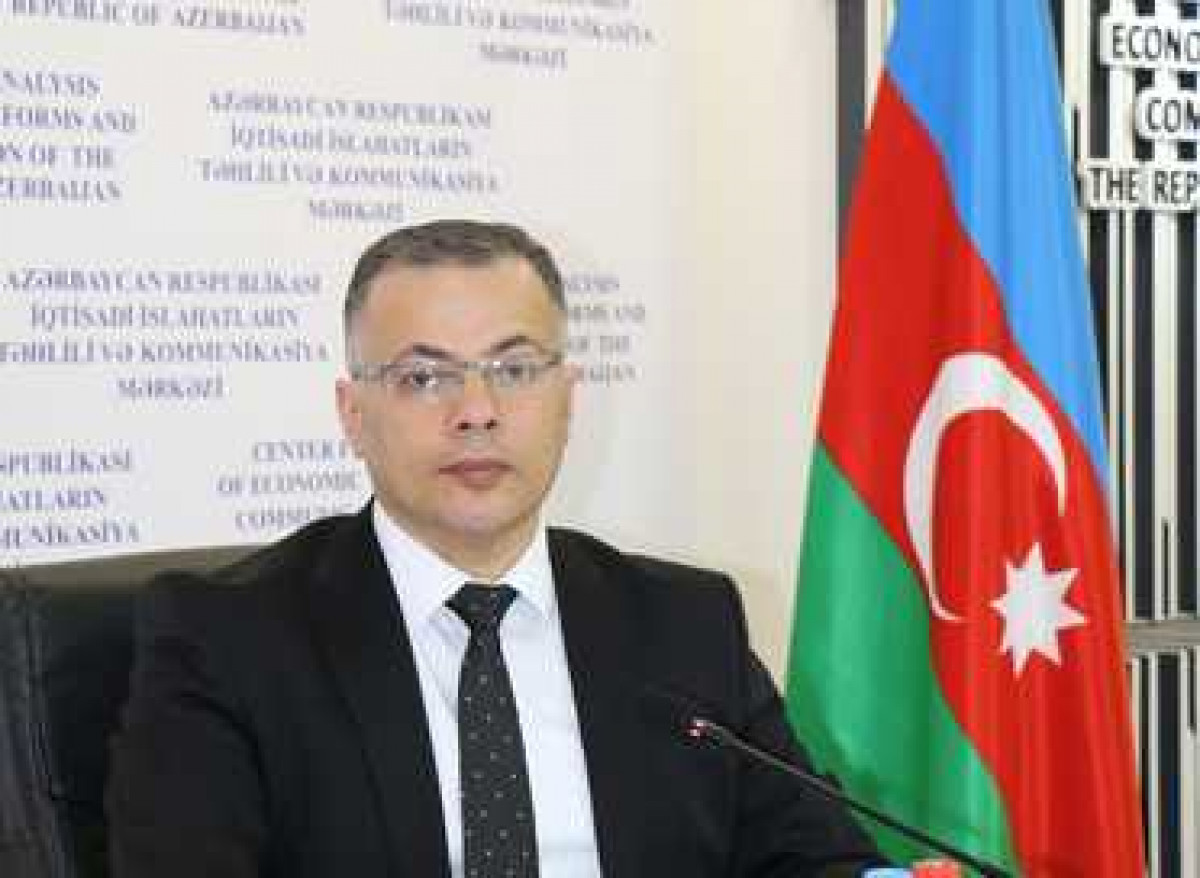
Vusal Gasimli: The Pandemic Slows the Growth Rate of Demand and Supply
Vusal Gasimli, Executive Director of the Center for Analysis of Economic Reforms and Communication (CAERC), stated that global shocks and the pandemic are negatively affecting the growth rate of aggregate demand and supply in Azerbaijan:
“Globally, the demand-supply spiral is trending downward. Nevertheless, real GDP growth in Azerbaijan is expected in the first quarter of this year. Non-oil industry, crop production, and information and communication services will be the main drivers of this growth. However, against the backdrop of a sharp decline in oil prices, the GDP deflator is also projected to fall in the first quarter. The GDP deflator, which has been declining since 2017, is expected to reach its lowest level this quarter. This will negatively impact the nominal value of goods and services produced domestically. A lower GDP deflator also affects the balance of payments, international investment position, and the level of savings.
In the current global economic crisis, macroeconomic policy choices are essentially between two options: preventing the pandemic and avoiding a recession. The Azerbaijani government has chosen a path that uses all available tools to control the pandemic while supporting market participants, thereby minimizing potential losses.
Some European countries, facing liquidity traps and near-zero policy rates, have been forced to mobilize financial resources through “helicopter money,” eurobonds, and “coronabonds.” Meanwhile, 80 developing countries rely on IMF support. The G20 has also allocated a 5-trillion-dollar fund to assist countries in managing the crisis. Of course, “free cheese is only in a trap.” Meanwhile, the rating agency Standard & Poor’s, considering Azerbaijan’s significant foreign exchange reserves, strong fiscal position, and low external debt, maintained the country’s international credit rating at “BB+.” If current account deficits or capital and financial account shortfalls arise under global shocks, the reserve assets will be sufficient to cover them. Both globally and domestically, economies will experience losses; the key issue is minimizing those losses, controlling external debt, and preparing for the post-coronavirus period.
It is also important to note that the slowdown in Azerbaijan’s supply growth is due not to the domestic business cycle but to external shocks. Once the impact of these shocks reaches its peak and begins to subside, Azerbaijan’s economy will resume development in line with its own business cycle. Even before the coronavirus crisis, global economic growth had already been slowing.
By combating the crisis with its own resources rather than relying on external debt or monetary easing, Azerbaijan is positioning itself for a stronger post-crisis recovery. According to Keynesian theory, government intervention during a crisis is necessary, provided that support programs are efficient and results-oriented. At the same time, the Ricardo-Barro effect suggests that debt-financed government spending increases future tax burdens to repay the debt. Considering both approaches, Azerbaijan is in a favorable position: the support provided to the economy today will not require citizens to repay it as taxes tomorrow. This is possible because Azerbaijan has established a social market model, with citizens at the center of government policy.”
Related news

A representative of the CAERC participated in a conference dedicated to the future…
Rashad Najafli, Deputy Director of the Economic Analysis Department of the Center for Analysis of Economic Reforms and Communication (CAERC), participated in the international conference on “New Challenges in Maintaining Financial…

New Opportunities in Technology Parks: Commercialization and Export of Innovations
The Decree of the President of the Republic of Azerbaijan dated October 22, 2026 on Amendments to the “Model Regulation on Technology Parks” provides for important innovations in terms of improving the activities of technoparks,…

Vusal Gasimli spoke at the opening of the Islamic Finance Forum
Vusal Gasimli, Executive Director of the Center for Analysis of Economic Reforms and Communication (CAERC) — a Doctor of Economic Sciences and Professor — delivered a speech at the opening ceremony of the "3rd Islamic…

CAERC expands cooperation with think tanks and universities in Uzbekistan
Ilyas Huseynov, Head of the Turkic World Research Center (TWRC) at the Center for Analysis of Economic Reforms and Communication (CAERC), held meetings with representatives from think tanks and higher education institutions, and delivered…

Meetings regarding preparations for the final monitoring and evaluation of the Socio-Economic…
The Center for Analysis of Economic Reforms and Communication (CAERC) has concluded a series of meetings with representatives from relevant government agencies. These meetings were held to refine outcome indicators for the year 2026—within…

The investment portfolio of “Enterprise Azerbaijan”’s partners exceeds 3 billion…
The global innovation program “Startup School 4: Five Continents – 500 Startups,” implemented by the “Enterprise Azerbaijan” portal of the Center for Analysis of Economic Reforms and Communication (CAERC),…

The establishment of the Karabakh National Park creates new opportunities for ecological…
The Order of the President of the Republic of Azerbaijan, Ilham Aliyev, dated October 20, 2026, "On the Establishment of the Karabakh National Park of the Republic of Azerbaijan," is regarded as a significant step toward…

World Bank: Azerbaijan’s strong financial buffers support economic stability and…
The "Europe and Central Asia Economic Update" and the "Macro-Poverty Outlook" for Azerbaijan, published by the World Bank in October 2026, indicate that the country has maintained its macroeconomic stability, strong…
Op-eds
Ilkin Gasimov
Chief advisor of the Economic analysis division
New Financial Model for Resource Allocation in General Education
Baghish Ahmadov
Advisor to the Executive director of the Center for Analysis of Economic Reforms and Communication
Azerbaijan International Investment Forum: Investment Cooperation and National Development Priorities
Abdulrahim Dadashov
Deputy head of the Monitoring and evaluation division
Environmental Responsibility is One of the Key Conditions in the Development of the Mining Industry
Latif Zeynalli
Head of State Programs Division
Development of Competition Will Create New Opportunities for Sustainable Economic Growth
Orkhan Sadigov
Head of the Monitoring and evaluation division
A New Approach to Managing Off-Budget Funds Will Strengthen Financial Discipline
Elshan Yusifli
Head of the Monitoring of sectoral programs sector
New Changes to Nakhchivan’s State Programme: Export, Logistics and Social Mechanisms Improved
Abdulrahim Dadashov
Deputy head of the Monitoring and evaluation division
New Law Strengthens the Sustainable Development and Digital Monitoring of the Fisheries Sector