
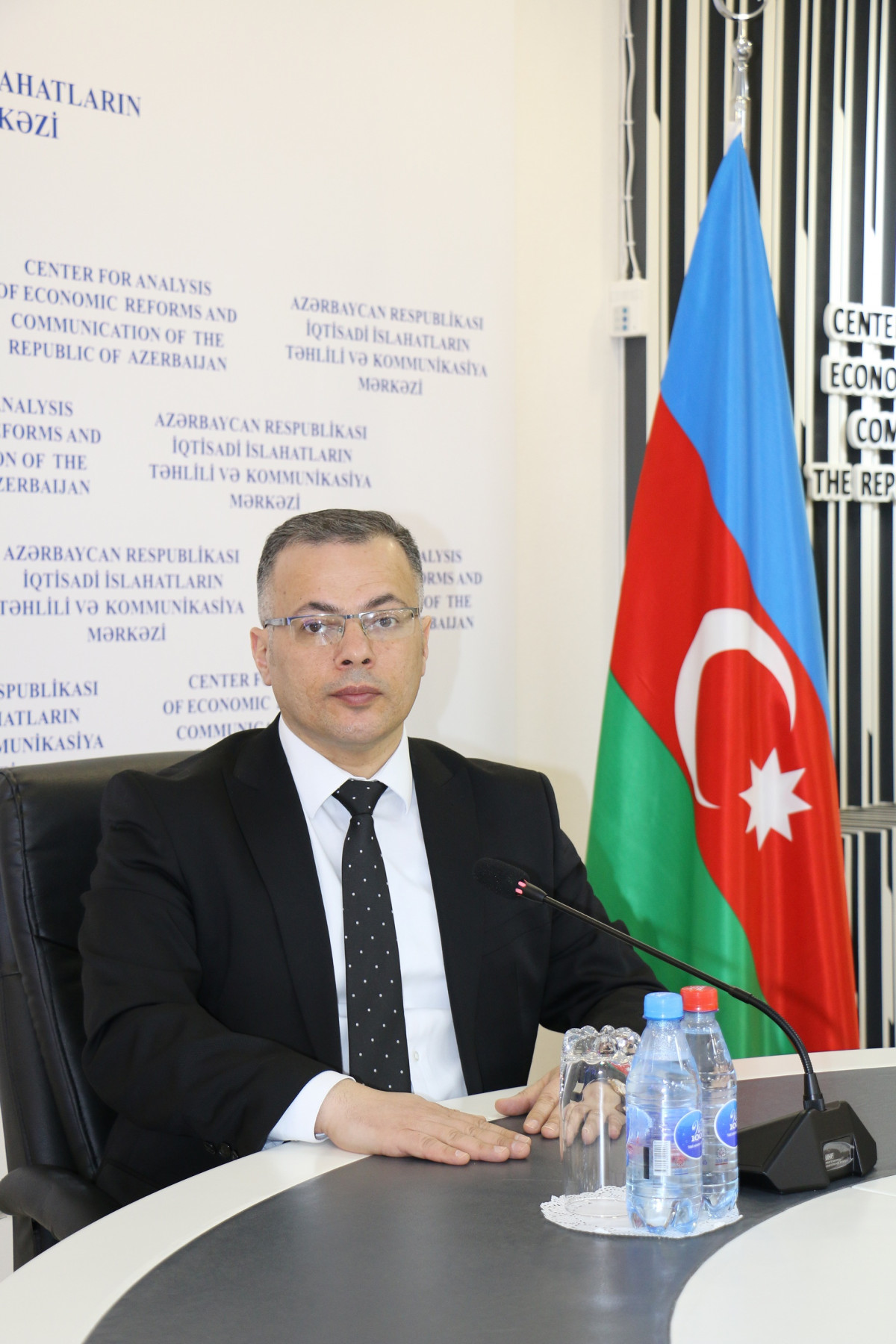
Vusal Qasimli: Direct Impact of Falling Oil Prices on the State Budget is Minimal
Earlier this week, oil prices in global markets dropped to as low as $30 per barrel, even if only technically, before partially stabilizing. Vusal Qasimli, Executive Director of the Center for Analysis and Communication of Economic Reforms (CAERC), commented to “Report” on the potential effects of this decline on the Azerbaijani economy.
He stated that the direct impact of lower oil prices on the state budget is minimal. The projected maximum transfer from the State Oil Fund to the state budget is 11.35 billion AZN, which can be provided without issue. This year’s transfer from the State Oil Fund accounts for only 15% of the fund’s total reserves. Even without considering future fund revenues, there is a seven-year window to execute this transfer. Including future earnings, the State Oil Fund will serve the Azerbaijani people for decades.
In addition to the state budget, the budgets of the State Social Protection Fund and the Unemployment Insurance Fund remain sustainable. In the first two months of this year, tax authorities collected 180 million AZN and customs authorities 70 million AZN above projections. This demonstrates that previous reforms, the reduction of the shadow economy, improvements in tax and customs administration, and the development of the non-oil sector are yielding results.
According to forecasts, 56.1% of the state budget revenues this year will come from the non-oil sector. Aside from the transfer from the State Oil Fund, 2.18 billion AZN will come from oil sector revenues via tax authorities. SOCAR’s budget payments are projected at 1.45 billion AZN this year. Since SOCAR mainly supplies the domestic market, volatility in international oil prices will have limited impact on this projection. Profit taxes from Production Sharing Agreements are expected to yield 730 million AZN, which could be more affected by falling oil prices. The Azerbaijani government has already accounted for these risks.
If oil drops to $40 per barrel, state budget revenues could decrease by only 1.6% compared to forecasts: 1.3% directly from reduced oil and gas sector income, and 0.3% indirectly via effects on the non-oil and gas sector. While oil price declines could have a larger effect on the overall budget, the current operational account balance allows Azerbaijan to maintain stability at $40–45 per barrel.
Commercial banks’ total foreign assets are 7.1 billion AZN and foreign liabilities 1.6 billion AZN, giving net foreign assets of 5.2 billion AZN. This positive balance makes the banking sector more resilient to external shocks. Concerns often arise about increased dollarization in such situations, but Azerbaijan already has a high level: 55% of deposits are in dollars, up from 37% in early 2015 before devaluations. This indicates a 1.5-fold reduction in potential pressure from dollarization compared to five years ago. Full deposit insurance and a higher share of manat deposits also stabilize the market.
Foreign currency constitutes one-third of the credit portfolio, supporting calm behavior by the public and businesses. Currency sales in banks continue normally, and the manat exchange rate remains stable. There is no panic.
Today, in a 14-day deposit auction conducted by the Central Bank, demand reached 268 million AZN, with an average interest rate of 5.51%. The Central Bank also held a currency auction, with 323.2 million USD demanded and fully met, including participation from the State Oil Fund. All of this occurred despite oil prices temporarily falling to $30 per barrel.
The calm response of the public, businesses, and banks is commendable. Azerbaijan has effectively built immunity to lower oil prices. Overall, the government, businesses, and public in Azerbaijan are better prepared for low oil prices than in 2015 and compared to other resource-rich regional countries. Furthermore, prolonged low oil prices are not in the interest of major global players—Saudi Arabia, Russia, and the USA. The current situation is temporary, caused by reduced demand due to COVID-19 and increased supply competition. In all cases, the Azerbaijani government is prepared to calculate risks and take appropriate measures.
Related news

A representative of the CAERC participated in a conference dedicated to the future…
Rashad Najafli, Deputy Director of the Economic Analysis Department of the Center for Analysis of Economic Reforms and Communication (CAERC), participated in the international conference on “New Challenges in Maintaining Financial…

New Opportunities in Technology Parks: Commercialization and Export of Innovations
The Decree of the President of the Republic of Azerbaijan dated October 22, 2026 on Amendments to the “Model Regulation on Technology Parks” provides for important innovations in terms of improving the activities of technoparks,…

Vusal Gasimli spoke at the opening of the Islamic Finance Forum
Vusal Gasimli, Executive Director of the Center for Analysis of Economic Reforms and Communication (CAERC) — a Doctor of Economic Sciences and Professor — delivered a speech at the opening ceremony of the "3rd Islamic…

CAERC expands cooperation with think tanks and universities in Uzbekistan
Ilyas Huseynov, Head of the Turkic World Research Center (TWRC) at the Center for Analysis of Economic Reforms and Communication (CAERC), held meetings with representatives from think tanks and higher education institutions, and delivered…

Meetings regarding preparations for the final monitoring and evaluation of the Socio-Economic…
The Center for Analysis of Economic Reforms and Communication (CAERC) has concluded a series of meetings with representatives from relevant government agencies. These meetings were held to refine outcome indicators for the year 2026—within…

The investment portfolio of “Enterprise Azerbaijan”’s partners exceeds 3 billion…
The global innovation program “Startup School 4: Five Continents – 500 Startups,” implemented by the “Enterprise Azerbaijan” portal of the Center for Analysis of Economic Reforms and Communication (CAERC),…

The establishment of the Karabakh National Park creates new opportunities for ecological…
The Order of the President of the Republic of Azerbaijan, Ilham Aliyev, dated October 20, 2026, "On the Establishment of the Karabakh National Park of the Republic of Azerbaijan," is regarded as a significant step toward…

World Bank: Azerbaijan’s strong financial buffers support economic stability and…
The "Europe and Central Asia Economic Update" and the "Macro-Poverty Outlook" for Azerbaijan, published by the World Bank in October 2026, indicate that the country has maintained its macroeconomic stability, strong…
Op-eds
Ilkin Gasimov
Chief advisor of the Economic analysis division
New Financial Model for Resource Allocation in General Education
Baghish Ahmadov
Advisor to the Executive director of the Center for Analysis of Economic Reforms and Communication
Azerbaijan International Investment Forum: Investment Cooperation and National Development Priorities
Abdulrahim Dadashov
Deputy head of the Monitoring and evaluation division
Environmental Responsibility is One of the Key Conditions in the Development of the Mining Industry
Latif Zeynalli
Head of State Programs Division
Development of Competition Will Create New Opportunities for Sustainable Economic Growth
Orkhan Sadigov
Head of the Monitoring and evaluation division
A New Approach to Managing Off-Budget Funds Will Strengthen Financial Discipline
Elshan Yusifli
Head of the Monitoring of sectoral programs sector
New Changes to Nakhchivan’s State Programme: Export, Logistics and Social Mechanisms Improved
Abdulrahim Dadashov
Deputy head of the Monitoring and evaluation division
New Law Strengthens the Sustainable Development and Digital Monitoring of the Fisheries Sector