
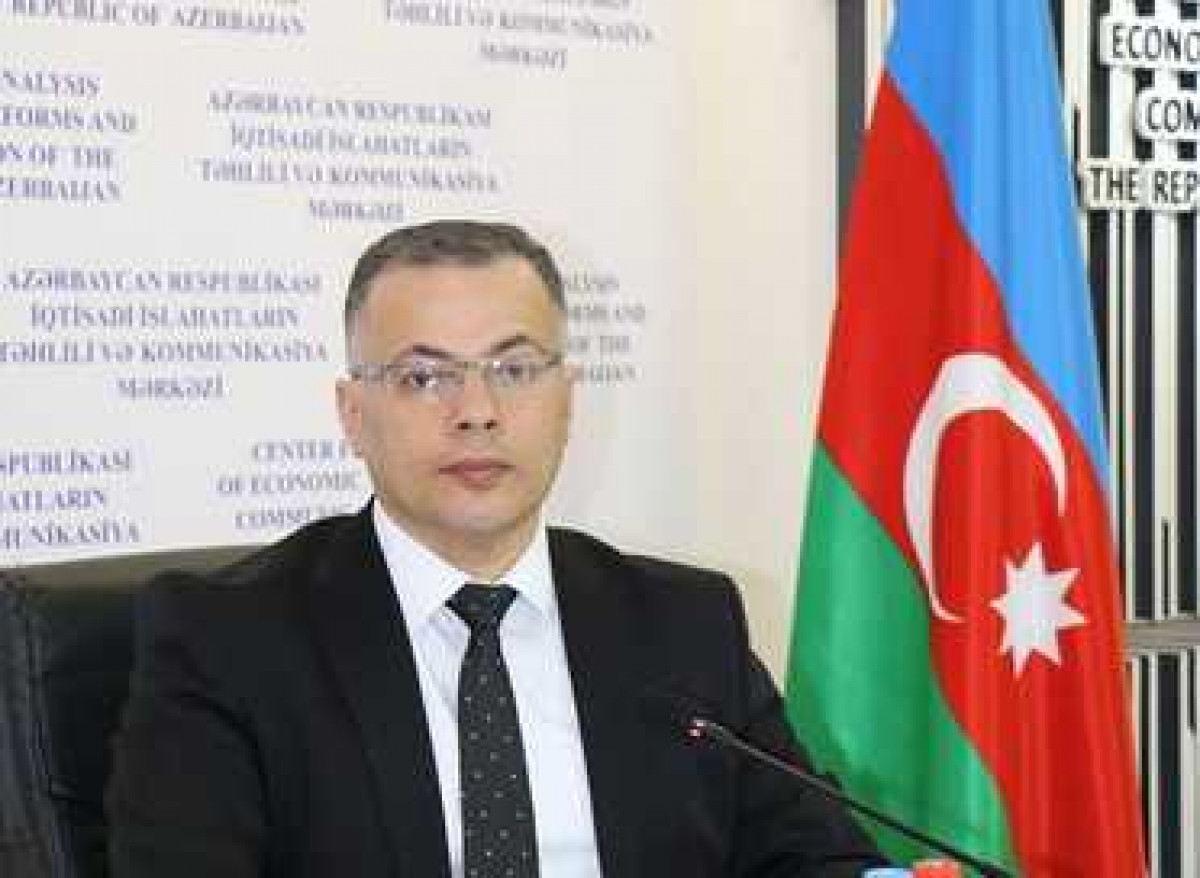
Vusal Gasimli: Interest Rate Corridor Parameters Should Be Balancing
According to the decision of the Central Bank of Azerbaijan, the policy rate was kept unchanged at 7.25% and the lower bound of the interest rate corridor at 6.75%, while the upper bound of the corridor was reduced from 9% to 8%. Commenting on this decision, Vusal Gasimli, Executive Director of the CAERC, stated that the upper limit of the interest rate corridor determines the one-day placement (reverse repo) rate: “Thus, by placing funds at a rate that is 1 percentage point cheaper, the Central Bank signals its intention to reduce the average market interest rate and provide affordable liquidity. This is because interest rates in the interbank money market had been rising, which could ultimately lead to higher lending rates. On the other hand, an increase in the cost of money in the interbank market signals an incentive to increase savings, which is not yet observable in practice.”
According to Gasimli, the contraction of the monetary base by more than AZN 2 billion, or 17 percent, in March–April of this year alone has contributed to an increase in interest rates in manat terms: “The decline in manat cash in circulation and bank reserves restricts credit resources and exerts upward pressure on interest rates. At the same time, the money multiplier—the banking system’s capacity to create money—declines. Average rates in the interbank repo market also nearly doubled in March–April of this year. Therefore, lowering the upper bound of the interest rate corridor will have a restraining effect on interest rates.”
Vusal Gasimli believes that, against the backdrop of a deficit in the balance of payments, reducing interest rates is desirable to stimulate investment activity: “The availability of affordable and favorable financing sources is a key condition in combating a crisis.”
According to Gasimli, the emergence of a balance of payments deficit does not allow for a reduction in the policy rate: “On the one hand, the economy needs cheap financing; on the other hand, in order to preserve manat stability and keep inflation under control, the policy rate cannot be reduced. Therefore, the parameters of the interest rate corridor should be balancing for the macroeconomy. At present, the priorities are financial stability, inflation control, and financing of the real sector.”
In the view of the CAERC head, the Central Bank’s previous decision also raised the minimum bound of the interest rate corridor, namely the one-day absorption (repo) rate: “Currently, the interest rate corridor is at its narrowest range in the past year, as the upper bound has been steadily reduced while the lower bound has been increased—effectively bringing them closer together. For example, if the difference between the lower and upper bounds of the corridor was 4% one year ago, it has now narrowed to 1.25%. Notably, the spread between lending and deposit rates has also been shrinking in parallel.”
Gasimli added that through the lower and upper bounds of the interest rate corridor—which cover one-day liquidity absorption and placement—the Central Bank can flexibly regulate market liquidity: “As is the case globally, our Central Bank aims to reduce the spread between the corridor it offers and the average market rate, thereby strengthening the transmission mechanism. In this context, it would be appropriate for Azerbaijan to determine an average market interest rate benchmark in line with international methodology. Such a tool could serve as a reference point for pricing in the money market and for use in monetary policy. To present short-term interbank interest rates, indices such as EONIA in the Eurozone, RUONIA in Russia, and TONIA in Kazakhstan are used.”
Related news

A representative of the CAERC participated in a conference dedicated to the future…
Rashad Najafli, Deputy Director of the Economic Analysis Department of the Center for Analysis of Economic Reforms and Communication (CAERC), participated in the international conference on “New Challenges in Maintaining Financial…

New Opportunities in Technology Parks: Commercialization and Export of Innovations
The Decree of the President of the Republic of Azerbaijan dated October 22, 2026 on Amendments to the “Model Regulation on Technology Parks” provides for important innovations in terms of improving the activities of technoparks,…

Vusal Gasimli spoke at the opening of the Islamic Finance Forum
Vusal Gasimli, Executive Director of the Center for Analysis of Economic Reforms and Communication (CAERC) — a Doctor of Economic Sciences and Professor — delivered a speech at the opening ceremony of the "3rd Islamic…

CAERC expands cooperation with think tanks and universities in Uzbekistan
Ilyas Huseynov, Head of the Turkic World Research Center (TWRC) at the Center for Analysis of Economic Reforms and Communication (CAERC), held meetings with representatives from think tanks and higher education institutions, and delivered…

Meetings regarding preparations for the final monitoring and evaluation of the Socio-Economic…
The Center for Analysis of Economic Reforms and Communication (CAERC) has concluded a series of meetings with representatives from relevant government agencies. These meetings were held to refine outcome indicators for the year 2026—within…

The investment portfolio of “Enterprise Azerbaijan”’s partners exceeds 3 billion…
The global innovation program “Startup School 4: Five Continents – 500 Startups,” implemented by the “Enterprise Azerbaijan” portal of the Center for Analysis of Economic Reforms and Communication (CAERC),…

The establishment of the Karabakh National Park creates new opportunities for ecological…
The Order of the President of the Republic of Azerbaijan, Ilham Aliyev, dated October 20, 2026, "On the Establishment of the Karabakh National Park of the Republic of Azerbaijan," is regarded as a significant step toward…

World Bank: Azerbaijan’s strong financial buffers support economic stability and…
The "Europe and Central Asia Economic Update" and the "Macro-Poverty Outlook" for Azerbaijan, published by the World Bank in October 2026, indicate that the country has maintained its macroeconomic stability, strong…
Op-eds
Ilkin Gasimov
Chief advisor of the Economic analysis division
New Financial Model for Resource Allocation in General Education
Baghish Ahmadov
Advisor to the Executive director of the Center for Analysis of Economic Reforms and Communication
Azerbaijan International Investment Forum: Investment Cooperation and National Development Priorities
Abdulrahim Dadashov
Deputy head of the Monitoring and evaluation division
Environmental Responsibility is One of the Key Conditions in the Development of the Mining Industry
Latif Zeynalli
Head of State Programs Division
Development of Competition Will Create New Opportunities for Sustainable Economic Growth
Orkhan Sadigov
Head of the Monitoring and evaluation division
A New Approach to Managing Off-Budget Funds Will Strengthen Financial Discipline
Elshan Yusifli
Head of the Monitoring of sectoral programs sector
New Changes to Nakhchivan’s State Programme: Export, Logistics and Social Mechanisms Improved
Abdulrahim Dadashov
Deputy head of the Monitoring and evaluation division
New Law Strengthens the Sustainable Development and Digital Monitoring of the Fisheries Sector