
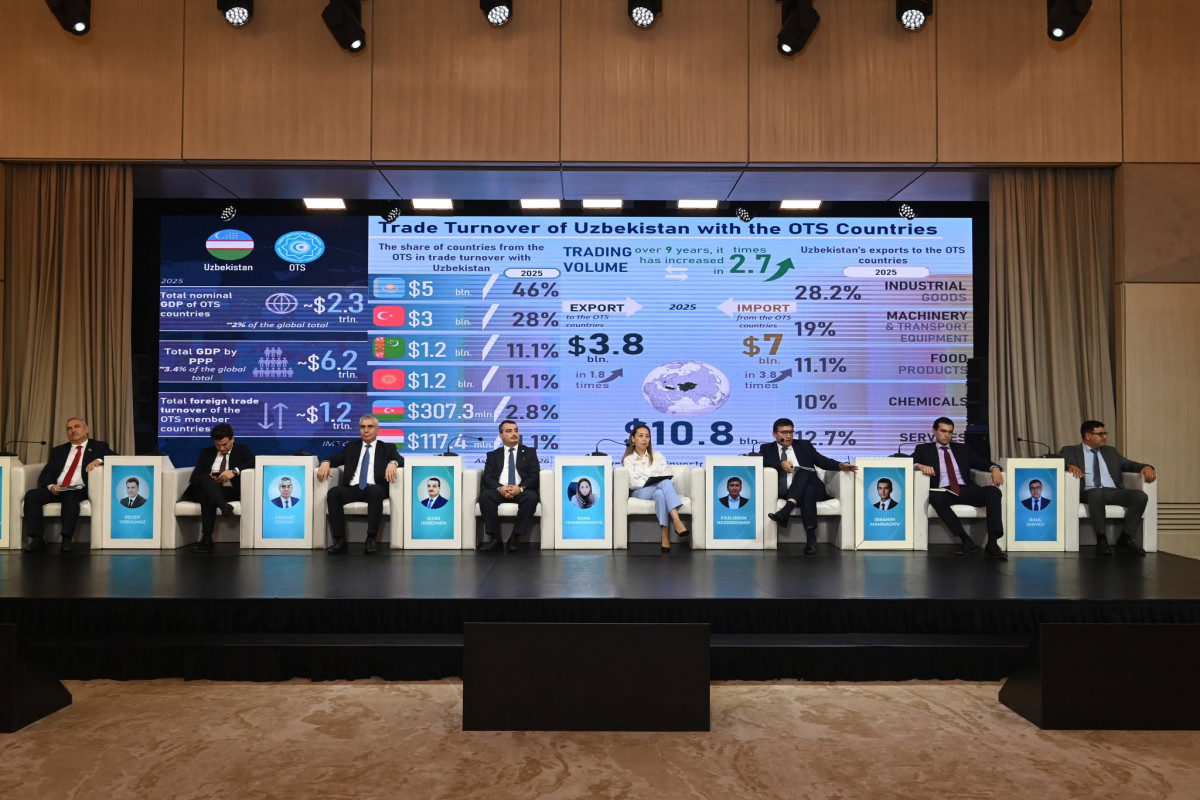
Three panels held as part of the “2nd International Conference of Leading National Think Tanks of Turkic States”
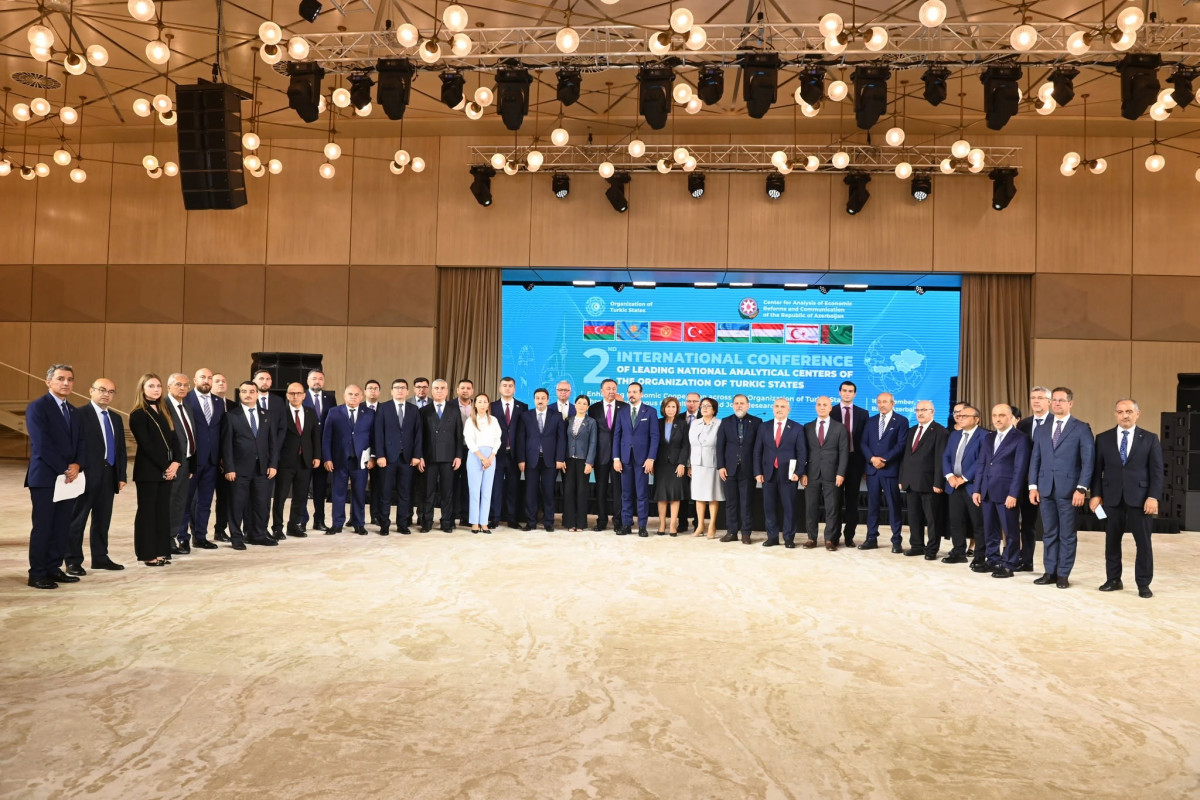
Three panels dedicated to regional integration, trade and economic cooperation, innovation, and economic transformation were organized as part of the “2nd International Conference of Leading National Think Tanks of Turkic States”, jointly organized by the Center for Analysis of Economic Reforms and Communication (CAERC) and the Secretariat of the Organization of Turkic States (OTS).
The first panel of the conference, titled “The Role of the Middle Corridor in Advancing Regional Integration and Infrastructure-Led Development”, was moderated by Fariz Ismayilzade, Member of the Milli Majlis and Director of the Institute for Development and Diplomacy.
The panel featured speeches by Farid Shafiyev, Chairman of the Board of the Center of Analysis of International Relations and Multiculturalism; Ramazan Erdağ, Head of the Center for Strategic Research of the Ministry of Foreign Affairs of Türkiye; Balázs Hendrich, Head of the Representation of the Organization of Turkic States in Hungary; Yaşar Sarı, Head of the Heydar Aliyev Eurasian Studies Center at Ibn Haldun University; Adilbek Yermekbaev, Director of the Center for Regional Studies at Al-Farabi Kazakh National University; İlyas Bozkurt, President of the Turkish Center for Economic, Political and Strategic Research (TESAM); and Okyay Sadıkoğlu, Head of the Northern Cyprus Promotion Platform.
The discussions focused on the role of the Middle Corridor in strengthening regional and international connectivity among Turkic states, deepening economic integration, and accelerating infrastructure-led development. Issues related to the development of transport and logistics infrastructure, harmonization of cross-border logistics and customs procedures, the formation of regional value chains, and financing of major infrastructure projects were discussed. An exchange of views was also held on the importance of the Middle Corridor in terms of geoeconomic resilience and economic diversification.
The second panel, titled “Assessment of Trade and Economic Relations among OTS Member States: Current Trends and Untapped Opportunities”, was moderated by Mehmet Yüce, Communications Counsellor at the Embassy of Türkiye in Uzbekistan.
The panel featured speeches by Nazim Imanov, Director General of the Institute of Economics of the Ministry of Science and Education of the Republic of Azerbaijan; Suat Beylur, Director of the Institute of Eurasian Studies at Khoja Akhmet Yassawi International Kazakh-Turkish University in Kazakhstan; Mirshohid Aslanov, Co-Founder of Uzbekistan’s Center for Progressive Reforms; Timur Abylaev, Deputy Director of the National Institute for Strategic Initiatives under the President of the Kyrgyz Republic; Cemal Akkuş, President of Türkiye’s Center for Alternative Studies and Secretary General of the Turkic World Yörük Türkmen Union; and László Vasa, Head of the Ludovika Turkic Studies Center in Hungary.
The panel participants discussed opportunities for deepening economic integration among OTS member states, expanding trade relations, and making more effective use of existing economic potential. The discussions addressed the harmonization of trade policies and customs procedures, reduction of domestic economic barriers, diversification of economies, and promotion of innovation-driven development.
The third panel, titled “Innovation for Sustainable Development: Policy Frameworks and Economic Transformation”, was also held as part of the conference.
The panel was moderated by Azer Allahveranov, Member of the Milli Majlis and Secretary General of the NGO Platform of Member States of the Organization of Turkic States. The discussion featured Recep Yorulmaz, Chairman of Türkiye’s Center for International Economic and Political Studies; Azamat Toshev, representative of Uzbekistan’s International Institute for Central Asia; Ilyas Huseynov, Head of the Center for Turkic World Studies at CAERC; Dana Yessenzhanova, representative of Kazakhstan’s International Science and Technology Center; Fazliddin Nasriddinov, Head of a Department at the Center for Economic Research and Reforms under the Administration of the President of the Republic of Uzbekistan; Ibrahim Mammadov, Head of the Turkic-Western Relations Initiative at Hungary’s Danube Institute; and Raul Dinyev, Chairman of the Azerbaijan Diaspora Center of the Turkish Republic of Northern Cyprus.
The panel discussed the role of innovation in ensuring sustainable economic development in Turkic states, digital trade and the formation of a unified digital economic ecosystem, the impact of artificial intelligence on economic transformation, and the development of digital infrastructure and data governance mechanisms.
Thus, the three panels held as part of the conference provided an extensive platform for discussing the prospects for developing economic cooperation among Turkic states in the areas of transport and logistics, trade, investment, digitalization, innovation, and human capital. The sessions also served as a platform for exchanging views on expanding the exchange of experience and knowledge among national think tanks, increasing opportunities for joint research, and strengthening the institutional foundations of economic cooperation within the framework of the Organization of Turkic States.
Related news

CAERC Will Create a New Module for Monitoring the State Program on the Mining and…
Prime Minister of the Republic of Azerbaijan Ali Asadov has signed an Order on ensuring the implementation of Order No. 1226 of the President of the Republic of Azerbaijan dated September 23, 2026, "On approving the 'State…

New Pharmaceutical Manufacturing Facility Opens New Opportunities for the Development…
The participation of President of the Republic of Azerbaijan Ilham Aliyev in the inauguration of the pharmaceutical manufacturing facility of "Gen Pharma Caucasus Manufacturing Operations" LLC in the Pirallahi Industrial…

CAERC Honored with Two Awards at the "International Finance Awards 2026"
The Center for Analysis of Economic Reforms and Communication (CAERC) has been honored with awards in two categories at the "International Finance Awards 2026," organized by the UK-based international media publication International…

Increasing Wages and Social Payments May Positively Impact Economic Activity
The statement by President Ilham Aliyev at the 8th Congress of the New Azerbaijan Party announcing that the minimum wage, pensions, and social allowances will be increased next year demonstrates that the social policy aimed at boosting…

Energy Security: Azerbaijan's Growing Role and New Opportunities
During his speech at the 8th Congress of the New Azerbaijan Party, President Ilham Aliyev emphasized Azerbaijan's expanding role in energy security, stating: "...rich in energy resources, Azerbaijan is turning into a very…

The Great Return at a New Stage: Sustainable Settlement and Economic Development
The restoration of the liberated territories and the return of former internally displaced persons (IDPs) to their native homelands are evaluated as an integral part of long-term socio-economic development. Under these circumstances,…

The final “Demo Day” of the “Startup School 4” programme of the Enterprise Azerbaijan…
The “Demo Day” event, the final stage of the “Startup School 4: Five Continents – 500 Startups” global innovation programme of the Enterprise Azerbaijan portal of the Center for Analysis of Economic…

Azerbaijan’s “Smart Monitoring” experience featured in an international publication
An article by Professor Vusal Gasimli, Executive Director of the Center for Analysis of Economic Reforms and Communication (CAERC), has been published in “Governance Matters”, a journal of the Chandler Governance Group…
Op-eds
Ilkin Gasimov
Chief advisor of the Economic analysis division
New Financial Model for Resource Allocation in General Education
Baghish Ahmadov
Advisor to the Executive director of the Center for Analysis of Economic Reforms and Communication
Azerbaijan International Investment Forum: Investment Cooperation and National Development Priorities
Abdulrahim Dadashov
Deputy head of the Monitoring and evaluation division
Environmental Responsibility is One of the Key Conditions in the Development of the Mining Industry
Latif Zeynalli
Head of State Programs Division
Development of Competition Will Create New Opportunities for Sustainable Economic Growth
Orkhan Sadigov
Head of the Monitoring and evaluation division
A New Approach to Managing Off-Budget Funds Will Strengthen Financial Discipline
Elshan Yusifli
Head of the Monitoring of sectoral programs sector
New Changes to Nakhchivan’s State Programme: Export, Logistics and Social Mechanisms Improved
Abdulrahim Dadashov
Deputy head of the Monitoring and evaluation division
New Law Strengthens the Sustainable Development and Digital Monitoring of the Fisheries Sector