
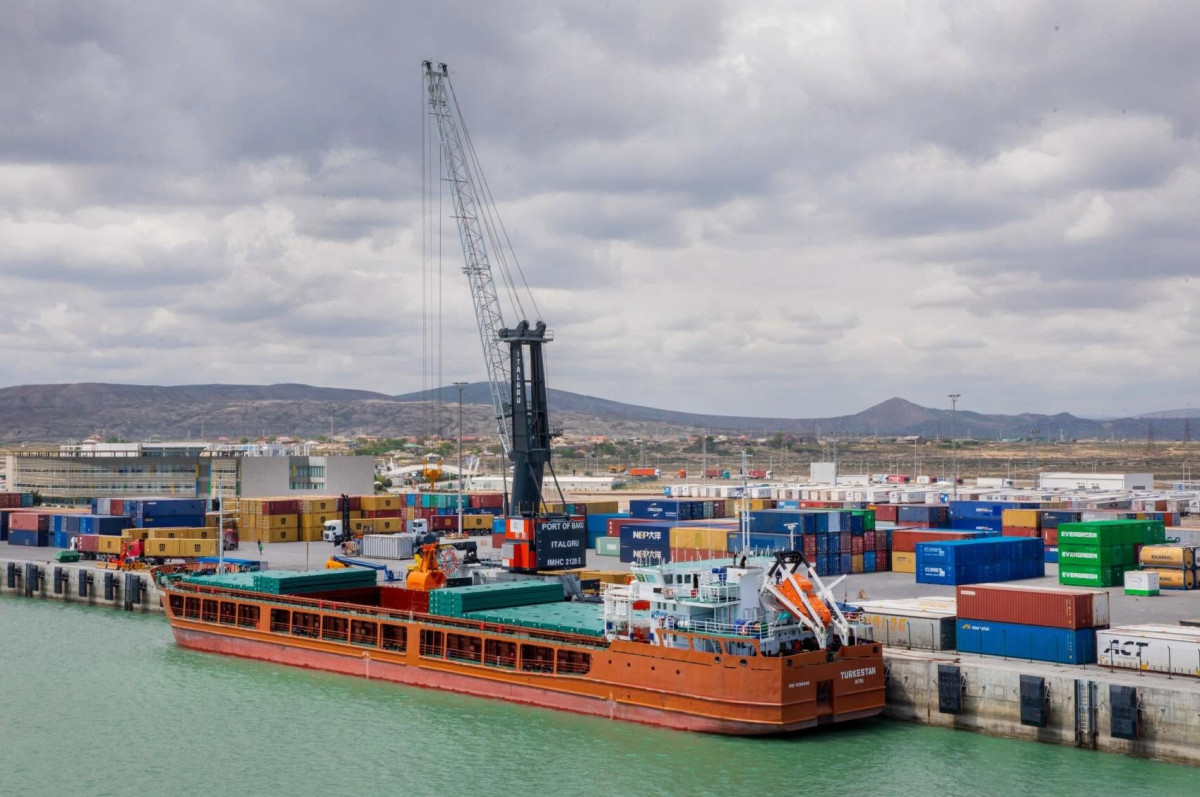
The Role of Baku Port in Azerbaijan’s Investment Attractiveness
When discussing Azerbaijan’s investment attractiveness, the country’s geographical location is one of the most frequently highlighted advantages. However, in the modern global economy, geographical location alone may not create an investment advantage. To transform this advantage into real economic value, it needs to be complemented by modern transport infrastructure, access to international markets, resilient supply chains, logistics capabilities, and a business environment conducive to investors.
The agenda of the 2nd Azerbaijan International Investment Forum, held in Baku, also demonstrates the relevance of this approach. Among the Forum’s key areas of discussion are the role of the South Caucasus in global connectivity, the trade, industrial, and connectivity potential of the Middle Corridor, industrial platforms and free economic zones, regional supply chains, and investment opportunities. The Forum program particularly emphasizes the development of the Middle Corridor not merely as a transit route, but as a regional economic platform integrated with production, processing, and value-added activities. In this context, the role of the Port of Baku is of particular importance.
Isa Gasimov, Head of a Division at the Center for Analysis of Economic Reforms and Communication, stated that the Port of Baku, located in the Alat settlement, has been established in a strategic location connecting Azerbaijan’s main railway and road corridors with the Caspian Sea. This location makes the port one of the key infrastructure components of the Middle Corridor, which is developing along the China–Central Asia–Caspian Sea–Azerbaijan–South Caucasus–Türkiye–Europe route.
The importance of the Port of Baku in Azerbaijan’s transport strategy is not limited to maritime transportation. As a multimodal logistics hub connecting railway, road, and maritime transport, the port plays an important role in integrating the country into regional and global supply chains. According to official data, the port’s current cargo handling capacity stands at 15 million tons of cargo and 100,000 TEUs, while the next stage of development envisages increasing these figures to 25 million tons and 500,000 TEUs, respectively. Thus, Azerbaijan’s geographical location is transformed into physical connectivity opportunities, which in turn create potential for economic activity.
In January–August 2026, more than 5.5 million tons of cargo and over 85,000 TEUs of containers were handled at the Port of Baku. Container throughput increased by 22 percent compared with the same period of the previous year, while dry cargo handling reached 1.6 million tons, representing an 80 percent increase. These figures demonstrate not only the growth in the port’s cargo handling activity but also the potential emerging for expanding Azerbaijan’s participation in regional supply chains.
Isa Gasimov emphasized that the key issue here is not how much investment is made in the Port of Baku. The more fundamental question is what new investment can be attracted to Azerbaijan through the port itself. For an investor, logistics infrastructure is not merely about transporting cargo from one point to another. Efficient and secure logistics enable more reliable access to raw materials for production, access to regional and global markets for products, diversification of supply chains, and optimization of logistics costs.
In this regard, the impact of the Port of Baku on investment attractiveness is shaped in two directions: first, the port expands the opportunities for companies operating in Azerbaijan to access foreign markets; second, the connectivity it creates provides opportunities for locating logistics, warehousing, distribution, processing, packaging, light industry, and other value-added activities in the country. Thus, the investment function of the port is not limited to handling cargo, but also involves creating conditions for new economic activity around the port. In this regard, the establishment of the Alat Free Economic Zone near the Port of Baku is of particular importance.
The key objectives of the Alat Free Economic Zone include attracting foreign investment, developing export-oriented and high-value-added production, and strengthening Azerbaijan’s position as a regional logistics and trade hub. In its latest market overview on Azerbaijan, the U.S. Department of Commerce also presents the Alat Free Economic Zone as a manufacturing and logistics hub adjacent to the Port of Baku. The significance of this model lies in the combination of two distinct advantages in one location: the Port of Baku provides physical and multimodal access to international markets, while the Alat Free Economic Zone provides a special economic and legal environment for production, investment, and business activity. This integration enables Azerbaijan to complement its transit function with production and export opportunities.
For this reason, the session titled “Industrial Platforms and Free Economic Zones: Azerbaijan as a Regional Manufacturing Hub” at the 2nd Azerbaijan International Investment Forum specifically addresses the integration of industrial platforms with logistics infrastructure, value-added production, and regional supply chains.
Isa Gasimov noted that the role of the Port of Baku in investment attractiveness cannot be considered separately from the Middle Corridor in a broader context. Among the topics of the dedicated Middle Corridor session in the “AIIF 2026” program are Trans-Caspian connectivity, the development of multimodal transport infrastructure, railways, ports and logistics capabilities, strengthening trade and investment ties between Central Asia, Azerbaijan, and China, as well as the transition from transit to production, processing, and value-added activities.
In this context, the importance of the Port of Baku is not limited to the mere passage of cargo flows through Azerbaijan. The key opportunity lies in utilizing these flows for investment, production, processing, logistics, and export activities within the country. As the physical hub of the Middle Corridor in Azerbaijan, the Port of Baku can also become one of the key platforms contributing to the formation of its economic value chain.
At the same time, investment attractiveness is not ensured solely by the development of new infrastructure. For investors, the speed, predictability, and level of integration of the logistics system are at least as important as the physical infrastructure itself. In this regard, the integrated functioning of ports, railways, roads, customs, border procedures, and logistics services as a unified system is of particular importance.
Following the integration of the Port of Baku into the structure of Azerbaijan Railways in 2025, the coordination of port and railway operations under a unified management model, as well as the establishment of a Single Transit Center at the port, can be considered among the steps taken in this direction. Bringing customs, border, migration, and other related services together within this center is aimed at reducing time losses in logistics processes. This experience demonstrates that, at the next stage, Azerbaijan’s competitive advantage may be determined not only by the scale of its infrastructure, but also by the efficiency and coordination with which it and related services operate.
Thus, the agenda of the 2nd Azerbaijan International Investment Forum highlights an important direction in the approach to Azerbaijan’s investment attractiveness: the country’s strategic geographical location is no longer viewed solely as a transit advantage, but together with the opportunities it creates for regional connectivity, production, investment, and economic value creation.
Related news

A representative of the CAERC participated in a conference dedicated to the future…
Rashad Najafli, Deputy Director of the Economic Analysis Department of the Center for Analysis of Economic Reforms and Communication (CAERC), participated in the international conference on “New Challenges in Maintaining Financial…

New Opportunities in Technology Parks: Commercialization and Export of Innovations
The Decree of the President of the Republic of Azerbaijan dated October 22, 2026 on Amendments to the “Model Regulation on Technology Parks” provides for important innovations in terms of improving the activities of technoparks,…

Vusal Gasimli spoke at the opening of the Islamic Finance Forum
Vusal Gasimli, Executive Director of the Center for Analysis of Economic Reforms and Communication (CAERC) — a Doctor of Economic Sciences and Professor — delivered a speech at the opening ceremony of the "3rd Islamic…

CAERC expands cooperation with think tanks and universities in Uzbekistan
Ilyas Huseynov, Head of the Turkic World Research Center (TWRC) at the Center for Analysis of Economic Reforms and Communication (CAERC), held meetings with representatives from think tanks and higher education institutions, and delivered…

Meetings regarding preparations for the final monitoring and evaluation of the Socio-Economic…
The Center for Analysis of Economic Reforms and Communication (CAERC) has concluded a series of meetings with representatives from relevant government agencies. These meetings were held to refine outcome indicators for the year 2026—within…

The investment portfolio of “Enterprise Azerbaijan”’s partners exceeds 3 billion…
The global innovation program “Startup School 4: Five Continents – 500 Startups,” implemented by the “Enterprise Azerbaijan” portal of the Center for Analysis of Economic Reforms and Communication (CAERC),…

The establishment of the Karabakh National Park creates new opportunities for ecological…
The Order of the President of the Republic of Azerbaijan, Ilham Aliyev, dated October 20, 2026, "On the Establishment of the Karabakh National Park of the Republic of Azerbaijan," is regarded as a significant step toward…

World Bank: Azerbaijan’s strong financial buffers support economic stability and…
The "Europe and Central Asia Economic Update" and the "Macro-Poverty Outlook" for Azerbaijan, published by the World Bank in October 2026, indicate that the country has maintained its macroeconomic stability, strong…
Op-eds
Ilkin Gasimov
Chief advisor of the Economic analysis division
New Financial Model for Resource Allocation in General Education
Baghish Ahmadov
Advisor to the Executive director of the Center for Analysis of Economic Reforms and Communication
Azerbaijan International Investment Forum: Investment Cooperation and National Development Priorities
Abdulrahim Dadashov
Deputy head of the Monitoring and evaluation division
Environmental Responsibility is One of the Key Conditions in the Development of the Mining Industry
Latif Zeynalli
Head of State Programs Division
Development of Competition Will Create New Opportunities for Sustainable Economic Growth
Orkhan Sadigov
Head of the Monitoring and evaluation division
A New Approach to Managing Off-Budget Funds Will Strengthen Financial Discipline
Elshan Yusifli
Head of the Monitoring of sectoral programs sector
New Changes to Nakhchivan’s State Programme: Export, Logistics and Social Mechanisms Improved
Abdulrahim Dadashov
Deputy head of the Monitoring and evaluation division
New Law Strengthens the Sustainable Development and Digital Monitoring of the Fisheries Sector