
Azerbaijan–Kyrgyzstan Alliance: From Strategic Partnership to a New Phase of Economic Integration
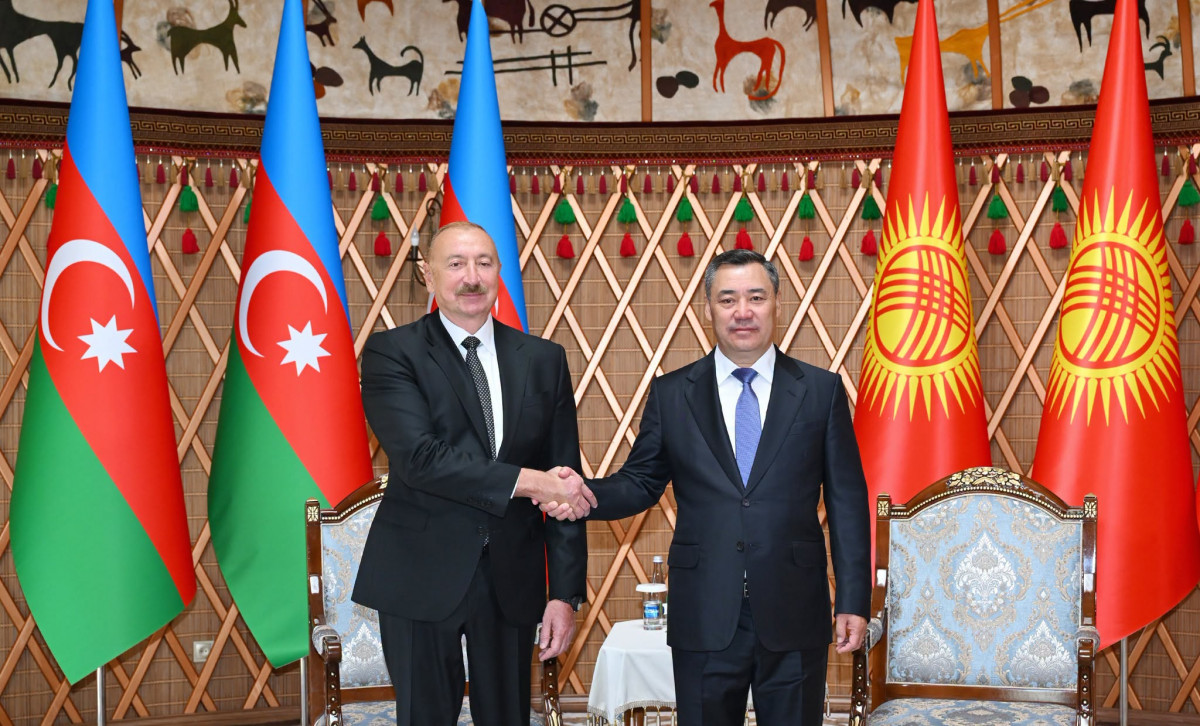
The state visit of the President of the Republic of Azerbaijan, Ilham Aliyev, to the Kyrgyz Republic laid the foundation for a qualitatively new stage in Azerbaijan–Kyrgyzstan relations. The "Treaty on Alliance Relations between the Republic of Azerbaijan and the Kyrgyz Republic," signed within the framework of the visit, elevated the legal and political framework of cooperation between the two brotherly countries from a strategic partnership to a higher tier—an alliance. This document holds historical significance not only for bilateral relations, but also for the political integration of the Turkic world as a whole.
Ilyas Huseynov, Head of the Center for Turkic World Studies (TDAM) at the Center for Analysis of Economic Reforms and Communication (CAERC), stated that in recent years, Azerbaijan has been strengthening institutional integration and consistently developing its ties within the Organization of Turkic States (OTS). The Treaty on Alliance Relations signed in Cholpon-Ata establishes a new political platform grounded in mutual trust, respect for sovereignty, and long-term cooperation across security, economic, transport, energy, and humanitarian spheres. Meanwhile, the convening of the 3rd meeting of the Interstate Council demonstrates that bilateral relations are no longer limited to political dialogue, but are transforming into a sustainable development model driven by concrete implementation mechanisms.
One of the most significant outcomes of the visit was the strategic steps taken toward expanding economic cooperation. The agreements signed between Azerbaijan and Kyrgyzstan encompass critical sectors such as investment, energy, transport, logistics, statistics, financial markets, and digital security. Notably, the Second Additional Protocol concerning the expansion of the operations of the Azerbaijan–Kyrgyz Development Fund holds major importance for financing joint investment projects between the two nations. This fund will facilitate the execution of large-scale projects across industry, agriculture, logistics, tourism, and manufacturing in the future.
As of July 1 of the current year, 97 commercial entities backed by Kyrgyz capital are registered in Azerbaijan across agriculture, industry, construction, trade, transport, and services, with 39 currently active. To date, cumulative direct investment flows from Azerbaijan to Kyrgyzstan stand at $68.8 million, while direct investment from Kyrgyzstan to Azerbaijan totals $25.2 million, predominantly concentrated in the non-oil and gas sector. The agreement on the promotion and mutual protection of investments, signed between the two countries on August 28, 1997, remains in full legal force.
In January–June of this year, trade turnover between Azerbaijan and Kyrgyzstan reached approximately 29 million USD. During the six-month period, exports from Azerbaijan to Kyrgyzstan totaled $25.5 million, while imports from Kyrgyzstan to Azerbaijan stood at $3.4 million. In the preceding year, total trade turnover between the two countries surpassed $77.1 million.
Economic indicators for the first quarter of 2026 also demonstrate substantial potential for expanded cooperation. The combined GDP of OTS member states reached 673.6 billion USD, with a collective population of 178.8 million and a total trade volume of 326 billion USD. During this period, the economy of Kyrgyzstan expanded by 10.1 percent, industrial output by 14 percent, fixed capital investment by 25.5 percent, and banking sector assets by 23 percent. These indicators position Kyrgyzstan as one of the most dynamically developing economies in the region. Meanwhile, Azerbaijan plays a pivotal partner role for Kyrgyzstan through its extensive expertise in transport-logistics infrastructure, energy projects, and investment climate enhancement, making the economic models of both nations highly complementary.
Huseynov added that among the signed documents, agreements on cooperation in cargo transit, maritime shipping, and shipbuilding draw particular attention. These legal instruments will serve to further expand freight transportation along the Trans-Caspian International Transport Route (Middle Corridor). Situated on the western shore of the Caspian Sea and in the heart of Central Asia respectively, Azerbaijan and Kyrgyzstan occupy crucial transit positions between Europe and Asia. The infrastructure network comprising the Baku International Sea Trade Port, the Baku–Tbilisi–Kars railway, and Caspian multimodal transport lines significantly enhances Central Asia’s access to European markets. Concurrently, memorandums signed on cargo transit, logistics, and digital transport solutions will contribute to bolstering the overall competitiveness of the Middle Corridor.
During the visit, a memorandum of understanding on energy sector cooperation and an accompanying 2026–2028 Roadmap established a structured legal framework for petroleum product supplies, energy security initiatives, and future green energy projects. In addition, memorandums signed in cybersecurity, financial market regulation, and statistical standardization represent important steps serving the digital transformation of bilateral economic ties.
The signing of sister-city memorandums between Shusha–Cholpon-Ata, Gabala–Karakol, and Ganja–Osh during the visit further reinforces the humanitarian dimension of bilateral relations. This initiative will facilitate expanded cooperation across tourism, education, culture, youth policy, and local administration. In particular, cooperation between Shusha and Cholpon-Ata holds special significance for developing ties between two major cultural capitals of the Turkic world.
The Head of TDAM emphasized that relations between Azerbaijan and Kyrgyzstan have transcended a purely bilateral framework to become a core component of broader integration processes within the Organization of Turkic States. The alliance treaty, the expansion of economic cooperation, the development of the investment fund, new transport and energy initiatives, municipal twinning, and the deepening of institutional alignment demonstrate that Baku and Bishkek are positioned to serve as primary locomotives of economic integration in the Turkic world in the coming years.
The strategic agreements reached as a result of this state visit serve not only the national interests of both states, but also make a significant contribution toward the operational expansion of the Middle Corridor, regional trade growth, capital mobility, and the consolidation of a unified economic space across the Turkic world. The Azerbaijan–Kyrgyzstan alliance thus stands as one of the foundational pillars of a new phase of economic integration alongside political solidarity within the Turkic world.
Related news

Vusal Gasimli spoke at the opening of the Islamic Finance Forum
Vusal Gasimli, Executive Director of the Center for Analysis of Economic Reforms and Communication (CAERC) — a Doctor of Economic Sciences and Professor — delivered a speech at the opening ceremony of the "3rd Islamic…

CAERC expands cooperation with think tanks and universities in Uzbekistan
Ilyas Huseynov, Head of the Turkic World Research Center (TWRC) at the Center for Analysis of Economic Reforms and Communication (CAERC), held meetings with representatives from think tanks and higher education institutions, and delivered…

Meetings regarding preparations for the final monitoring and evaluation of the Socio-Economic…
İqtisadi İslahatların Təhlili və Kommunikasiya Mərkəzində (İİTKM) “Azərbaycan Respublikasının 2022–2026-cı illərdə sosial-iqtisadi inkişaf Strategiyası” çərçivəsində 2026-cı ilin yekunları üzrə…

The investment portfolio of “Enterprise Azerbaijan”’s partners exceeds 3 billion…
The global innovation program “Startup School 4: Five Continents – 500 Startups,” implemented by the “Enterprise Azerbaijan” portal of the Center for Analysis of Economic Reforms and Communication (CAERC),…

The establishment of the Karabakh National Park creates new opportunities for ecological…
The Order of the President of the Republic of Azerbaijan, Ilham Aliyev, dated October 20, 2026, "On the Establishment of the Karabakh National Park of the Republic of Azerbaijan," is regarded as a significant step toward…

World Bank: Azerbaijan’s strong financial buffers support economic stability and…
The "Europe and Central Asia Economic Update" and the "Macro-Poverty Outlook" for Azerbaijan, published by the World Bank in October 2026, indicate that the country has maintained its macroeconomic stability, strong…

The new healthcare management model aims to improve the quality and accessibility…
The Decree “On a Number of Measures Related to the Improvement of Management in the Healthcare Sector,” signed by President of the Republic of Azerbaijan Ilham Aliyev on 19 October 2026, represents the next stage of reforms…

An event dedicated to the Day of Restoration of Independence - October 18, was held…
An educational meeting titled “Azerbaijan’s State Independence Is Eternal, Primordial and Irreversible” was held at the Center for Analysis of Economic Reforms and Communication on the initiative of Reform Volunteers…
Op-eds
Ilkin Gasimov
Chief advisor of the Economic analysis division
New Financial Model for Resource Allocation in General Education
Baghish Ahmadov
Advisor to the Executive director of the Center for Analysis of Economic Reforms and Communication
Azerbaijan International Investment Forum: Investment Cooperation and National Development Priorities
Abdulrahim Dadashov
Deputy head of the Monitoring and evaluation division
Environmental Responsibility is One of the Key Conditions in the Development of the Mining Industry
Latif Zeynalli
Head of State Programs Division
Development of Competition Will Create New Opportunities for Sustainable Economic Growth
Orkhan Sadigov
Head of the Monitoring and evaluation division
A New Approach to Managing Off-Budget Funds Will Strengthen Financial Discipline
Elshan Yusifli
Head of the Monitoring of sectoral programs sector
New Changes to Nakhchivan’s State Programme: Export, Logistics and Social Mechanisms Improved
Abdulrahim Dadashov
Deputy head of the Monitoring and evaluation division
New Law Strengthens the Sustainable Development and Digital Monitoring of the Fisheries Sector