
World Bank: Azerbaijan’s strong financial buffers support economic stability and a new phase of development
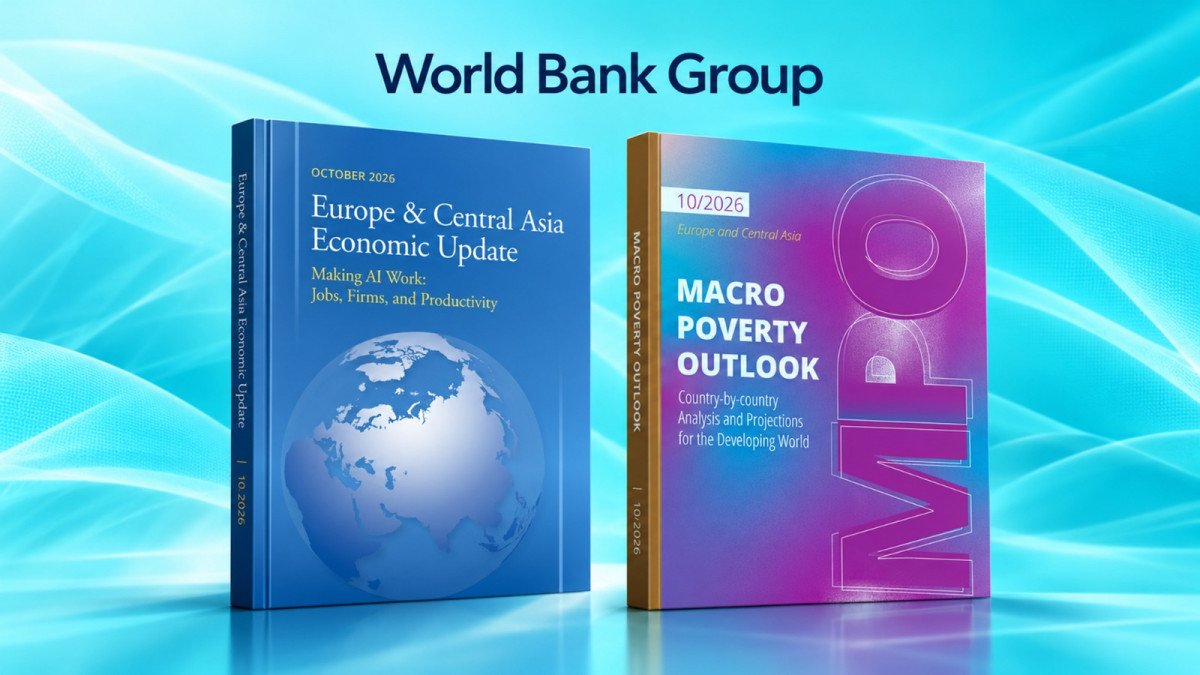
The "Europe and Central Asia Economic Update" and the "Macro-Poverty Outlook" for Azerbaijan, published by the World Bank in October 2026, indicate that the country has maintained its macroeconomic stability, strong fiscal buffers, and robust external position amidst global geopolitical and economic uncertainties.
Commenting on the World Bank’s assessments of the Azerbaijani economy, Rashad Najafli, Deputy Head of the Economic Analysis Department at the Center for Analysis of Economic Reforms and Communication, stated that the indicators presented in the report demonstrate the country’s resilient financial defense system against external shocks.
It is particularly noteworthy that the World Bank’s assessment characterizes Azerbaijan’s macroeconomic framework as stable and its fiscal buffers as significant. The fact that the State Oil Fund’s assets have reached 73 billion US dollars—equivalent to approximately 96 percent of GDP—while public debt remains at just 18.2 percent of GDP, and the Central Bank’s foreign currency reserves have risen to 13.7 billion US dollars, represents significant financial strengths for the country. These indicators distinguish Azerbaijan as one of the countries in the region with the strongest fiscal and external buffers.
According to World Bank data, the state budget surplus reached 7 percent of GDP in the first half of 2026. For comparison, this figure stood at 2.6 percent at the end of 2025. High energy prices have not only boosted export revenues but also significantly strengthened the country's external economic position.
The current account surplus rose from 4.4 percent of GDP at the end of 2025 to 9.5 percent in the first quarter of 2026. Meanwhile, the trade surplus reached approximately 21 percent of GDP in the first half of 2026, compared to 3.7 percent during the same period in 2025. The Central Bank’s foreign currency reserves have increased to a level sufficient to cover approximately seven months of imports.
The World Bank forecasts that Azerbaijan’s strong financial position will be maintained through the end of the year, with the current account surplus projected to reach 7 percent of GDP and the fiscal surplus 4 percent of GDP by the end of 2026.
Rashad Najafli stated that the simultaneous maintenance of high budget, current account, and trade surpluses enhances Azerbaijan's capacity to withstand fluctuations in global energy prices, geopolitical risks, and potential pressures on international trade routes. These financial buffers serve not only as indicators of current stability but also as strategic capital for financing a new phase of economic development. The key priority is to channel these existing advantages toward expanding the non-oil sector, promoting private investment, advancing digitalization, developing human capital, and boosting productivity. Such an approach could transform financial resilience into long-term structural competitiveness.
The World Bank forecasts that Azerbaijan's economy will grow by 1.2 percent in 2026, 1.8 percent in 2027, and 1.9 percent in 2028. In the medium term, an acceleration in growth is contingent upon the continued reform of the business environment, an increase in private investment in non-oil sectors, and the diversification of the sources of economic activity. The report states that growth in the services sector is projected to rise from 2.6 percent in 2026 to 3.4 percent in 2027, and further to 3.6 percent in 2028. Growth in the agricultural sector is expected to reach 2.2 percent in 2027 and 2.4 percent in 2028. These forecasts indicate that the role of non-oil sectors in economic growth may gradually strengthen.
Assessing the dynamics within the banking sector positively, Rashad Najafli noted that the 12.1 percent increase in lending to the economy and the 13.3 percent rise in loans to the population—projected through June 2026—indicate an expansion in financial intermediation. A 24.2 percent growth in banks' net profit, alongside a 16.4 percent increase in provisions for potential losses, demonstrates that the sector has strengthened its capacity both to support economic activity and to build buffers against risks.
Inflation is projected to remain within the Central Bank of Azerbaijan’s target range of 4±2 percent, standing at 5.8 percent by the end of 2026, before declining to 4.6 percent in 2027 and 4 percent in 2028.
The key takeaway from the World Bank report is that Azerbaijan has entered this period of global uncertainty with significant financial reserves, low public debt, and a strong external position. In the period ahead, complementing these advantages with the improvement of the business environment, an increase in private investment, technological upgrading, and the development of human capital could create a solid foundation for higher and sustainable economic growth.
Source:
World Bank, “Europe and Central Asia Economic Update, October 2026: Making AI Work – Jobs, Firms, and Productivity”
“Macro Poverty Outlook: Azerbaijan, October 2026”
https://thedocs.worldbank.org/en/doc/d5f32ef28464d01f195827b7e020a3e8-0500022021/related/mpo-eca.pdf
Related news

A representative of the CAERC participated in an international training on capital…
Rashad Najafli, Deputy Head of the Economic Analysis Department at the Center for Analysis of Economic Reforms and Communication (CAERC), participated in an international training session held in Almaty, Kazakhstan. The training,…

Staff members of the IITKM participated in an international training program on…
Staff members from the Center for Analysis of Economic Reforms and Communication (CAERC) participated in an international practical training program jointly organized by the National Artificial Intelligence Center (NAIC) and the School…

Vusal Gasimli met with the CEO of the international research center “Oxford Insights”
A meeting was held between Vusal Gasimli, Executive Director of the Center for Analysis of Economic Reforms and Communication (CAERC), Doctor of Economic Sciences, Professor, and Richard Stirling, Chief Executive Officer of the international…

CAERC presents special edition of “Invest in Garabagh and Eastern Zangezur” publication…
The Center for Analysis of Economic Reforms and Communication (CAERC) has published the third special edition of the “Invest in Garabagh and Eastern Zangezur” (Investment in Garabagh and East Zangezur) review on the occasion…

A meeting was held regarding the implementation of the State Program on Ensuring…
A meeting was held at the Center for Analysis of Economic Reforms and Communication (CAERC) to discuss the monitoring and evaluation of measures to be implemented under the “State Program on Ensuring Food Safety in the Republic…

The next meeting of the Coordination Group on the Global Innovation Index has been…
At the latest meeting of the Coordination Group on the Global Innovation Index, discussions focused on the results achieved by Azerbaijan in the "Global Innovation Index 2026" report, as well as future objectives. An online…

The final of the “Startup School 4: Five Continents – 500 Startups” program by the…
The final stage of the “Startup School 4: Five Continents – 500 Startups” global innovation programme, organised by the “Enterprise Azerbaijan” portal of the Center for Analysis of Economic Reforms and…

The final of the “Startup School 4: Five Continents – 500 Startups” program by the…
The finale – “Demo Day” – of the “Startup School 4: Five Continents – 500 Startups” global innovation program, hosted by the “Enterprise Azerbaijan” portal operated by the Center…
Op-eds
Ilyas Huseynov
Head of the Turkic World Research Center
Azerbaijan’s Chairmanship of the OTS: Deepening Economic and Trade Cooperation and Strengthening the Regional Economic Power…
Isa Gasimov
Head of the “Enterprise Azerbaijan” portal
New Opportunities in Technology Parks: Commercialization and Export of Innovations
Abdulrahim Dadashov
Deputy head of the Monitoring and evaluation division
The establishment of the Karabakh National Park creates new opportunities for ecological restoration and sustainable tourism…
Sevinj Jabbarova
Leading consultant of the Monitoring and evaluation division
New Pharmaceutical Manufacturing Facility Opens New Opportunities for the Development of Local Pharmaceutical Industry
Tarana Salifova
Advisor to the Executive Director of the CAERC
The Great Return at a New Stage: Sustainable Settlement and Economic Development
Rashad Najafli
Deputy head of the Economic analysis division
Azerbaijan advances on the path of innovation: Key directions of progress
Latif Zeynalli
Head of State Programs Division
Investment activity and a strong financial position create new opportunities for economic growth