
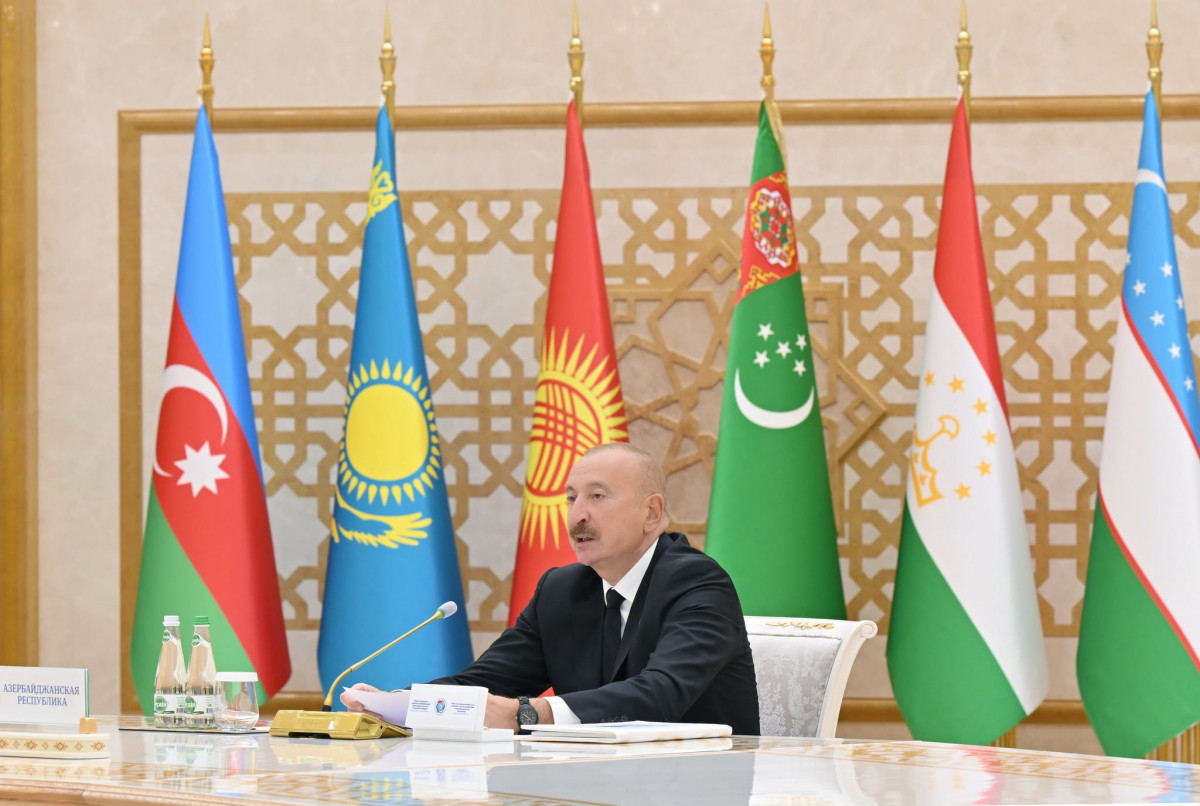
Integration between Azerbaijan and Central Asian countries is moving to a new stage in non-oil exports and digitalization.
The 8th Consultative Meeting of the Heads of State of the Republic of Azerbaijan and Central Asian Countries, held in Turkmenbashi, Turkmenistan, with the participation of President Ilham Aliyev, has defined a new trajectory for the development of political, economic and logistical ties between our countries. The President’s address at the meeting and the Joint Statement signed at its conclusion demonstrate that relations between Azerbaijan and Central Asian countries are moving beyond the traditional framework of political dialogue and entering a new phase characterised by a unified digital economy, joint export mechanisms and collective integration into global supply chains.
Commenting on the subject, Ayxan Gadeshov, Head of the Azexport.az portal at the Center for Analysis of Economic Reforms and Communication, stated that the establishment of joint investment funds at the intergovernmental level and an increase of more than 50% in trade turnover are fundamentally reshaping the region’s position on the global trade map.
The focus is no longer limited to bilateral trade relations; discussions now also encompass joint production and strategies for accessing third-country markets, particularly Western markets, collectively. The reality is that Azerbaijan serves as the safest and most reliable gateway to the West for Central Asian countries, based on the close fraternal ties between our nations. At the same time, Azerbaijan plays a decisive role in facilitating the movement of transit and supply routes from Europe to Central Asia. Against the backdrop of these global logistical realities, the meeting of the heads of state also addressed support for small and medium-sized enterprises (SMEs), the development of e-commerce and the expansion of market access for industrial products. More closely coordinated customs, trade and transit policies between Central Asia and Azerbaijan are expected in the near future.
Aykhan Gadashov placed particular emphasis on the fact that a significant part of Azerbaijan’s relations with Central Asian states aligns with the objectives pursued within the framework of the Organization of Turkic States (OTS). He noted that the agreements reached at these meetings also serve to accelerate the implementation of strategic projects undertaken within the OTS framework. The Azexport portal of the Center for Analysis of Economic Reforms and Communication also cooperates closely with the Organization of Turkic States. The portal is currently one of the implementing partners involved in establishing the “OTS Made” brand, which aims to create a common value chain across the OTS region. With the development of this brand, products from Azerbaijan and Central Asian countries will enter global markets not individually, but under a unified, competitive common brand that embodies high quality standards. This will significantly enhance the export potential of the countries in the region and substantially increase the international recognition of their products.
A. Gadashov added that one of the most important pillars of economic integration is the digitalisation of the non-oil sector, particularly agriculture. The views expressed at the meeting on promoting digital innovation and startup ecosystems are fully consistent with ongoing practical initiatives. Food security and the transit of agricultural products are known to be priorities for our countries. To this end, Azexport is also participating as one of the implementing partners in the development of the “Digital Agro Data” platform, specifically designed for the OTS. The platform’s core objective is to establish a unified statistical database for the agricultural sector across the countries of the region, digitalise import and export operations, and facilitate real-time knowledge and experience sharing. Through this platform, farmers and exporters will be able to analyse market supply and demand, as well as logistical routes, more accurately. Consequently, data-driven decision-making will minimise risks associated with agricultural exports.
Noting that infrastructure and logistics serve as the lifeblood of e-commerce and non-oil exports, A. Gadashov also highlighted the growing importance of the Middle Corridor. In particular, he emphasised that the 20% increase in cargo flows along the Middle Corridor during the first eight months of this year confirms Azerbaijan’s emerging role as a key e-commerce and transit hub in the region. Furthermore, the head of the portal noted that Azerbaijan’s unique strategic position is significant not only for the transportation of goods but also for energy transmission. The fact that a project to export electricity generated in Kazakhstan and Uzbekistan, particularly green energy, to Europe via Azerbaijan is currently under consideration further demonstrates that Azerbaijan is a geostrategic partner for Central Asia.
In conclusion, Azerbaijan is poised to become part of an entirely new economic architecture. The establishment of joint ventures with Central Asian countries, the introduction of common brands such as “OTS Made” to global markets, and the expansion of transit capabilities indicate that Azerbaijan is evolving beyond its role as a mere logistical bridge into a hub that generates and manages added value. All the issues discussed at the meeting demonstrate that, for Central Asian states, Azerbaijan is not only a country with which they share a common history, brotherhood and spiritual values, but also a strong and reliable economic partner with considerable potential, with whom cooperation is essential in every respect.
Related news

2 Days Left Until the Final: "Enterprise Azerbaijan" Portal to Present…
Startups, investors, entrepreneurs, and innovation ecosystem stakeholders will convene in Baku. The grand finale - "Demo Day" - of the "Startup School 4: Five Continents - 500 Startups" global innovation program,…

A CAERC representative participates in international training on financial crisis…
Rashad Najafli, Deputy Head of the Economic Analysis Department at the Center for Analysis of Economic Reforms and Communication (CAERC), participated in an international training programme on “Financial Crisis Management”…

World Economic Forum: Azerbaijan could become a digital trade hub for the Middle…
The World Economic Forum (WEF), in collaboration with the Center for Analysis and Coordination of the Fourth Industrial Revolution (C4IR Azerbaijan), operating under the Ministry of Economy of the Republic of Azerbaijan, has published…

A unified coordination mechanism for construction projects will strengthen execution…
The Decree signed by President Ilham Aliyev on “Establishing a Commission for Improving Administrative Procedures in the Implementation of Construction Projects and Coordinating the Activities of State Bodies (Institutions)…

Presidential Order Assigns Monitoring and Evaluation of Construction Projects to…
President Ilham Aliyev has signed an Order "On Establishing a Commission on the Improvement of Administrative Procedures in the Implementation of Construction Projects and Coordination of the Activities of State Bodies (Institutions)…

New Legislative Amendments to Foster the Expansion of Digital Services Exports
A legislative package signed by the President of the Republic of Azerbaijan on October 22, 2026, comprising amendments to the Regulations on Technology Parks, the Tax Code, the Migration Code, and the Laws "On Public Procurement,"…

A representative of the CAERC participated in a conference dedicated to the future…
Rashad Najafli, Deputy Director of the Economic Analysis Department of the Center for Analysis of Economic Reforms and Communication (CAERC), participated in the international conference on “New Challenges in Maintaining Financial…

New Opportunities in Technology Parks: Commercialization and Export of Innovations
The Decree of the President of the Republic of Azerbaijan dated October 22, 2026 on Amendments to the “Model Regulation on Technology Parks” provides for important innovations in terms of improving the activities of technoparks,…
Op-eds
Ilkin Gasimov
Chief advisor of the Economic analysis division
New Financial Model for Resource Allocation in General Education
Baghish Ahmadov
Advisor to the Executive director of the Center for Analysis of Economic Reforms and Communication
Azerbaijan International Investment Forum: Investment Cooperation and National Development Priorities
Abdulrahim Dadashov
Deputy head of the Monitoring and evaluation division
Environmental Responsibility is One of the Key Conditions in the Development of the Mining Industry
Latif Zeynalli
Head of State Programs Division
Development of Competition Will Create New Opportunities for Sustainable Economic Growth
Orkhan Sadigov
Head of the Monitoring and evaluation division
A New Approach to Managing Off-Budget Funds Will Strengthen Financial Discipline
Elshan Yusifli
Head of the Monitoring of sectoral programs sector
New Changes to Nakhchivan’s State Programme: Export, Logistics and Social Mechanisms Improved
Abdulrahim Dadashov
Deputy head of the Monitoring and evaluation division
New Law Strengthens the Sustainable Development and Digital Monitoring of the Fisheries Sector