
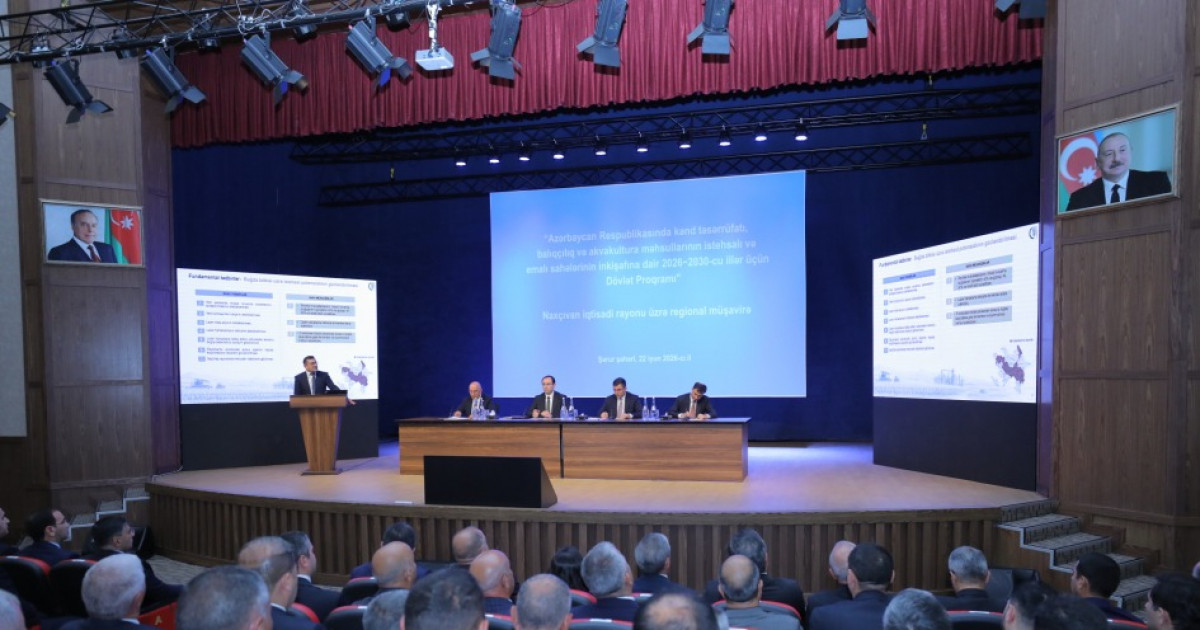
Regional Meetings on Agricultural Development Priorities for 2026–2030 Concluded
Regional meetings have been held across 13 economic regions of the country to discuss the measures to be implemented under the State Programme on the Development of Production and Processing of Agricultural, Fishery and Aquaculture Products in the Republic of Azerbaijan for 2026–2030, approved by Order No. 1044 of the President of the Republic of Azerbaijan dated May 25, 2026. The events, organized by order of the Head of State, brought together heads and representatives of relevant state bodies, heads of local executive authorities, employees of the Center for Analysis of Economic Reforms and Communication (CAERC), farmers, entrepreneurs, and other stakeholders.
Baghish Ahmadov, Adviser to the Executive Director of CAERC, who participated in the regional meetings, noted that the sessions were of significant importance in terms of explaining the strategic targets set out in the State Programme to regions, establishing a unified approach to their implementation, and strengthening public-private sector cooperation. According to him, the meetings provided comprehensive information on the measures envisaged under the programme, the state support mechanisms to be extended to business entities engaged in the production and processing of agricultural and fishery products, projects planned to improve water supply, and the promotion of investment in the agricultural sector.
Baghish Ahmadov noted that the implementation of the State Programme envisages attracting approximately 5.9 billion manats in investment. Of this amount, approximately 2.2 billion manats will be financed from the state budget, with the remainder to be provided through private sector investment. In addition, a portion of private investment is envisaged to be supported through concessional financial instruments via the state's development institutions.
According to him, the regional meetings also served an important role as a direct dialogue platform with farmers and business entities. During these sessions, farmers' questions relating to the State Programme were answered by representatives of relevant state bodies, and their proposals and initiatives were heard and discussed for consideration during the programme's implementation process. Private business entities also presented investment projects they plan to carry out, and views were exchanged on expanding public-private partnerships.
Baghish Ahmadov emphasized that the sessions provided detailed information on the state support mechanisms envisaged in the areas of land consolidation, the introduction of modern irrigation systems and innovative technologies, the establishment of intensive orchards, the expansion of greenhouse farming, the development of animal husbandry and improvement of breed composition, the creation of cold storage facilities and grain silos, and the development of the agricultural processing industry. Extensive discussion was also held on the application of an interest rate subsidy mechanism to facilitate access to financial resources in agriculture, the implementation of additional support measures in animal husbandry, and the promotion of deeper processing of cotton.
According to the CAERC official, one of the key outcomes of the regional meetings was the further strengthening of coordination among central and local state bodies, farmers, business entities, and other stakeholders in the implementation of the State Programme. The sessions served not only to inform farmers and business entities about the measures envisaged under the State Programme, but also provided an opportunity to gather their proposals and recommendations regarding the effective implementation of those measures.
Baghish Ahmadov noted that the meetings resulted in the formation of a unified regional approach to the implementation of the State Programme, with key challenges and opportunities systematically assessed. According to him, in the next phase, the specification of the programme's envisaged measures at the level of each administrative district, the development of action plans aligned with local potential, and the ongoing monitoring and results-oriented evaluation of the implementation process will play an important role in achieving the programme's targets.
Related news

A representative of the CAERC participated in a conference dedicated to the future…
Rashad Najafli, Deputy Director of the Economic Analysis Department of the Center for Analysis of Economic Reforms and Communication (CAERC), participated in the international conference on “New Challenges in Maintaining Financial…

New Opportunities in Technology Parks: Commercialization and Export of Innovations
The Decree of the President of the Republic of Azerbaijan dated October 22, 2026 on Amendments to the “Model Regulation on Technology Parks” provides for important innovations in terms of improving the activities of technoparks,…

Vusal Gasimli spoke at the opening of the Islamic Finance Forum
Vusal Gasimli, Executive Director of the Center for Analysis of Economic Reforms and Communication (CAERC) — a Doctor of Economic Sciences and Professor — delivered a speech at the opening ceremony of the "3rd Islamic…

CAERC expands cooperation with think tanks and universities in Uzbekistan
Ilyas Huseynov, Head of the Turkic World Research Center (TWRC) at the Center for Analysis of Economic Reforms and Communication (CAERC), held meetings with representatives from think tanks and higher education institutions, and delivered…

Meetings regarding preparations for the final monitoring and evaluation of the Socio-Economic…
The Center for Analysis of Economic Reforms and Communication (CAERC) has concluded a series of meetings with representatives from relevant government agencies. These meetings were held to refine outcome indicators for the year 2026—within…

The investment portfolio of “Enterprise Azerbaijan”’s partners exceeds 3 billion…
The global innovation program “Startup School 4: Five Continents – 500 Startups,” implemented by the “Enterprise Azerbaijan” portal of the Center for Analysis of Economic Reforms and Communication (CAERC),…

The establishment of the Karabakh National Park creates new opportunities for ecological…
The Order of the President of the Republic of Azerbaijan, Ilham Aliyev, dated October 20, 2026, "On the Establishment of the Karabakh National Park of the Republic of Azerbaijan," is regarded as a significant step toward…

World Bank: Azerbaijan’s strong financial buffers support economic stability and…
The "Europe and Central Asia Economic Update" and the "Macro-Poverty Outlook" for Azerbaijan, published by the World Bank in October 2026, indicate that the country has maintained its macroeconomic stability, strong…
Op-eds
Ilkin Gasimov
Chief advisor of the Economic analysis division
New Financial Model for Resource Allocation in General Education
Baghish Ahmadov
Advisor to the Executive director of the Center for Analysis of Economic Reforms and Communication
Azerbaijan International Investment Forum: Investment Cooperation and National Development Priorities
Abdulrahim Dadashov
Deputy head of the Monitoring and evaluation division
Environmental Responsibility is One of the Key Conditions in the Development of the Mining Industry
Latif Zeynalli
Head of State Programs Division
Development of Competition Will Create New Opportunities for Sustainable Economic Growth
Orkhan Sadigov
Head of the Monitoring and evaluation division
A New Approach to Managing Off-Budget Funds Will Strengthen Financial Discipline
Elshan Yusifli
Head of the Monitoring of sectoral programs sector
New Changes to Nakhchivan’s State Programme: Export, Logistics and Social Mechanisms Improved
Abdulrahim Dadashov
Deputy head of the Monitoring and evaluation division
New Law Strengthens the Sustainable Development and Digital Monitoring of the Fisheries Sector