
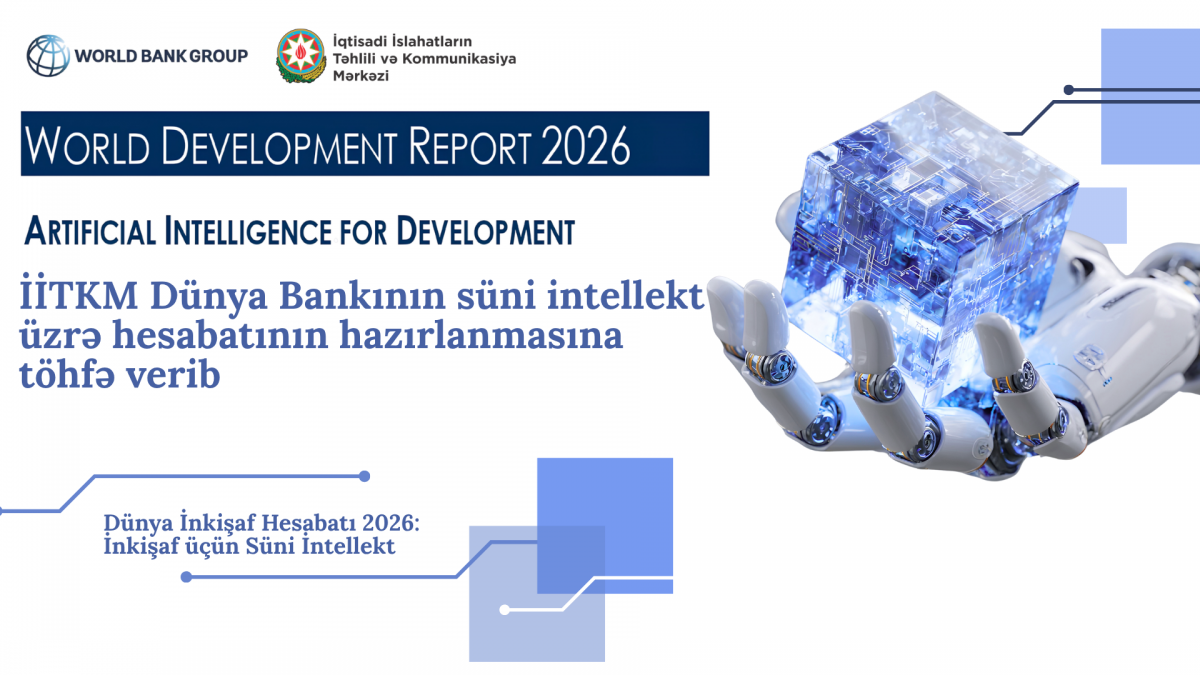
CAERC Contributes to the Preparation of the World Bank's Report on Artificial Intelligence
The Center for Analysis of Economic Reforms and Communication (CAERC) took part in the international consultation process carried out within the framework of preparing the World Bank's flagship publication, the "World Development Report 2026: Artificial Intelligence for Development." Regarded as one of the most authoritative analytical publications in the field of global economic development and public policy, the report assesses the opportunities and challenges that artificial intelligence presents for developing countries.
According to the report's concept document, CAERC was among the influential international organizations, government agencies, research centers, development partners, and leading technology companies engaged in the consultations during the report's preparation. The consultation process involved OpenAI, Microsoft, Google, Meta, NVIDIA, Amazon, Anthropic, the International Monetary Fund (IMF), the Organisation for Economic Co-operation and Development (OECD), the International Telecommunication Union (ITU), the Asian Development Bank (ADB), the African Development Bank (AfDB), the European Bank for Reconstruction and Development (EBRD), UNICEF, UNDP, and numerous other prominent research and policy institutions working in the field of artificial intelligence.
Commenting on the World Bank's report, Rashad Najafli, Deputy Head of CAERC's Economic Analysis Department, noted that artificial intelligence holds the potential to accelerate economic growth, increase productivity, promote entrepreneurship, improve the quality of public services, and enhance decision-making processes. According to him, the report particularly emphasizes that developing countries do not need to create advanced AI models of their own in order to benefit from these opportunities. The main priority, he said, is adapting existing AI technologies to local conditions, languages, and development priorities, as well as ensuring their effective application.
Per the World Bank's assessment, rather than replacing the workforce in developing countries, artificial intelligence will expand its capabilities and contribute to higher productivity and improved service quality.
The report emphasizes that digital infrastructure, institutional capacity, data governance, and human capital are key prerequisites for the successful use of artificial intelligence. At the same time, AI creates opportunities for government agencies to strengthen forecasting capabilities, use resources more efficiently, increase transparency and accountability, and deliver more effective, citizen-oriented services.
Rashad Najafli noted that the World Bank's report demonstrates that artificial intelligence is being recognized not merely as a technological innovation, but as a new engine of development. He stated that CAERC's involvement in this process reflects the growing international recognition of Azerbaijan's experience in digital transformation, evidence-based policymaking, and data-driven governance. He further noted that the approaches reflected in the report align with the digital transformation policy being implemented in Azerbaijan, where significant results have been achieved in recent years in data-driven governance, electronic monitoring systems, and the application of AI-based solutions.
It should be noted that CAERC is one of the country's leading institutions in the practical application of artificial intelligence in public administration. The Center carries out the monitoring and evaluation of strategic state programs, strategies, and action plans implemented in the Republic of Azerbaijan through the centralized "Smart Unified Electronic Reporting Platform." The platform makes extensive use of artificial intelligence technologies for data collection, processing, and analysis, risk identification, results evaluation, and decision-support purposes.
CAERC's achievements in the fields of data-driven governance and the integration of artificial intelligence into the public sector have also received high recognition at the international level.
Related news

A representative of the CAERC participated in a conference dedicated to the future…
Rashad Najafli, Deputy Director of the Economic Analysis Department of the Center for Analysis of Economic Reforms and Communication (CAERC), participated in the international conference on “New Challenges in Maintaining Financial…

New Opportunities in Technology Parks: Commercialization and Export of Innovations
The Decree of the President of the Republic of Azerbaijan dated October 22, 2026 on Amendments to the “Model Regulation on Technology Parks” provides for important innovations in terms of improving the activities of technoparks,…

Vusal Gasimli spoke at the opening of the Islamic Finance Forum
Vusal Gasimli, Executive Director of the Center for Analysis of Economic Reforms and Communication (CAERC) — a Doctor of Economic Sciences and Professor — delivered a speech at the opening ceremony of the "3rd Islamic…

CAERC expands cooperation with think tanks and universities in Uzbekistan
Ilyas Huseynov, Head of the Turkic World Research Center (TWRC) at the Center for Analysis of Economic Reforms and Communication (CAERC), held meetings with representatives from think tanks and higher education institutions, and delivered…

Meetings regarding preparations for the final monitoring and evaluation of the Socio-Economic…
The Center for Analysis of Economic Reforms and Communication (CAERC) has concluded a series of meetings with representatives from relevant government agencies. These meetings were held to refine outcome indicators for the year 2026—within…

The investment portfolio of “Enterprise Azerbaijan”’s partners exceeds 3 billion…
The global innovation program “Startup School 4: Five Continents – 500 Startups,” implemented by the “Enterprise Azerbaijan” portal of the Center for Analysis of Economic Reforms and Communication (CAERC),…

The establishment of the Karabakh National Park creates new opportunities for ecological…
The Order of the President of the Republic of Azerbaijan, Ilham Aliyev, dated October 20, 2026, "On the Establishment of the Karabakh National Park of the Republic of Azerbaijan," is regarded as a significant step toward…

World Bank: Azerbaijan’s strong financial buffers support economic stability and…
The "Europe and Central Asia Economic Update" and the "Macro-Poverty Outlook" for Azerbaijan, published by the World Bank in October 2026, indicate that the country has maintained its macroeconomic stability, strong…
Op-eds
Ilkin Gasimov
Chief advisor of the Economic analysis division
New Financial Model for Resource Allocation in General Education
Baghish Ahmadov
Advisor to the Executive director of the Center for Analysis of Economic Reforms and Communication
Azerbaijan International Investment Forum: Investment Cooperation and National Development Priorities
Abdulrahim Dadashov
Deputy head of the Monitoring and evaluation division
Environmental Responsibility is One of the Key Conditions in the Development of the Mining Industry
Latif Zeynalli
Head of State Programs Division
Development of Competition Will Create New Opportunities for Sustainable Economic Growth
Orkhan Sadigov
Head of the Monitoring and evaluation division
A New Approach to Managing Off-Budget Funds Will Strengthen Financial Discipline
Elshan Yusifli
Head of the Monitoring of sectoral programs sector
New Changes to Nakhchivan’s State Programme: Export, Logistics and Social Mechanisms Improved
Abdulrahim Dadashov
Deputy head of the Monitoring and evaluation division
New Law Strengthens the Sustainable Development and Digital Monitoring of the Fisheries Sector